

Microplastic pollution is a complex crisis that is fundamentally altering ocean ecosystems and threatening global ecological and economic stability.
|
Read all about: MICROPLASTIC CRISIS IN INDIA: SOURCES, IMPACTS, WAY FORWARD l ICROPLASTIC POLLUTION AND HEALTH ISSUES |
Microplastics are defined as tiny plastic fragments or particles that are less than 5 millimetres (0.2 inches) in diameter.
They are categorized into two types:
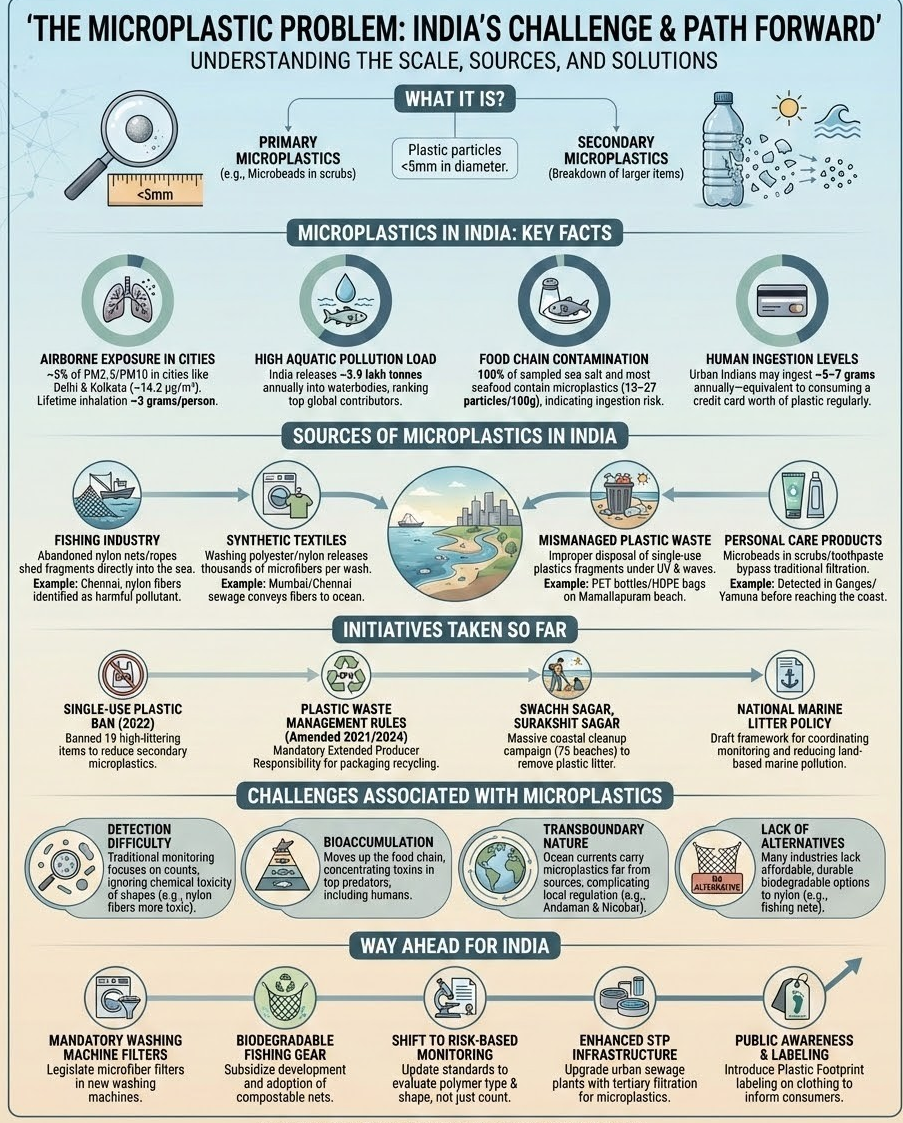 .How Do Microplastics Enter in Oceans?
Wastewater and Surface Runoff
Synthetic Textiles: Every time synthetic clothes (like polyester or nylon) are washed, they release thousands of microfibres. According to the International Union for Conservation of Nature (IUCN), synthetic textiles are the single largest source of primary microplastics in the ocean, accounting for approximately 35% of the total.
Personal Care Products: Microbeads in cosmetics are washed down drains and are often too small to be captured by standard wastewater treatment plants, leading them directly into rivers and oceans.
Urban and Road Runoff
Tyre Wear: As vehicle tyres wear down, they release particles made of synthetic rubber and plastic. Tyre dust is estimated to contribute about 28% of the primary microplastics found in the world's oceans. (Source: IUCN)
City Dust: This includes particles from synthetic paints, road markings, and building coatings that are washed into storm drains.
Maritime Activities
Fishing and Shipping: Abandoned, lost, or discarded fishing gear (known as "ghost gear") and plastic coatings on ships break down over time into secondary microplastics.
Industrial Accidents
Nurdle Spills: During transport or manufacturing, pre-production plastic pellets (nurdles) can be spilled into the environment. A single container spill can release billions of these particles into the sea.
The ingestion of microplastics has been documented in over 800 marine species, ranging from tiny zooplankton to large whales. (Source: UNEP)
Physical Harm and Blockages: Once ingested, microplastics can cause internal abrasions and block the digestive tracts of marine animals, leading to a false sense of fullness, starvation, and eventually death.
Chemical Toxicity: Microplastics act as "chemical sponges," absorbing Persistent Organic Pollutants (POPs) from the surrounding water. These concentrated toxins are then released inside the animal's body.
Reproductive and Developmental Issues: Exposure to the chemical additives in plastics, such as Phthalates, acts as an endocrine disruptor in marine life, leading to reduced fertility, stunted growth, and abnormal development in species like oysters and small fish.
Trophic Transfer (Biomagnification): Microplastics move up the food chain. When predators eat smaller organisms that have ingested plastic, the concentration of both plastic and associated toxins increases at each level.
Contamination of the Food Chain: Humans are estimated to consume between 39,000 to 52,000 microplastic particles annually through seafood, salt, sugar, and bottled water. (Source: Environmental Science & Technology Journal)
Detection in Human Systems: For the first time, microplastics have been detected in human blood, lung tissue, and the placenta, proving that these particles can cross biological barriers and enter the internal environment of the body. (Source: Lancet)
Carrier of Pathogens: Microplastics in the ocean can form a "plastisphere"—a thin layer of biofilm that serves as a breeding ground for harmful bacteria like Vibrio, transporting diseases across oceans to human coastal populations.
Leaching of Endocrine Disruptors: The chemicals used to make plastics flexible or flame-retardant (like Phthalates) are known to interfere with human hormones, which is linked to obesity, diabetes, and reproductive disorders.
Inhalation Risks: Microplastics are now airborne; urban populations are increasingly inhaling microplastic fibres from synthetic textiles and tyre dust, which can lead to chronic respiratory inflammation.
Global Scale of the Crisis
Production & Waste: As of 2026, the world produces over 450 million tonnes of plastic annually. Under a "business-as-usual" scenario, this is projected to nearly triple by 2060. (Source: UNEP)
Environmental Leakage: Every day, the equivalent of 2,000 garbage trucks full of plastic is dumped into oceans, rivers, and lakes. Total leakage into aquatic systems is estimated at 19–23 million tonnes per year. (Source: UNEP)
Oceanic Accumulation: There are over 170 trillion plastic particles currently afloat in the world’s oceans. The Great Pacific Garbage Patch now covers roughly 1.6 million square kilometres, an area three times the size of France. (Source: Ocean Cleanup)
Human Ingestion: Current research suggests humans inhale up to 68,000 microplastic particles every day and ingest thousands more through food and water. (Source: Journal Plos One)
Scale of the Crisis in India
India has emerged as the highest contributor to global plastic pollution, accounting for approximately one-fifth (20%) of the total waste generated worldwide. (Source: Journal Nature)
Annual Release: India is projected to release 391,879 tonnes of microplastics into water bodies, the second-highest globally after China. (Source: EA Earth Action)
Total Plastic Waste: India generates approximately 9.3 million tonnes of plastic pollution annually. (Source: Journal Nature)
Urban Air Quality: Microplastics make up about 5% of PM2.5/PM10 in cities like Delhi and Kolkata. Urban Indians inhale roughly 3 grams of plastic in their lifetime. (Source: IISER Kolkata)
Legacy Landfills: A CSIR-NEERI study warns that India's decades-old "legacy landfills" are major sources, leaking microplastics into groundwater via toxic leachate.
Global Policy: The 2026 UN Global Plastics Treaty
Finalization of the Legally Binding Instrument to End Plastic Pollution.
National Action: India's 2026 EPR Expansion
Plastic Waste Management (Amendment) Rules, 2026: India has expanded Extended Producer Responsibility (EPR) framework to include "Category V" wastes, specifically targeting microplastic-shedding materials like synthetic textiles and industrial nurdles.
Green Credit Programme: The government has launched incentives for companies that transition from synthetic packaging to "compostable" or "bio-benign" materials.
Technological Mandates
Washing Machine Filtration: Following France’s 2025 lead, several nations (including the UK and Japan) have mandated that all new domestic washing machines must be sold with built-in microfibre filters starting in 2026.
The "Legacy Plastic" Problem
Even if all new plastic production ceased today, the billions of tonnes of plastic already in landfills and the ocean will continue to fragment into microplastics for the next 500+ years due to UV degradation. This is known as the "Plastic Debt".
Technological & Infrastructure Limitations
Current Wastewater Treatment Plants (WWTPs) are not 100% efficient. Even a "highly efficient" plant that captures 98% of particles still releases millions of microplastics daily into local rivers due to the sheer volume of water processed. (Source: World Bank)
Monitoring microplastics in the human bloodstream or deep-sea sediments requires extremely expensive equipment (like μ-FTIR), which is not accessible to many developing nations.
Economic & Supply Chain Dependency
Global apparel industry is heavily dependent on polyester and nylon because they are cheap. Switching to natural fibres (cotton/wool/jute) involves massive land-use changes and higher costs, creating a conflict between affordability and sustainability.
Approximately 28% of primary microplastics in oceans come from tyre wear. Currently, there is no viable "plastic-free" alternative for high-performance vehicle tyres that meets global safety standards. (Source: IUCN)
Regulatory Loopholes
While "intentionally added" microbeads are easy to ban, "secondary" microplastics are harder to regulate because they depend on the success of global waste management systems, which are currently failing to handle 40% of generated waste.
“Design for Circularity" and Material Innovation
Bio-benign Alternatives: Accelerating the development of PHA (Polyhydroxyalkanoates) and other truly biodegradable polymers that do not fragment into persistent microplastics.
Eliminating Additives: Phasing out hazardous chemical additives (like phthalates and PFAS) to ensure that recycled plastics are safe and do not leach toxins.
Strengthening Infrastructure and Technology
Upgrading WWTPs: Investing in Membrane Bioreactors (MBR) and advanced sand filtration in Wastewater Treatment Plants to capture microplastics before they enter water bodies.
Standardized Monitoring: Establishing a Global Microplastics Observation System to standardize how we measure and report plastic concentrations in air, water, and human tissue.
Policy and Global Governance
Implementing the Global Plastics Treaty: Ensuring that the legally binding instrument finalized in 2026 includes mandatory production caps and high-standard EPR across all nations.
Green Public Procurement: Governments should lead by example by mandating the use of plastic-free alternatives in public infrastructure, healthcare, and office supplies.
Behavioral and Social Change
Sustainable Fashion: Promoting the "Slow Fashion" movement to reduce the demand for synthetic textiles (polyester/nylon) and encouraging the use of washing bags designed to capture microfibres.
Addressing microplastic pollution requires a global shift toward a "Restorative Economy" that prioritizes a legally binding international treaty to radically decouple economic growth from virgin plastic production while integrating technological innovation with strict regulatory accountability.
Source: DOWNTOEARTH
|
PRACTICE QUESTION Q. Discuss the primary and secondary sources of microplastics in the marine environment. Highlight the specific impacts of these pollutants on marine biodiversity and human health. 150 words |
Primary microplastics are intentionally manufactured at microscopic sizes (less than 5mm) for applications like microbeads in cosmetics and "nurdles" used in plastic production. Secondary microplastics result from the environmental fragmentation and weathering of larger plastic debris, such as bags and fishing gear.
Microplastics and nanoplastics have infiltrated the human food chain and have been detected in drinking water, seafood, sea salt, and breast milk. They can cross biological barriers and cause cellular toxicity, oxidative stress, disrupted gut microbiota, and carry endocrine-disrupting chemicals.
The GPGP is a massive ocean accumulation zone that is rapidly gathering floating plastic debris. Studies indicate that microplastics account for the vast majority of the trillions of individual plastic pieces floating in this area, posing a severe threat to pelagic ecosystems.
© 2026 iasgyan. All right reserved