

A new study published in the journal Marine Pollution Bulletin revealed that while microplastic abundance on Chennai’s beaches is lower than global averages, the high concentration of nylon fibers poses a severe ecological risk.
The study challenges the traditional metric of pollution assessment.
Why Nylon is a "Severe Ecological Risk"?
Microplastics are synthetic solid plastic particles of regular or irregular shape, with a diameter ranging from 1 μm to 5 mm. They are insoluble in water and act as vectors for other toxic chemicals.
Classification of Microplastics
Primary Microplastics: These are intentionally manufactured to be small for specific industrial or consumer applications.
Secondary Microplastics: Formed by the breakdown of larger plastic items (bottles, fishing nets) due to UV radiation, wind, and wave action.
Nanoplastics: A subset of particles smaller than 1 μm (micrometer), which can permeate biological barriers like the blood-brain barrier or placenta.
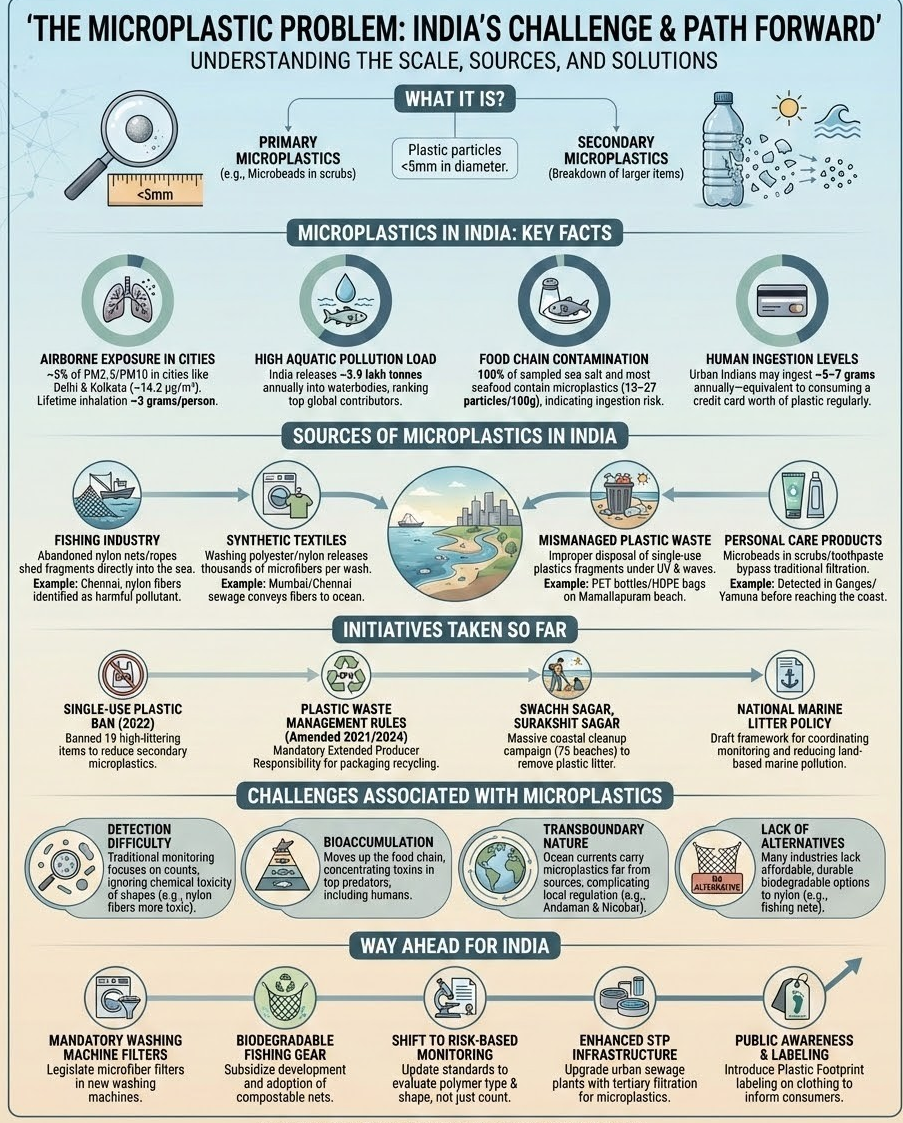 Status of Microplastics in India
India releases an estimated 3.9 lakh tonnes of microplastics into aquatic environments annually, making it the second-largest polluter globally after China. (Source: EA Earth Action Report)
Riverine System
Ganga River: Recorded the highest microplastic concentration among major rivers, with significant loads entering from untreated sewage and industrial discharge. (Source: CPCB Reports)
Yamuna River: Microplastics have been detected in the groundwater of Delhi and along the river banks, confirming that river pollution is leaching into the water table. (Source: TERI)
Freshwater Ecosystems: White-colored fibers and fragments (Polypropylene and Polyethylene) are the most common types found in freshwater lakes and rivers. (Source: National Institute of Health)
Coastal & Marine Area
Chennai: A major hotspot where 91.2% of beach sediment microplastics are nylon fibers, largely from fishing gear degradation. (Source: National Centre for Coastal Research)
Goa: Colva Beach has emerged as a pollution hotspot due to high tourism activity, with microplastic concentrations higher than other beaches in the state. (Source: Springer Environmental Science Study).
Deep Sea: Microplastics found in deep-sea sediments in the Bay of Bengal and Arabian Sea, proving that pollution is settling on the ocean floor. (Source: CPCB Report)
What are the Impacts of Microplastics?
Human Health Impacts
Respiratory & Digestive Entry: Microplastics have been detected in the human lungs, stools, and blood, primarily entering through contaminated salt, sugar, and bottled water.
Chemical Toxicity: Microplastics in water bodies often carry heavy metals like Lead and Cadmium; long-term ingestion is linked to endocrine disruption and potential reproductive issues.
Cellular Damage: Research indicates that microplastics can cause oxidative stress and inflammatory responses in human cells, which are precursors to chronic diseases.
Ecological & Marine Impacts
Bioaccumulation in Fisheries: Over 20% of commercial fish sampled along the Indian coast (like Mackerel and Anchovies) contained microplastics in their guts, which can lead to reduced growth and survival rates for marine life. (Source: ICAR)
Soil Fertility: Accumulation of microplastics in agricultural soil—from plastic-coated fertilizers or contaminated irrigation—alters soil porosity and inhibits the growth of earthworms, essential for soil health.
Coral Reef Degradation: In the Lakshadweep and Andaman islands, microplastics are being ingested by corals, causing "physical blockage" that leads to coral bleaching and death.
Socio-Economic Impacts
Fisheries Livelihood: Contamination in catch leads to lower market value and potential export bans, threatening the livelihoods of approximately 30 million fishers and fish farmers in India.
Tourism Decline: Plastic litter and microplastic-laden sands in hotspots like Goa and Kerala reduce the aesthetic value of beaches, impacting the tourism sector which contributes significantly to state GDPs.
Mandatory Digital Traceability: Under the Plastic Waste Management (Amendment) Rules, 2025, the Ministry of Environment mandated that all plastic packaging must carry a QR code or Barcode.
Redefining "Biodegradable”: Government amended the Plastic Waste Management Rules in 2024 to define biodegradable plastics.
Recycled Content Mandates: To reduce the volume of virgin plastic entering the ecosystem, the government has enforced mandatory use of recycled plastic content in packaging.
Standardised Testing Protocols: The Bureau of Indian Standards (BIS) has notified standard IS 17899 T:2022, which specifies that biodegradable plastics must achieve 90% degradation within a set timeframe to ensure they do not persist as micro-fragments in the soil.
National Marine Litter Policy: The Ministry of Earth Sciences (MoES) and the National Centre for Coastal Research (NCCR) are finalizing a National Marine Litter Policy aligned with the UN's Clean Seas Campaign.
Extended Producer Responsibility (EPR) Audit: The Central Pollution Control Board (CPCB) has operationalized a centralized EPR portal that now registers importers and brand owners.
Lack of Standardized Testing: India currently lacks a universally mandated protocol for measuring microplastics in different matrices (air, water, soil), making data comparison between states difficult.
Detection Infrastructure: Most state-level pollution control boards lack the advanced equipment, such as μ-FTIR or Raman Spectroscopy, required to identify nano-plastics and specific polymer types. (Source: CPCB)
Inadequate Wastewater Treatment: 70% of India’s urban sewage is discharged untreated; existing STPs (Sewage Treatment Plants) are generally not designed to filter out micro-fibers, which pass directly into rivers. (Source: NITI Aayog)
Informal Recycling Sector: Over 90% of plastic waste in India is handled by the informal sector; while efficient at picking large items, they cannot "see" or collect microplastics, which continue to leak into the environment. (Source: Centre for Science and Environment)
The "Biodegradable" Loophole: Despite the 2024 amendments, many products labeled as "biodegradable" still contain additives that only accelerate fragmentation into microplastics rather than full mineralisation.
EPR Compliance Costs: Small and Medium Enterprises (SMEs) struggle with the high costs of digital traceability (QR codes) and the increased price of recycled plastic resins required by the 2025 mandates.
Legacy Pollution: Even with a total ban today, the millions of tonnes of plastic already in Indian landfills and rivers will continue to break down into microplastics for decades.
Upgrading STPs: Integrating membrane bioreactors (MBR) or sand filtration in existing Sewage Treatment Plants (STPs).
Detection Labs: Establishing a national network of NABL-accredited labs specifically for micro- and nano-plastic testing in food and water to ensure uniform data across states.
Standardizing "Biodegradable": Enforcing the IS 17899 T:2022 standard strictly to ensure "biodegradable" plastics undergo 90% mineralization without leaving microplastic fragments.
Tire Wear Regulation: Developing "Tire Abrasion Standards" under the National Clean Air Programme (NCAP) to reduce the volume of rubber-derived microplastics entering the city dust and runoff.
Incentivising Circularity: Providing tax credits or subsidies to MSMEs that transition from multi-layered plastics (MLP) to monomaterials, which are easier to recycle and less likely to fragment into microplastics.
Bioremediation: Investing in "Plastic-eating" microbes and fungi research (e.g., Ideonella sakaiensis) for landfill management to break down legacy plastic before it turns into micro-fragments.
Global Treaty Alignment: India must align its domestic definitions of "microplastics" with the final UN Global Plastic Treaty (2025) to ensure seamless export of plastic-packaged goods.
Microplastics represent a "planetary boundary" threat. For India, tackling this requires a shift from "Waste Management" to "Material Management"—reducing dependency on virgin polymers and strictly enforcing the circular economy principles under the LiFE (Lifestyle for Environment) mission.
Source: THE HINDU
|
PRACTICE QUESTION Q. Consider the following statements regarding microplastics: 1. Primary microplastics result from the environmental breakdown of larger plastic items like PET bottles. 2. The Plastic Waste Management (Amendment) Rules, 2024 legally define biodegradable plastics as those that degrade without leaving microplastics behind. Which of the statements given above is/are correct? a) 1 only b) 2 only c) Both 1 and 2 d) Neither 1 nor 2 Answer: b Explanation: Statement 1 is Incorrect: Primary microplastics are those that are manufactured to be small (e.g., microbeads in face washes, industrial pellets, or synthetic fibers). The environmental breakdown of larger plastic items like PET bottles results in Secondary microplastics. Statement 2 is Correct: The Plastic Waste Management (Amendment) Rules, 2024 updated the definition of "biodegradable plastics." To be certified as such in India, a material must now degrade completely in a specific environment without leaving any microplastics behind, ensuring they do not persist as invisible pollutants. |
Primary microplastics are tiny plastic particles purposefully manufactured for commercial use, such as microbeads in exfoliating cosmetics and toothpaste. Secondary microplastics are formed from the breakdown and fragmentation of larger plastic items (like PET bottles and fishing nets) due to environmental factors such as wave action and UV radiation.
Microplastics enter the human body via inhalation of airborne particles and ingestion of contaminated water and food. They bioaccumulate in the body and absorb toxic chemicals like endocrine disruptors. Recent studies have linked them to hormonal disruptions, immune system issues, and potential impacts on fetal brain development after being detected in human placentas.
It is a massive government initiative executed by the Ministry of Earth Sciences. The campaign involved a widespread coastal cleanup across 75 beaches in India to physically remove heavy plastic litter before UV rays could fragment it into harmful secondary microplastics.
© 2026 iasgyan. All right reserved