The International Solar Alliance drives global energy transitions by mobilizing $1 trillion in investments and deploying 1,000 GW of solar capacity by 2030. Through initiatives like OSOWOG and STAR-C, it ensures universal access to affordable, sustainable, and clean energy.
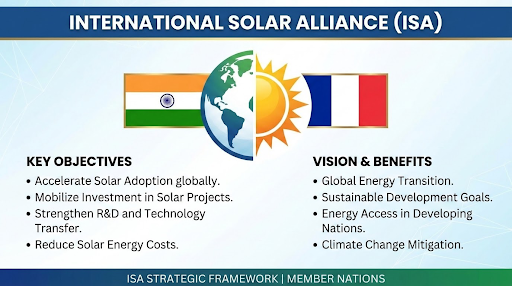
Jordan has officially joined the International Solar Alliance (ISA).
It is a global inter-governmental body dedicated to scaling affordable and accessible solar energy, particularly for Least Developed Countries (LDCs) and Small Island Developing States (SIDS).
Establishment: Jointly launched by India and France during the 21st Conference of Parties (COP21) to the UNFCCC in Paris in 2015.
Headquarters: Located in Gurugram, Haryana, India. It is the first international inter-governmental organization to be headquartered in India.
Membership: Initially open to countries between the Tropics of Cancer and Capricorn. A 2020 amendment expanded eligibility to all UN member states.
Current Status: Over 120 countries have signed the ISA Framework Agreement, with over 105 having fully ratified it.
Core Objectives and Vision
Major Initiatives of the ISA
|
Initiative |
Key Features and Purpose |
|
Launched with the UK at COP26, it aims to create a transnational renewable electricity grid to facilitate energy sharing across borders. |
|
|
Global Solar Facility (GSF) |
A payment guarantee fund launched at COP27 to de-risk investments in solar projects and attract private capital, especially in African nations. |
|
Viability Gap Funding (VGF) Scheme |
Provides financial grants (10-35% of project cost) to make solar projects commercially viable in LDCs and SIDS. |
|
STAR-C Programme |
Focuses on capacity building, training professionals, and fostering innovation to create a "Silicon Valley of solar" in the Global South. |
|
Green Hydrogen Innovation Centre |
Promotes research, knowledge-sharing, and advocacy to advance the use of solar energy for producing green hydrogen. |
|
Solar for She Initiative |
Focuses on gender inclusivity by ensuring greater participation of women in the solar energy sector. |
Global Leadership: As a co-founder and host, the ISA enhances India's soft power and establishes its leadership role in climate action and global energy governance.
Domestic Energy Goals: The ISA's objectives align with and accelerate India’s domestic renewable energy targets, such as achieving 500 GW of non-fossil fuel capacity by 2030. India is currently ranked 4th globally in renewable energy capacity.
Economic Opportunities: It boosts India's domestic solar manufacturing ecosystem, creating jobs and fostering innovation in line with the 'Aatmanirbhar Bharat' mission.
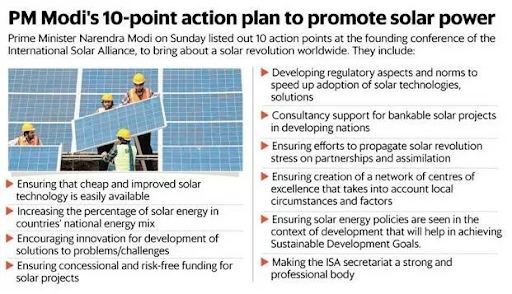
Strengthen Financial Architecture: Develop innovative financial tools like green bonds and blended finance to attract private sector investment.
Intensify Technology Transfer: Facilitate the transfer of advanced solar technologies and support the localization of manufacturing in member countries.
Address Infrastructure Gaps: Prioritize investments in smart grids, battery storage, and cross-border grid interconnection to manage the intermittency of solar power.
Enhance Capacity Building: Scale up training programs and establish more Centers of Excellence to create a skilled workforce for the solar sector.
Promote Broader Partnerships: Deepen collaborations with multilateral development banks (MDBs), international financial institutions (IFIs), and the private sector to mobilize resources and expertise.
The International Solar Alliance (ISA) drives the global energy transition by de-risking investments via the Global Solar Facility and building technological autonomy through the STAR-C programme, making solar energy a viable, universal tool for energy security and climate action.
Source: NEWSABLE.ASIANETNEWS
|
PRACTICE QUESTION Q. Evaluate the role of the International Solar Alliance (ISA) in fostering South-South cooperation and addressing global energy poverty. 150 words |
The ISA is an intergovernmental organization launched by India and France at the 2015 UN Climate Change Conference (COP21) in Paris. It aims to promote solar energy adoption globally, reduce technology costs, and mobilize critical investments to accelerate the clean energy transition.
Initially, membership was restricted to countries located fully or partially between the Tropics of Cancer and Capricorn. However, in 2020, the ISA framework was amended to open membership to all United Nations member states.
The "One Sun, One World, One Grid" (OSOWOG) is a transnational grid integration project championed by the ISA. It aims to connect energy grids across Asia, the Middle East, Europe, and Africa to transfer surplus solar power across different time zones, thereby solving the intermittency problem of solar energy.



© 2026 iasgyan. All right reserved