India’s power sector emissions fell 2.6% in 2025 despite rising electricity demand, marking a key decoupling driven by rapid solar expansion and supportive policies. The country achieved its 50% non-fossil capacity NDC target early, though rising industry and transport emissions demand wider decarbonisation and a just transition.
Copyright infringement not intended
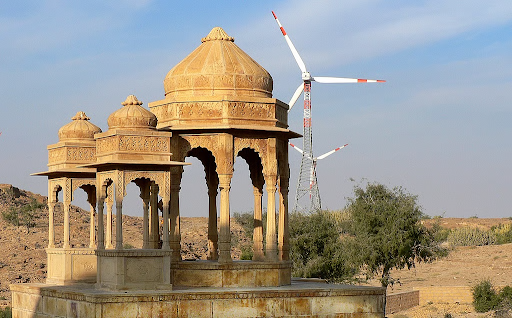
Picture Courtesy: DOWNTOEARTH
Context
According to new data from Climate TRACE, India achieved the largest reduction in greenhouse gas emissions among major economies in 2025, driven by a 2.6% drop in power sector emissions due to rapid solar and wind deployment.
What are the Key Findings of the Report?
Record-High Emissions
Global GHG emissions peaked in 2025, with nearly every month surpassing the corresponding previous year's emissions.
Primary Drivers
The increase was primarily driven by sectors like fossil fuel operations (up by 1.56%), transportation, and manufacturing, with emissions from oil and gas production alone jumping by 4.1%.
Resurgence of Methane (CH4)
Global methane emissions rose by 1.03% to a record 412.59 Mt. Methane is a potent GHG, contributing about 30% of global temperature rise since the industrial era. (Source: IEA)
A Silver Lining in the Power Sector
Global power sector emissions, the largest source of GHGs (26%), fell by a slight 0.13%, marking the first decline since the COVID-19 pandemic.
Emission Trends by Major Economies
|
Country |
Emission Trend in 2025 |
Key Drivers |
|
India |
Largest decrease among major nations, with a drop of 27.5 Mt (0.65%). |
A 2.6% fall in power sector emissions, driven by a rapid expansion of renewable energy capacity. |
|
Russia |
Steepest increase in emissions, rising by 51.6 Mt (1.64%). |
Expansion of oil and gas production and related activities. |
|
China |
Emissions growth slowed to just 0.28%, the lowest since 2015. |
Record installation of clean energy (300 GW solar, 100 GW wind), causing a 0.4% drop in power sector emissions. |
|
USA |
Emissions remained relatively flat with a minor increase of 0.23%. |
Mixed trends across different sectors. |
What are the Key Drivers of Emission Reduction in the Power Sector?
Record Capacity Growth: A total of 44.51 GW of new RE capacity was added (between January and November 2025), driven primarily by solar power.
Structural Shift in Power: In 2025, new non-fossil fuel capacity additions met all of India's increased power demand, causing coal-fired power generation to decline by 3%.
Ahead of Climate Targets: India met its NDC goal of sourcing 50% of its cumulative electric power installed capacity from non-fossil fuel sources in June 2025, five years ahead of the original 2030 deadline.
Supportive Policy Environment: Success came from a supportive RE investment ecosystem, powered by government initiatives, such as:
Conclusion
India's success in renewable energy and emission reduction, particularly in the power sector, is a key step towards its long-term goal of achieving Net Zero emissions by 2070.
Source: DOWNTOEARTH
|
PRACTICE QUESTION Q. While the expansion of renewable energy is crucial for meeting India's climate commitments, it also presents significant socio-economic challenges. Elaborate. 150 words |
The primary reason is the unprecedented expansion of renewable energy (RE). In 2025, India added a record amount of RE capacity, with solar power being the main contributor. For the first time, new clean energy capacity was sufficient to meet the entire growth in power demand.
In June 2025, India achieved its Nationally Determined Contribution (NDC) target of having 50% of its cumulative electric power installed capacity from non-fossil fuel sources. This milestone was reached five years ahead of the 2030 deadline.
The 'just transition' challenge refers to the socio-economic difficulties faced by states and communities that are heavily dependent on the fossil fuel economy (like coal mining). It involves creating policies to provide alternative livelihoods and social safety nets for those affected by the shift to renewable energy.


© 2026 iasgyan. All right reserved