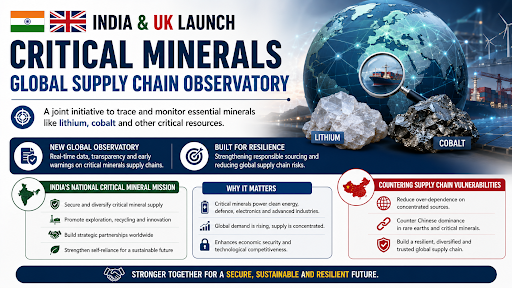
India and the UK launched the Critical Minerals Global Supply Chain Observatory to trace essential resources like lithium and cobalt. Alongside India's National Critical Mineral Mission, this initiative aims to counter supply chain vulnerabilities and Chinese dominance in rare earths.
Why In News?
India and the United Kingdom launched the Critical Minerals Global Supply Chain Observatory (GSCO).
|
Read all about: India-UK FTA 2025 l India-UK Relations |
What is the Global Supply Chain Observatory (GSCO)?
The India-UK Global Supply Chain Observatory (GSCO) functions as an AI-powered interactive intelligence platform that tracks global Critical Minerals (CMs) and Rare Earth Elements (REE) value chains.
|
What are Critical Minerals? Critical Minerals are vital natural resources that form the foundation of modern economic development, technological advancement, and national security. These minerals include highly strategic elements such as Lithium, Cobalt, Nickel, Graphite, and Rare Earth Elements (REEs),. Their extraction and processing suffer from extreme geographical concentration, making dependent nations highly vulnerable to supply chain disruptions, trade restrictions, and geopolitical monopolization. |
The Institute for Manufacturing (IfM) at the University of Cambridge lead this project, collaborating closely with IIT Bombay, TEXMiN at IIT (ISM) Dhanbad, and the Gujarat Mineral Development Corporation (GMDC),,.
The UK and India drive this initiative through a £1.8 million funding injection for Phase II, cementing it as a project under the UK-India Technology Security Initiative (TSI),.
Objectives of the Observatory
Constructs comprehensive databases to map end-to-end supply chains, explicitly pinpointing material deficits, recycling potential, and availability risks for both India and the UK.
Formulates strategic recommendations to fortify supply chain resilience and mitigate severe geopolitical or climate-driven disruptions.
Pilots modern innovations by utilizing Generative AI and remote sensing tools to enable real-time analysis of material flows.
Catalyzes bilateral trade and investment by removing market bottlenecks and enabling the seamless application of British and Indian innovations in both markets.
Amplifies capacity building and knowledge dissemination to advance sustainable mineral extraction, refining, and circular economy practices.
Key Features of the India–UK GSCO
Deploys Big Data Analytics and Large Language Models (LLMs) to visualize global supply chain dynamics in near real-time, tracking resources directly from the mine to the magnet.
Monitors an expansive digital infrastructure containing over 4,000 data points that track price movements, processing capacities, and immediate geopolitical risks.
Executes advanced stress testing and simulation models that evaluate how global supply networks withstand economic shocks and black swan events.
Conducts digital sustainability auditing using satellite technology to measure Greenhouse Gas (GHG) emissions, biodiversity loss, and overall compliance with Environmental, Social, and Governance (ESG) standards,.
Establishes a dedicated satellite campus at IIT (ISM) Dhanbad to physically anchor the project's practical implementation and skill development within India.
Why are Critical Minerals Important for India?
Drives the Green Energy Transition: India requires critical minerals to manufacture solar panels, wind turbines, and energy storage systems to meet climate commitments; reaching 500 GW of non-fossil fuel capacity by 2030 and Net-Zero emissions by 2070.
Fuels Advanced Manufacturing: Strategic sectors, including electric mobility (EVs), semiconductor manufacturing, telecommunications, and defense hardware, completely depend on these resources.
Reduces High Import Dependency: India is currently 100% import dependent for lithium, cobalt and nickel.
Mitigates Weaponization Risks: Over-reliance on China exposes India to strategic bottlenecks and export bans; thus, indigenous development under the National Critical Mineral Mission (NCMM) and international partnerships like the GSCO remain urgent national priorities to prevent market manipulation.
Conclusion
The India-UK GSCO acts as a transformative geopolitical shield, leveraging AI to secure India's critical mineral supply chains, accelerate green transition, and dismantle dangerous import dependencies.
Source: PIB
|
PRACTICE QUESTION Q. "China's dominance in the refining and processing of critical minerals poses a direct threat to India's green transition and EV industry." Analyze. 150 words |
The India–UK GSCO is a specialized, technology-driven intelligence platform designed to monitor global critical mineral flows, identify risks, and support strategic decision-making for both nations.
Critical minerals are the backbone of modern economies, indispensable for powering clean energy technologies, advanced manufacturing, electric mobility, and strategic defense sectors essential for India's future growth.
The National Critical Mineral Mission (NCMM) provides the overarching domestic policy framework that the observatory supports, aiming to secure a long-term, sustainable supply of minerals through exploration, processing, and recycling initiatives.


© 2026 iasgyan. All right reserved