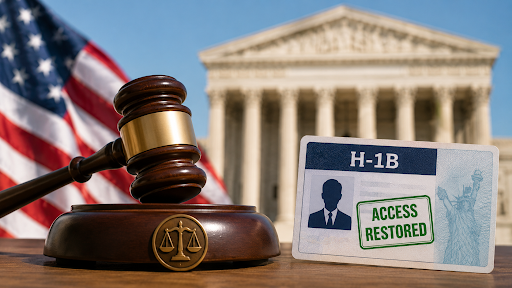
A federal judge struck down President Trump's $100,000 H-1B fee, ruling it an unauthorized tax violating APA and Congressional taxation authority, restoring access for Indian professionals and U.S. tech employers to the skilled worker visa program.
Why In News?
A federal judge in Boston has struck down the $100,000 fee imposed by US President Donald Trump on new H-1B visas, ruling it an unauthorized tax that exceeds presidential authority.
What is the H-1B Visa Program?
The H-1B visa allows U.S. employers to hire foreign workers in specialty occupations requiring theoretical and practical application of highly specialized knowledge (minimum bachelor's degree or equivalent).
Specialty occupations include STEM fields, IT, finance, engineering, medicine, and architecture.
Congressional statutory cap: 65,000 visas annually, plus 20,000 exemptions for holders of U.S. master's degrees or higher — totaling 85,000 (approximately 0.05% of the U.S. labor force).
U.S. Citizenship and Immigration Services (USCIS) conducts a lottery when registrations exceed the cap.
Major Sectors Employing H-1B Workers
Impact of Judgement on Indian Professionals
Increased Opportunities
Reduced Hiring Costs
Impact of Judgement on U.S. Companies
Easier Talent Acquisition
Reduced Compliance Costs
Conclusion
The June 2026 federal court ruling restores the H-1B program's accessibility, protects congressional taxation authority, and preserves the U.S. innovation pipeline for Indian professionals and American employers alike.
Source: thehindu
|
PRACTICE QUESTION Q. Consider the following statements regarding the H-1B visa program of the United States:
Which of the statements given above is/are correct? A. 1 and 2 only B. 2 and 3 only C. 1, 2, and 3 D. 1 only Answer: A Explanation: Statement 1 is CORRECT: The H-1B is explicitly recognized as a dual-intent visa. This means H-1B holders can legitimately apply for and pursue U.S. permanent residency (a Green Card) without jeopardizing their current visa status. Statement 2 is CORRECT: An H-1B visa is initially issued for a maximum of three years. It can be extended, but the standard maximum statutory period is six years. Further extensions beyond six years may be permitted in certain circumstances, such as when an employee's Green Card application is pending. Statement 3 is INCORRECT: Spouses and unmarried children under the age of 21 are absolutely permitted to accompany H-1B visa holders. They enter the United States under the dependent H-4 visa category. |
U.S. District Judge Leo Sorokin ruled the fee unlawful because it functions as an unauthorised tax imposed by executive action, violating the U.S. Constitution by bypassing the exclusive taxing authority of Congress.
The judgment provides massive relief to Indian techies by blocking a near-insurmountable financial barrier, ensuring American companies can continue sponsoring new, high-skilled Indian talent without facing prohibitive hiring costs.
The H-1B is a highly sought-after, non-immigrant U.S. work visa that allows domestic employers to temporarily hire foreign professionals in specialty occupations requiring a bachelor's degree or technical expertise.
The current Trump administration strongly favors restricting the program under an "America First" labor agenda, actively seeking to implement stricter wage rules, enhanced applicant vetting, and lottery priorities for higher earners.


© 2026 iasgyan. All right reserved