India's 2026 BRICS Chairship promotes resilience, innovation, and sustainability. Key initiatives include leading the SME Working Group under PartNIR to boost MSME technology access, and joining the BRICS Centre for Industrial Competencies to enhance global manufacturing capabilities.
Why In News?
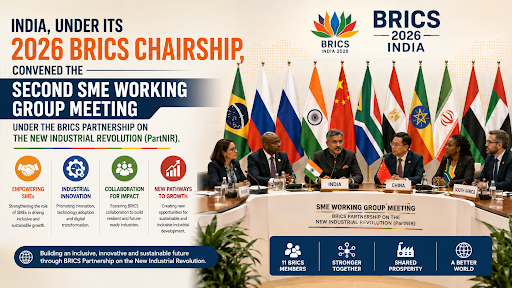
India, under its 2026 BRICS Chairship, convened the second SME Working Group Meeting under the BRICS Partnership on the New Industrial Revolution (PartNIR).
What Is the BRICS Partnership on the New Industrial Revolution (PartNIR)?
Origin: The initiative was proposed by Chinese President Xi Jinping at the 10th BRICS Summit in 2018 to leverage opportunities in new technologies and expand practical economic cooperation.
Establishment: It was formally launched in 2021 as an institutional mechanism to unify industrial capabilities, digital systems, and sustainable practices across the bloc.
The BRICS Centre for Industrial Competencies (BCIC) serves as a core execution arm of PartNIR, operating in cooperation with the United Nations Industrial Development Organization (UNIDO).
The partnership promotes a just and fair environment for sustainable development, focusing on industrial cooperation, technology transfer, and the development of complementary production capacities.
Key Initiatives
PartNIR Innovation Center: Established in Xiamen, China, to serve as a physical and digital hub for training, project cooperation, and AI development in emerging markets.
SME Working Group: Operational arm of PartNIR. Under India's 2026 BRICS Chairship, the Ministry of MSME leads specific initiatives to enhance technology adoption, financing access, and sustainable growth for small enterprises.
Why Is PartNIR Important for BRICS Countries?
Economic Resilience: It helps member nations mitigate the impact of multiple economic disruptions and build long-term structural strength.
Global Value Chain Integration: PartNIR encourages broader participation of developing economies in higher-value added segments of global manufacturing.
Supply Chain Stability: The framework emphasizes creating resilient, reliable, and stable supply chains to counter global polarization and trade uncertainties.
Innovation-Led Growth: It prioritizes innovation as a primary driver for economic growth, employment generation, and inclusive development.
Bridging the Technology Divide: The partnership addresses the digital divide by facilitating access to emerging technologies like Artificial Intelligence (AI) and High-Performance Computing (HPC).
Sustainable Transition: It supports just and equitable energy transitions while ensuring access to technologies that foster climate-resilient industries.
What OpportunitiesPartNIR Create for India?
National Empowerment
The National Productivity Council (NPC) is now the designated India Centre for BRICS Industrial Competencies, leading capacity-building and productivity enhancement.
Manufacturing Modernization
BCIC acts as a one-stop centre for Indian enterprises to access training, technology upgradation, and global collaboration.
Export Competitiveness
By aligning with PartNIR standards, Indian MSMEs can better integrate into global value chains, supporting India's goal of reaching a 25% manufacturing share of GDP.
Technological Showcase
Platforms like the BRICS New Industrial Revolution Exhibition allow Indian firms to showcase cutting-edge products, such as industrial AI models and humanoid robots.
Strategic Alignment
PartNIR complements domestic initiatives like Atmanirbhar Bharat, Digital Public Infrastructure (DPI), and the IndiaAI Mission.
Sustainable Agriculture
India’s priorities in PartNIR include fostering climate-resilient farming and exploring a BRICS Grain Exchange to ensure food security.
Conclusion
PartNIR serves as a strategic multilateral framework that empowers BRICS nations to bridge the technology divide and transform MSMEs into globally competitive engines of sustainable industrial growth.
Source: ANINEWS
|
PRACTICE QUESTION Q. Consider the following statements regarding the BRICS Partnership on the New Industrial Revolution (PartNIR):
Which of the statements given above is/are correct? A) 1 only B) 2 only C) Both 1 and 2 D) Neither 1 nor 2 Answer: C Explanation: Statement 1 is correct: Under its 2026 BRICS Chairship, India is actively leading the SME Working Group under the PartNIR framework. The Ministry of MSME spearheaded meetings focused entirely on enhancing technology access and building innovation ecosystems for Micro, Small and Medium Enterprises (MSMEs). Statement 2 is correct: India formally joined the BRICS Centre for Industrial Competencies (BCIC) in February 2026. Spearheaded by the Department for Promotion of Industry and Internal Trade (DPIIT) and UNIDO, the one-stop center aims to bolster advanced manufacturing and support MSMEs through Industry 4.0 competencies. |
The theme for India's chairship is "Building for Resilience, Innovation, Cooperation and Sustainability
It stands for BRICS Partnership on the New Industrial Revolution, which features an SME Working Group focused on expanding technology access, commercialization, and finance for MSMEs.
BRICS members currently include Brazil, Russia, India, China, South Africa, Egypt, Ethiopia, Iran, United Arab Emirates, and Indonesia.


© 2026 iasgyan. All right reserved