The USTR proposes a 12.5% unilateral tariff on India and 53 other economies for failing to block forced labor imports. This strategic move threatens India’s export competitiveness and drastically complicates the ongoing India-US Bilateral Trade Agreement (BTA) negotiations.
Why In News?
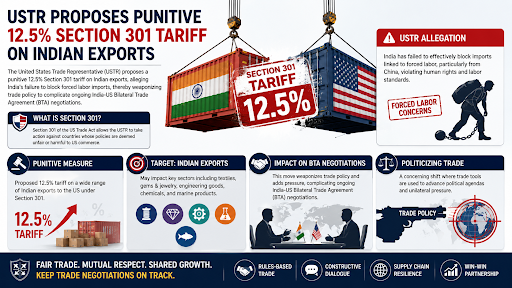
The United States Trade Representative (USTR) proposes a punitive 12.5% tariff on Indian exports, alleging India's failure to block forced labor imports.
|
Read all about: India's Strategy Against US Pressure l India-US Trade Deal 2026 |
What Is the USA Proposed 12.5% Additional Tariff?
The Office of the United States Trade Representative (USTR) proposes an additional 12.5% tariff on imports from 54 economies, including India and China.
The USTR proposes a lower 10% tariff for six economies (Canada, Ecuador, the European Union, Indonesia, Mexico, and Pakistan) that maintain partial forced labor enforcement regimes.
The USTR grounds this action in a Section 301 investigation covering 60 economies, concluding that the target nations fail to establish and effectively enforce prohibitions on importing goods produced with forced labor.
The USTR classifies this failure as an "unreasonable" trade practice that burdens or restricts US commerce, thus justifying retaliatory tariffs to eliminate the competitive advantage of cheap labor.
What Are Forced Labour Import Restrictions?
The US defines forced labor as work or service exacted from a person under the menace of penalty and for which the worker does not volunteer.
The US insists that global reliance on forced labor creates an artificial cost advantage and an unlevel global playing field that unfairly penalizes ethical American firms.
The proposed restrictions punish nations that fail to block goods made with forced labor in third countries from entering their domestic markets, viewing this as a loophole that distorts global market conditions.
How the Proposal Affects India's Export Competitiveness?
Indian exporters face substantially higher compliance and production costs, threatening their pricing edge in the US market.
India loses competitive parity with key regional rivals like Pakistan and Indonesia, which face a lower 10% tariff compared to India's 12.5%.
The tariffs trigger increased scrutiny and constant questioning of Indian labor practices, which threatens to destabilize established global supply chains and delay shipments.
Which Indian Sectors Face the Highest Exposure?
Textiles, apparel, and cotton production face disruption, though the USTR proposes a specific "textile mechanism" that may allow a certain volume of these imports at reduced duty rates.
Steel, aluminium, automobiles, and auto parts experience high risk due to their involvement in trans-shipment practices.
Electronics, engineering goods, chemicals, and gems and jewelry stand as highly exposed, export-oriented sectors.
Agriculture and seafood processing face intense scrutiny; notably, the US Department of Labor recently added Indian shrimp to its list of goods produced by forced labor following whistleblower reports of debt bondage and poor working conditions.
How Does This Development Affect India-U.S. Strategic Partnership?
The punitive tariff proposal complicates ongoing negotiations for a Bilateral Trade Agreement (BTA) between New Delhi and Washington, which US officials claim is currently 99% complete.
Analysts highlight that the US employs these tariffs as a strategic pressure tactic to force India into making significant concessions at the BTA negotiating table.
India denies the forced labor allegations and rejects the timing of these tariffs amid active diplomatic negotiations, highlighting an ideological clash where trade policy merges with national security and human rights.
|
WTO Framework Taking unilateral trade actions against other member countries without first securing approval under the World Trade Organization (WTO) Understanding on Rules and Procedures Governing the Settlement of Disputes violates the WTO Agreement. The Indian government argues that the US probe remains unjustified because global rules already exist to govern these issues, implying the US bypasses established multilateral frameworks. |
What Should Be India's Way Forward?
India must challenge the legal scope of the Section 301 investigation, arguing that the statute traditionally targets market-access barriers for US firms, not a foreign country's third-party import policies.
Policymakers must treat the Bilateral Trade Agreement (BTA) negotiations and the Section 301 tariffs as distinctly separate matters to avoid yielding to pressure tactics.
Trade experts advise New Delhi to prepare to absorb the tariffs or boldly step away from the BTA—similar to Malaysia's approach—if the agreement demands massive concessions without reciprocal benefits.
Indian industries must diversify their export destinations to reduce reliance on the unpredictable US market, mirroring the recent strategy adopted by the Indian seafood processing industry.
Conclusion
The US leverages forced labor allegations to weaponize Section 301 tariffs, requiring India to defend its vital export sectors while strategically decoupling the threat from ongoing Bilateral Trade Agreement negotiations.
Source: THEHINDU
|
PRACTICE QUESTION Q. Analyze the strategic implications of the US Section 301 tariffs on the ongoing India-US Bilateral Trade Agreement (BTA) negotiations. 150 words |
It is a US law authorizing the President to retaliate unilaterally against foreign trade practices deemed "unreasonable" or discriminatory to US commerce.
The US targets 60 economies; 54 (including India and China) face 12.5% tariffs, while 6 (like Pakistan and the EU) face 10% tariffs due to having partial enforcement regimes.
The WTO mandates that member nations use its multilateral dispute settlement mechanism before applying retaliatory actions; executing unilateral actions violates this agreement.


© 2026 iasgyan. All right reserved