The US launched a Section 301 investigation against India, claiming schemes like PLI create excess capacity harming US industries. Bypassing the WTO, it threatens Make in India through possible tariffs. India must respond via diplomacy, WTO action, trade diversification, and stronger domestic manufacturing.
Copyright infringement not intended
Picture Courtesy: ECONOMICTIMES
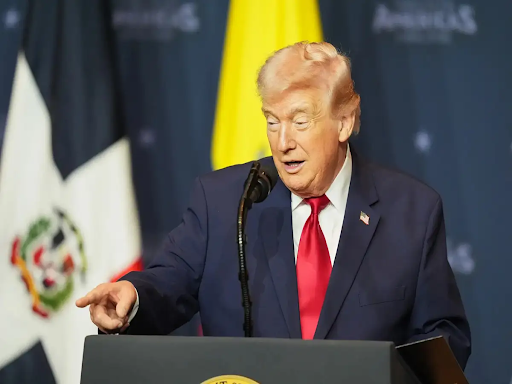
The U.S. has launched a Section 301 trade investigation against India and 15 others over manufacturing policies causing "structural excess capacity" potentially challenging India's 'Make in India' initiative.
Section 301 is a domestic law that allows the US to take unilateral action against foreign trade practices it considers unfair or discriminatory.
It empowers the Office of the United States Trade Representative (USTR) to:
The central allegation is that Indian government policies promote "structural excess capacity"—building production capabilities far beyond domestic demand, leading to government-supported export surges that hurt US producers.
Trade Imbalance: The US has highlighted India's goods trade surplus, which was $58.2 billion in 2025 (Source: USTR).
Sector-Specific Scrutiny: Several key Indian sectors are under the scanner for potential excess capacity and high exports:
Policy Focus: The probe is examining Indian policies like government subsidies, the role of State-Owned Enterprises (SOEs), and financial incentive schemes. A key, though unnamed, target is the Production Linked Incentive (PLI) Scheme.
A negative finding by the USTR could have serious consequences for India, whose bilateral trade with the US reached $132.2 billion in FY25. (Source: IBEF)
Risk of Tariffs
The US could impose more tariffs on Indian exports, making them uncompetitive. This mirrors the action against China, where tariffs of up to 25% were imposed on $370 billion of goods.
Investor Uncertainty
The investigation creates a climate of uncertainty, which could deter foreign and domestic investment in the Indian manufacturing sector and undermine the goals of 'Make in India'.
Trade Negotiations
It complicates ongoing talks for a bilateral trade agreement, which were recently reaffirmed by leaders in February 2026.
Supply Chain Disruption
Key Indian manufacturing sectors that are integrated with global supply chains could face disruption.
Diplomatic Engagement
India must engage constructively with the USTR, proving its PLI scheme is WTO-compliant (production-linked, not export-linked) and aims to promote a competitive industrial base.
Leveraging the WTO
If talks fail and tariffs are imposed, India must challenge the measures at the WTO's Dispute Settlement Body, aligning with other major economies that oppose US unilateralism.
Market Diversification
This probe highlights the need for India to reduce the export dependency on the US market. Accelerating Free Trade Agreements (FTAs) with partners like the EU is crucial.
Strengthening Domestic Competitiveness
Focus on Domestic reforms to reduce logistics costs, ease regulatory burdens, and improve the overall business environment.
The US Section 301 investigation challenges India's economic diplomacy and global manufacturing role, requiring a strategy of measured negotiation, WTO reliance, and domestic reform for the India-US strategic partnership to overcome economic friction and preserve broader geopolitical cooperation.
Source: ECONOMICTIMES
|
PRACTICE QUESTION Q. The reduction of U.S. tariffs to 18% provides a 'Strategic Window' for Indian exporters. Discuss. 150 words |
Section 301 is a US law that gives the Office of the United States Trade Representative (USTR) the authority to investigate and take unilateral action, such as imposing tariffs, against foreign countries whose trade practices are deemed unfair, unreasonable, or discriminatory to US commerce.
The US is using Section 301 as a legally durable mechanism to protect its domestic manufacturing after a Supreme Court decision struck down tariffs imposed under different emergency powers. It allows the administration to continue applying trade pressure on its partners.
The US alleges that Indian government subsidies, like the Production Linked Incentive (PLI) scheme, are causing "structural excess capacity." This means India is manufacturing far more than it consumes, leading to surplus production that is exported at prices competitive enough to potentially harm US domestic industries.


© 2026 iasgyan. All right reserved