The Thucydides Trap concept describes the severe risk of war when an emerging power threatens a ruling hegemon. Popularized by Graham Allison, it presently frames the US-China rivalry, while India's rapid rise presents a potential future challenge to American dominance.
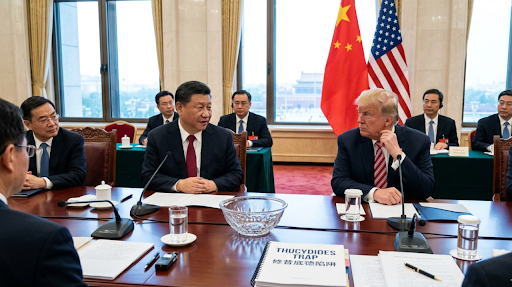
During the Beijing meeting between Presidents Xi Jinping and Donald Trump, the term "Thucydides Trap" emerged as a focal point in strategic talks between the US and China.
American political scientist Graham Allison coined the concept to describe the structural stress and tendency toward war that occurs when a rising power threatens to displace an established ruling power.
The theory draws direct inspiration from ancient Greek historian Thucydides, who observed that the rapid rise of Athens and the resulting fear in Sparta made the Peloponnesian War inevitable.
Allison's Harvard University study reveals that in 12 out of 16 historical cases over the past 500 years, this exact power dynamic triggered a military conflict or war.
The theory maintains that war is not absolutely inevitable, but escaping the trap demands tremendous diplomatic effort, mutual concessions, and massive adjustments from both nations.
Global leaders and scholars currently apply the concept to analyze modern US-China relations and the shifting global balance of power.
China shows a rapid economic, technological, and military growth that challenges the US-led international order and American global hegemony.
Geopolitical tensions escalate over trade wars, semiconductor restrictions, cyber espionage, and territorial disputes in the South China Sea and the Taiwan Strait.
Top leaders acknowledge the danger; Xi Jinping cites the Thucydides Trap in talks with US Presidents to emphasize the need for mutual respect and win-win cooperation to avoid repeating history's pattern of confrontation.
The framework highlights the severe danger of inadvertent escalation, warning that standard crises or miscalculations between these nuclear-armed superpowers can quickly cascade into full-scale war.
Source: TIMESOFINDIA
|
PRACTICE QUESTION Q. In modern international relations, which two global superpowers are most frequently discussed in the news regarding the Thucydides Trap? A) United States and Russia B) United States and China C) India and China D) Germany and Russia Answer: B Explanation: The Thucydides Trap is a political term used to describe the severe friction that occurs when a rising global power threatens to displace an established ruling power. In contemporary geopolitics, this concept is almost exclusively applied to the strategic competition and risk of conflict between the United States (the dominant power) and China (the rising power). |
The Thucydides Trap is a term describing the severe structural stress and high risk of war that occurs when an emerging power threatens to displace an established great power. It is based on the ancient Greek historian Thucydides' observation that the rise of Athens and the fear it instilled in Sparta made the Peloponnesian War inevitable.
The term was coined around 2011 by American political scientist Graham T. Allison, who later popularized it in his 2017 book Destined for War: Can America and China Escape Thucydides’s Trap?.
While the concept is largely applied to the US and China, India’s sustained rise in economic, technological, and military capabilities could position it as a future systemic challenger to US hegemony. This raises the long-term risk of a new Thucydides Trap dynamic between Washington and New Delhi.


© 2026 iasgyan. All right reserved