India assumed the Chair of the Common Criteria Development Board (CCDB) for 2026–2028, leading global IT security evaluation standards. This milestone enhances India's influence in cybersecurity, digital trust, and mutually recognized secure technology certification.
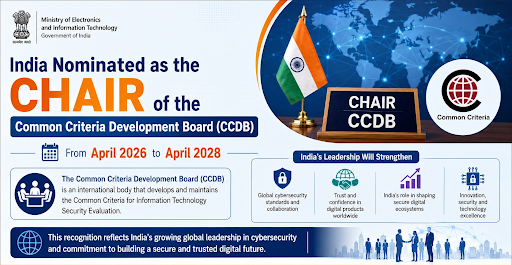
India nominated as the Chair of the Common Criteria Development Board (CCDB) from April 2026 to April 2028.
The Common Criteria Development Board (CCDB) acts as the technical core and engine of the Common Criteria Recognition Arrangement (CCRA).
The board manages the international work program for the Common Criteria (CC) and the Common Methodology for Information Technology Security Evaluation (CEM).
It establishes the technical standards, certification frameworks, and evaluation criteria necessary to secure global IT products.
The CCDB dictates how global governments and organizations assess cybersecurity protections embedded in digital systems to build digital trust.
Assuming CCDB Chairmanship (2026–2028)
India leads the technical core, allowing the nation to directly define and shape international security evaluation methodologies and certification standards.
Advancing National Technology Ecosystems
The leadership role directly strengthens India's domestic strategies to build trusted digital public infrastructure, secure electronics manufacturing, and a robust semiconductor ecosystem.
Guiding Emerging Technology Standards
India ensures that global cybersecurity frameworks prioritize regulations for emerging threats in Artificial Intelligence (AI), Cloud Computing, Internet of Things (IoT), and Quantum technologies.
Enhancing Global Tech Regulation
The engagement aligns with India’s expanding global footprint in technology regulation, AI governance, digital diplomacy, and cyber resilience initiatives.
Empowering Domestic Nodal Agencies
India utilizes the Ministry of Electronics and Information Technology (MeitY) and the STQC Directorate as the official Certification Body to issue recognized IT security evaluations, strengthening domestic technology governance.
Source: PIB
|
PRACTICE QUESTION Q. With reference to the Common Criteria Recognition Arrangement (CCRA) and the Common Criteria Development Board (CCDB), consider the following statements:
Which of the statements given above is/are correct? A) 1 and 2 only B) 2 and 3 only C) 1 and 3 only D) 1, 2, and 3 Answer: A Explanation: Statement 1 is correct: The Common Criteria Recognition Arrangement (CCRA) is a foundational international treaty framework. It enables member countries to mutually recognize IT security certificates produced by independent, licensed laboratories across international borders. This completely eliminates the need for redundant, costly re-certification in individual destination countries. Statement 2 is correct: The Common Criteria Development Board (CCDB) functions strictly as the technical core of the CCRA. While other high-level committees manage administrative policy, the CCDB is directly responsible for the technical management, international work program, and evolutionary maintenance of the Common Criteria (CC) and Common Methodology for Information Technology Security Evaluation (CEM) standards. Statement 3 is incorrect: The Standardisation Testing and Quality Certification (STQC) Directorate does act as India’s official Certification Body for IT security evaluations under the CCRA framework. However, the STQC functions as an attached office under the Ministry of Electronics and Information Technology (MeitY), not the Ministry of Science and Technology. |
The CCDB serves as the technical core of the Common Criteria Recognition Arrangement (CCRA). It manages the international work program for the Common Criteria (CC) and the Common Methodology for Information Technology Security Evaluation (CEM), focusing on the technical standards for securing global IT products.
The CCRA is an international treaty that enables the mutual recognition of IT security certificates across borders. This arrangement ensures that products evaluated under the Common Criteria by one member country are accepted globally without needing re-certification, smoothing international trade in secure IT products.
This leadership role positions India at the forefront of defining international security evaluation methodologies. It allows India to influence global cybersecurity standards for emerging technologies like AI and IoT, directly supporting its national strategies for digital public infrastructure and trusted supply chains.


© 2026 iasgyan. All right reserved