The repatriation of the 11th-century Chola copper plates from the Netherlands highlights India's rich maritime and cultural heritage. Ancient epigraphic records like the Uttaramerur inscriptions, these artifacts offer profound insights into early Indian administration and scripts.
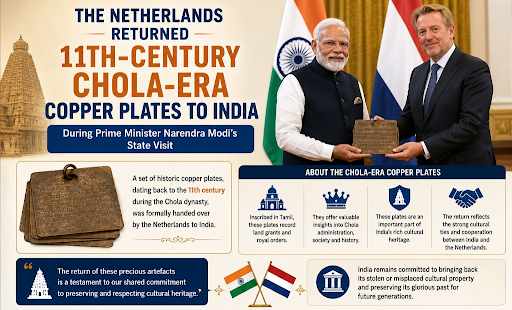
The Netherlands returned 11th-century Chola-era copper plates to India during Prime Minister Narendra Modi's state visit.
|
Origin & Peak |
|
|
Maritime Prowess |
|
|
Art & Architecture |
|
|
Religious Pluralism |
|
|
Historical Records |
|
Origins
Historians officially call the Leiden Plates the Anaimangalam Copper Plates as one of the most crucial surviving administrative records of the Chola dynasty.
Emperor Raja Raja Chola I (985–1014 CE) originally made an oral commitment to grant specific land and revenues to a foreign monastery.
His son, Rajendra Chola I, officially executed and formalized this verbal order onto durable copper plates.
Kulottunga Chola I later expanded the grant and added three smaller plates to the collection following an appeal by Javanese emissaries.
Physical Features & Structure
The collection weighs nearly 30 kilograms and consists of 21 large plates (issued by Rajendra Chola I) and 3 smaller plates (issued by Kulottunga Chola I).
A heavy bronze ring binds the plates together, secured by the intricate royal seal of Rajendra Chola I.
The royal seal displays the Tiger (Chola emblem) sitting upright alongside the Twin Fish (Pandyas) and a Bow (Cheras). This combination symbolizes Chola military supremacy and suzerainty over rival South Indian kingdoms.
The scribes utilized a bilingual composition to record the charter:
Colonial History & Recent Repatriation
Dutch missionary and official Florentius Camper acquired the plates in the 18th century (around 1700-1712) while the Dutch East India Company (VOC) controlled Nagapattinam.
The descendants of Camper transferred the plates to the Leiden University library in the Netherlands in 1862, which gave the artifacts their popular Western name.
The Netherlands formally returned the plates to India in May 2026 during Prime Minister Narendra Modi's diplomatic visit.
The Archaeological Survey of India (ASI) will preserve these artifacts in New Delhi.
They function as primary legal documents (tamra shasanas) that officially guarantee rights, obligations, and land grants given to religious institutions, learned Brahmanas, and officials.
They preserve detailed genealogical lists and trace royal lineages, which helps historians accurately fill chronological gaps in dynastic histories.
They record vital administrative data, revealing the contemporary political structures, taxation policies, revenue systems, and agricultural details of ancient empires.
They offer authentic insights into the social conditions, cultural exchanges, and religious pluralism of medieval South India.
Source: NEWSONAIR
|
PRACTICE QUESTION Q. Consider the following statements about the recently repatriated Anaimangalam (Leiden) Copper Plates:
Which of the statements given above is/are correct? A) 1 and 2 only B) 2 and 3 only C) 1 and 3 only D) 1, 2, and 3 Answer: A Explanation: Statement 1 is correct: The Anaimangalam (Leiden) Copper Plates document the grant of land revenues (the village of Anaimangalam) to the Chudamani Vihara, a Buddhist monastery in Nagapattinam. This monastery was built by King Sri Mara Vijayottungavarman of the Srivijaya kingdom (modern-day Indonesia) with the permission and support of the Chola empire. Statement 2 is correct: The original oral decree and land grant were issued by Emperor Rajaraja Chola I. His son, Rajendra Chola I, later formalised the charter and had it permanently engraved onto the copper plates. Statement 3 is incorrect: The plates are bilingual, not entirely written in Sanskrit. They consist of two distinct sections: a Sanskrit portion tracing the genealogy of the Chola dynasty, and a Tamil portion detailing the specific administrative and local tax-grant arrangements. |
They are 11th-century Chola dynasty artifacts consisting of copper plates that record grants of land revenues to a Buddhist monastery in Nagapattinam.
It details the local administrative structure and election system (via pot-tickets) of the village assembly during the Pallava and Chola periods.
Evolving from Brahmi around the 5th century CE, Grantha is an ancient South Indian script predominantly used to write Sanskrit in the Tamil-speaking region.


© 2026 iasgyan. All right reserved