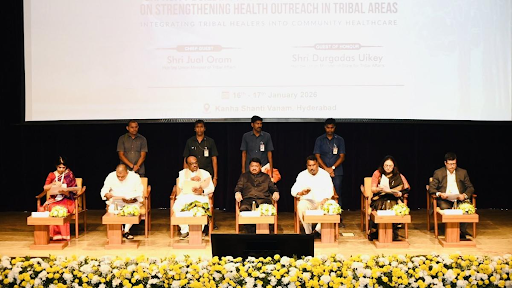
The Ministry of Tribal Affairs to recognize one lakh tribal healers under a QCI certification framework. Integrating indigenous practitioners into formal healthcare aims to bridge gaps in remote areas, preserve traditional knowledge, and ensure dignity, legality, and inclusive, pluralistic healthcare delivery by 2026.
Copyright infringement not intended
Picture Courtesy: THEHINDU
The Union Ministry of Tribal Affairs announced to formally recognise one lakh tribal healers as partners in the public health ecosystem to strengthen healthcare delivery in tribal communities.
It is a healthcare system deeply rooted in the culture and environment of indigenous communities, distinct from codified systems like Ayurveda or Unani.
Holistic Approach: Treats the individual as a whole—body, mind, and spirit—rather than just alleviating symptoms.
Community-Centric: Health is viewed as a matter of community well-being, not just individual health.
Reliance on Biodiversity: Utilizes locally available medicinal plants, herbs, and other natural resources.
Oral Tradition: Knowledge is passed down through generations orally, from master to apprentice.
Diverse Practices: Includes herbal medicine, bone setting, spiritual healing, massages, and dietary advice.
Modern V/S Traditional Health Systems
|
Modern Allopathic Medicine |
Traditional Tribal Healing |
|
|
Approach |
Reductionist (focuses on disease and symptoms) |
Holistic (focuses on overall well-being) |
|
Diagnostics |
Relies on technology, lab tests, and imaging |
Relies on physical observation, natural signs, and spiritual insight |
|
Treatment |
Standardized protocols, pharmaceuticals, surgery |
Personalized remedies using local flora/fauna, rituals |
|
Knowledge System |
Codified, documented, and formally taught |
Oral, experiential, and passed through generations |
Bridging Healthcare Gaps
Tribal communities, which constitute 8.6% of India's population, often live in remote areas and have limited access to modern healthcare. (Source: Census 2011)
Healers act as the first point of contact, offering accessible and affordable care, thus helping achieve the goal of Universal Health Coverage (UHC).
Cultural Preservation and Trust
Formal recognition protects invaluable traditional knowledge from being lost.
Healers are trusted members of the community, which increases the acceptance and effectiveness of public health interventions.
National & Global Policy Alignment
WHO's Traditional Medicine Strategy: Aligns with the WHO's emphasis on integrating traditional and complementary medicine into national health systems.
WHO Global Centre for Traditional Medicine (GCTM): India established the WHO Global Centre for Traditional Medicine (GCTM) in Jamnagar, Gujarat, demonstrating its leadership in leveraging traditional medicine internationally.
Sustainable Development Goals (SDGs): Contributes directly to SDG 3 (Good Health and Well-being).
Documentation and Validation
The National Tribal Research Institute, along with other bodies, is working on creating a comprehensive database of tribal healers and their practices.
This involves documenting medicinal plants, treatment procedures, and their efficacy in a structured manner.
Integration Models
Collaborative Care: Training healers to work alongside ASHA workers and ANMs for basic healthcare, health education, and timely referrals to Primary Health Centres (PHCs).
Two-way Referral System: Creating a system where PHCs can refer patients for certain ailments to validated traditional healers, and healers can refer critical cases to modern doctors.
Protecting Intellectual Property Rights (IPR)
Traditional Knowledge Digital Library (TKDL): Expanding the TKDL database to include documented tribal medicinal knowledge to prevent biopiracy and wrongful patenting by international corporations.
Biological Diversity Act, 2002: This act mandates benefit-sharing with local communities when their traditional knowledge or biological resources are used for commercial purposes.
|
Constitutional and Legal Frameworks Several existing legal frameworks support this initiative:
|
Challenges
Standardization and Safety: Ensuring the safety, efficacy, and dosage standardization of traditional remedies without undermining the core principles of the healing system is a major challenge.
Risk of Biopiracy: Despite safeguards like TKDL, the documentation of knowledge could make it vulnerable to exploitation by pharmaceutical companies without equitable benefit-sharing.
Resistance from Medical Community: Overcoming skepticism and resistance from some modern medical practitioners is essential for successful integration.
Loss of Authenticity: Formalization and commercialization might lead to the dilution of authentic, sacred practices, turning them into a commodified service.
Power Dynamics: There is a risk that traditional healers could be relegated to a subordinate role in the healthcare hierarchy rather than being treated as equal partners.
Community-Led Framework: Ensure that tribal communities and healers are central to the process of policy-making, documentation, and implementation.
Phased Integration: Begin with areas where collaboration is most evident, such as primary care, nutrition, and mental health, before moving to more complex integrations.
Robust IPR Protection: Strengthen legal frameworks for benefit-sharing and grant communities "community IPR" over their collective knowledge.
Inter-disciplinary Dialogue: Promote mutual respect and understanding by creating platforms for regular dialogue between modern doctors, policymakers, and traditional healers.
Integrating traditional tribal healers into the public health system could help bridge modern healthcare gaps and support indigenous health.
Source: THEHINDU
|
PRACTICE QUESTION Q. "The formal recognition of tribal healers is a step toward medical pluralism in India." Critically analyze. (150 words) |
The Bharat Tribal Health Observatory (B-THO) is India’s first national observatory focused on tribal health, established by the Ministry of Tribal Affairs in collaboration with ICMR. Its purpose is to create a national repository of tribe-disaggregated health data to enable evidence-based policymaking and research to eliminate diseases in tribal districts.
Integration is necessary to address the severe health disparities faced by tribal communities, including a high burden of communicable and non-communicable diseases, severe malnutrition, and an "access and trust deficit" in the formal healthcare system due to geographical isolation and cultural barriers.
India protects traditional knowledge through legal instruments like the Biological Diversity Act, 2002, and initiatives like the Traditional Knowledge Digital Library (TKDL). The TKDL documents traditional knowledge from ancient texts in a digitized format accessible to international patent offices, allowing them to verify that a claimed "invention" is not novel and thus preventing wrongful patents.

© 2026 iasgyan. All right reserved