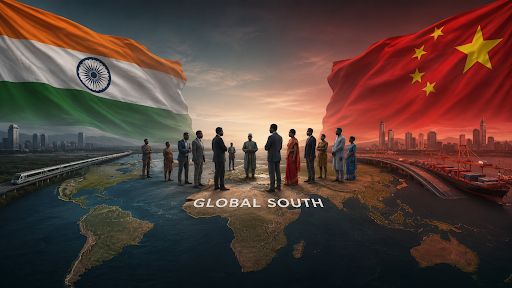
India and China are actively competing for leadership of the Global South. While China uses massive infrastructure financing and debt diplomacy via the BRI, India leverages capacity building, Digital Public Infrastructure, and democratic governance to offer a transparent development alternative.
Why In News?
The geopolitical rivalry between India and China intensifies as Beijing publishes a new White Paper asserting its status as a permanent member of the Global South.
What is the Global South?
The Global South includes nations across Asia, Africa, Latin America, and Oceania that share historical legacies of colonialism, economic underdevelopment, and a collective desire for equitable global governance.
Strategic Autonomy: Member nations practice "non-alignment 2.0," hedging between major powers to maximize geoeconomic interests without joining rigid military blocs.
Development-Centric Focus: The bloc prioritizes economic revitalization, poverty alleviation, and infrastructure over ideological alignment.
Diverse Political Systems: The group remains non-monolithic, housing both vibrant democracies and rigid autocracies united by common economic grievances.
Global Governance: The bloc demands the democratization of post-WWII institutions, including the UN Security Council, IMF, and World Bank.
Economic Gravity: The BRICS+ coalition now accounts for over 36% of global GDP and 45% of the world population, according to the World Bank.
Climate Justice: Nations advocate the principle of Common but Differentiated Responsibilities (CBDR), demanding climate finance and technology transfers from the industrialized Global North.
Strategic Importance of the Global South
Demographic Advantage: The region houses the world’s youth; India leverages its demographic dividend with 65% of its population under 35.
Resource Endowment: Nations hold critical minerals like lithium, cobalt, and rare earths essential for the green energy transition.
Emerging Markets: Global powers target these consumers to bypass Western protectionism; Chinese exports to the Global South surged 39-fold between 2000 and 2024.
Voting Power: As the absolute majority in the UN General Assembly, these nations define international human rights norms and technology standards.
India’s Approach: The Democratic Alternative
Voice of Global South Summit: India institutionalized dialogue by hosting three summits, including the 2024 edition with 173 dignitaries from 123 countries.
Development Partnership Administration: India maintains a USD 32 billion portfolio across 68 countries, executing 208 projects in Africa focused on water, electricity, and education.
Digital Public Infrastructure (DPI): India exports its India Stack, UPI, and Aadhaar as scalable, low-cost governance models.
Vaccine Maitri: India delivered over 162 million vaccine doses to 96 countries during the pandemic, establishing itself as the "pharmacy of the world."
SAGAR Vision: India acts as a net security provider in the Indian Ocean, offering disaster relief and coastal surveillance to littoral states.
China’s Strategy: Infrastructure and Debt
Belt and Road Initiative (BRI): China finances mega-infrastructure projects, with trade involving BRI partners exceeding USD 3 trillion.
Infrastructure Financing: Chinese state-owned banks provided USD 75 billion in African infrastructure loans between 2000 and 2021 (Institute for Security Studies).
Resource Diplomacy: Beijing secures exclusive extraction rights for commodities, controlling major mining operations in the Democratic Republic of Congo and Latin America.
Debt Diplomacy: China fuses finance with security, creating dependencies; 67% of Kenya’s external debt is owed to China, leading to asset losses like Sri Lanka’s Hambantota port.
Key Areas of India–China Competition
Africa: India targets USD 200 billion in bilateral trade by 2030, while China maintains dominance with USD 348 billion in trade as of 2025.
Indian Ocean Region: China’s "String of Pearls" strategy builds dual-use ports (e.g., Gwadar, Djibouti), which India counters via the Quad and the Chabahar Port.
Southeast Asia: China leverages ASEAN trade (approaching USD 982.3 billion), while India builds credibility through defense exports like BrahMos.
Latin America: China acts as a primary trade partner, while India diversifies its energy portfolio through oil imports from Brazil and Colombia.
Pacific Island Countries: Both nations compete for diplomatic recognition; India utilizes the Forum for India–Pacific Islands Cooperation (FIPIC) to provide climate resilience funding.
Opportunities and Challenges for India
Opportunities: India offers a transparent, democratic model based on the Kampala Principles, technology-sharing via the Pan-African e-Network, and sustainable finance through the International Solar Alliance (ISA).
Challenges: India faces financing constraints compared to China’s trillion-dollar ecosystem, geopolitical friction due to its Quad alignment, and supply chain dependencies (e.g., 70% import dependence on Chinese APIs).
Way Forward
Institutionalization: India must transform the Voice of Global South Summit into a permanent secretariat for consistent policy coordination.
Comparative Advantage: Focus on exporting DPI, healthcare, and ITEC training to build human capital.
Connectivity: Accelerate the India-Middle East-Europe Economic Corridor (IMEEC) and the International North-South Transport Corridor (INSTC).
Multilateral Reform: Use the G20, BRICS, BIMSTEC, and IORA to push for urgent reforms in the UN Security Council and Bretton Woods institutions.
Conclusion
To cement its leadership in the Global South, India must transcend aspirational rhetoric by delivering consistent, transparent development financing and technological public goods that offer a viable, democratic alternative to Chinese hegemony.
Source: INDIANEXPRES
|
PRACTICE QUESTION Q. "While China leverages its massive financial scale to dominate the Global South, India relies on normative legitimacy and capacity building." Critically analyse. 250 words |

© 2026 iasgyan. All right reserved