The India–New Zealand FTA secures sensitive sectors like dairy while gaining duty-free access for textiles and pharma. Beyond tariffs, it integrates $20 billion in investment and professional mobility, serving as a strategic template for future deep economic partnerships.
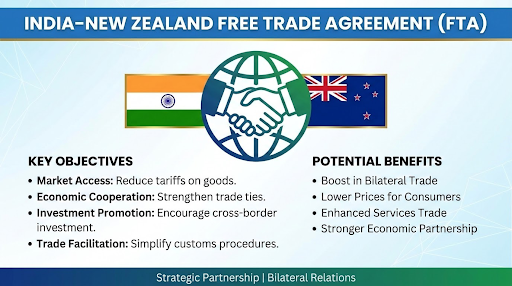
The India-New Zealand signed Free Trade Agreement to double bilateral trade to $5 billion by granting 100% duty-free access for Indian exports while protecting the domestic dairy sector.
|
READ ALL ABOUT: INDIA AND NEW ZEALAND CONCLUDED FREE TRADE AGREEMENT (FTA) l INDIA-NEW ZEALAND RELATIONS: CHALLENGES AND WAY FORWARD l ABOUT INDIA AND NEW ZEALAND RELATIONS |
A Free Trade Agreement (FTA) is a pact between two or more nations to reduce or eliminate barriers to imports and exports among them.
Under an FTA, goods and services can be bought and sold across international borders with little or no government tariffs, quotas, subsidies, or prohibitions to inhibit their exchange.
Agreement is built on three main pillars: Trade in Goods, Services & Mobility, and Investment.
Sectoral Impact
Beneficiary Sectors
Protected Sectors
Diversification Strategy (China+1)
Following FTAs with the UAE, Australia, and EFTA, this deal reinforces India's strategy to diversify trade away from China. It provides Indian exporters a foothold in the Oceania region, serving as a gateway to smaller Pacific Island economies.
Boosting "Make in India"
By securing cheaper raw materials like wood (logs), wool, and coking coal (which now enter India duty-free), the FTA reduces input costs for Indian manufacturers, making them more competitive globally.
Setting a Precedent
The $20 billion investment commitment mirrors the model used in the India-EFTA TEPA, signaling that India now views FTAs as "investment bridges" rather than just trade corridors.
Non-Tariff Barriers (NTBs): Beyond tariffs, Indian exporters face developed-market hurdles like phytosanitary standards. Success requires mutual standards recognition.
NZ Political Backlash: NZ opposition parties criticize the dairy exclusion as unfair, creating political friction that may hinder implementation.
Trade Deficit Risks: As FTAs often widen India's trade deficit (e.g., ASEAN), monitoring NZ imports is vital to maintain trade balance.
Operationalizing the "Gateway to Oceania" Strategy
India should leverage New Zealand as a diplomatic and logistical gateway to the Pacific Island Nations, such as Fiji and Vanuatu. This strategy supports India's Act East Policy and helps mitigate China's regional influence.
Tackling Non-Tariff Barriers (NTBs)
The Joint Trade Committee (JTC) should prioritize Mutual Recognition Agreements (MRAs) to ensure New Zealand recognizes Indian organic and inspection standards, eliminating redundant testing.
Upgrading Domestic Dairy & Agriculture
India should utilize the FTA’s "Technical Barriers to Trade" chapter to import New Zealand’s world-class dairy technology (cold chains, milking machines, and genetic stock) to modernize the cooperative sector. This prepares Indian farmers for future competition rather than just shielding them.
Fully Utilizing the Services Quota
The Ministry of Skill Development should align training programs with New Zealand’s specific skill shortages (e.g., nursing, elder care, and construction) to ensure Indian workers have a high acceptance rate.
Monitoring the Trade Deficit
India benefits less immediately from the FTA since New Zealand’s tariffs were already low (2-3%). To protect domestic industry, the Department of Commerce should monitor quarterly data to trigger Safeguard Mechanisms against sudden import surges.
The India–New Zealand FTA serves as a strategic blueprint for future deep trade deals, demonstrating India’s ability to balance global supply chain integration with domestic welfare through proactive diplomacy and structural reforms.
SOURCE: TIMESOFINDIA
|
PRACTICE QUESTION Q. In the context of international trade agreements, the term "Round-tripping" or the exploitation of "Rules of Origin" loopholes refers to: a) Exporting goods at a price lower than their normal value in the domestic market. b) Third countries routing their exports through an FTA partner nation to illegally claim tariff concessions. c) Re-importing domestic goods to claim tax exemptions from the government. d) The practice of exclusively trading in the domestic currency between two nations. Answer: b Explanation: Weak enforcement of Rules of Origin allows third countries (e.g., China) to exploit tariff cuts by routing their goods through an FTA partner country (e.g., Singapore or Vietnam) to avoid standard customs duties, highlighting the need for strict value-addition criteria. |
India secured zero-tariff access for 100% of its merchandise exports to New Zealand. Additionally, New Zealand legally committed to facilitating USD 20 billion in Foreign Direct Investment (FDI) into India over 15 years and granted a quota of 5,000 visas for Indian skilled professionals.
As of FY 2024-25, total bilateral trade (including both merchandise and services) stood at approximately USD 2.4 billion. The trade relationship is currently anchored by the services sector, which contributed USD 1.24 billion.
Strict Rules of Origin and localized value-addition criteria are necessary to prevent third countries from routing their products through an FTA partner (a practice known as round-tripping) to illegally exploit tariff cuts and dump cheap goods into the Indian market.


© 2026 iasgyan. All right reserved