India and New Zealand concluded FTA to double trade to $5 billion by 2030. It grants zero-duty access to Indian exports, protects dairy, secures $20 billion investment, opens visas and STEM mobility, and strengthens Indo-Pacific ties aligned with Viksit Bharat.
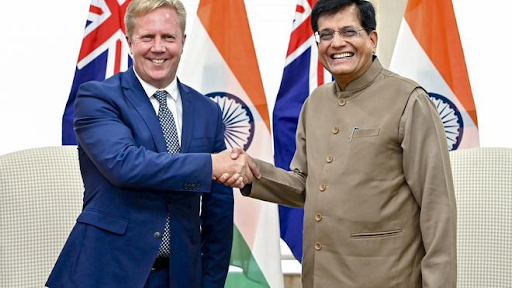
Copyright infringement not intended
Picture Courtesy: THEHINDU
India and New Zealand concluded negotiations for a comprehensive Free Trade Agreement (FTA) in December 2025.
|
Read all about: INDIA-NEW ZEALAND RELATIONS: CHALLENGES AND WAY FORWARD l ABOUT INDIA AND NEW ZEALAND RELATIONS |
An FTA is a pact between two or more countries to reduce or eliminate barriers to trade, such as tariffs (import taxes) and non-tariff barriers (e.g., quotas, complex regulations).
The primary goal is to boost the exchange of goods and services, encourage investment, and promote deeper economic cooperation, creating a predictable and transparent trading environment.
|
Current State of India-New Zealand Bilateral Trade
|
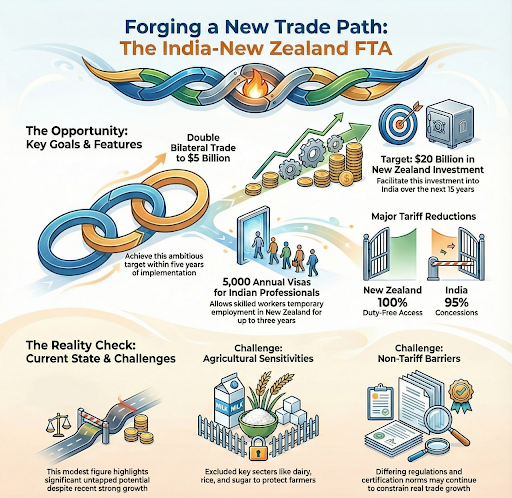
Tariff Liberalisation for India: New Zealand will offer 100% duty-free access to all Indian exports immediately upon the agreement's implementation, eliminating previous tariffs up to 10% on Indian goods like apparel, leather goods, and auto components.
Tariff Liberalisation for New Zealand: India has offered tariff concessions on over 70% of its tariff lines, covering 95% of New Zealand's exports to India. Over 54% of NZ exports will gain immediate duty-free access, increasing to over 80% eventually.
Protection of Sensitive Indian Sectors: India excludes sensitive farm sectors like dairy, rice, wheat, sugar, onions, and edible oils from market access concessions to protect farmer livelihoods.
Mobility for Indian Professionals:
Trade Facilitation: The agreement includes robust provisions on Rules of Origin, customs cooperation, and sanitary and phytosanitary (SPS) measures to reduce procedural delays and ensure smooth trade flows.
Cooperation in Traditional Medicine: For the first time, New Zealand has signed an annex to facilitate trade in Ayurveda, yoga, and other traditional Indian medicine services, promoting India's AYUSH systems globally.
Source: THEHINDU
|
PRACTICE QUESTION Q. Analyse the strategic significance of the recently concluded Free Trade Agreement (FTA) between India and New Zealand for India's Indo-Pacific strategy. 150 words |
The biggest gain is securing 100% duty-free market access for all Indian exports to New Zealand from the first day of the agreement. This is particularly beneficial for labour-intensive sectors like textiles, apparel, and pharmaceuticals.
The dairy sector was a major sticking point, as highly efficient dairy exporter New Zealand clashed with India, the world's largest milk producer with over 80 million dependent rural families. India considered tariff-free access for New Zealand's dairy products a "red line," fearing severe impacts on Indian farmers' livelihoods.
The agreement opens new mobility pathways. It includes a quota of 5,000 temporary employment visas for Indian professionals in high-demand sectors like IT and engineering, and 1,000 work and holiday visas, enhancing people-to-people ties and trade in services.


© 2026 iasgyan. All right reserved