The Indian Prime Minister’s Malaysia visit advanced the Comprehensive Strategic Partnership with UPI-PayNet linkage, Su-30 maintenance deal, and a semiconductor alliance. The visit underlined Malaysia’s role in India’s Act East and Indo-Pacific strategy, shifting relations toward deeper defense, digital, and energy cooperation.
Copyright infringement not intended
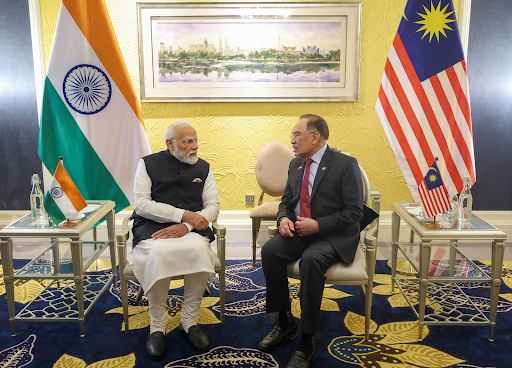
Picture Courtesy: pmindia
Context
The Indian Prime Minister visited Malaysia in February 2026 to operationalize the Comprehensive Strategic Partnership (CSP)
What are the Key Outcomes of the February 2026 Visit?
Digital and Financial Connectivity
Digital Council: Formalised the Malaysia–India Digital Council (MIDC) to boost cooperation in fintech, AI, cybersecurity, e-governance, and Digital Public Infrastructure
Cross-Border Payments: Welcomes the NPCI International Limited (NIPL)–PayNet partnership to facilitate affordable cross-border digital payment.
Local Currency Trade: Agreed to promote local-currency trade settlement (INR–MYR) through collaboration between the Reserve Bank of India and Bank Negara Malaysia.
Strategic Sectoral Cooperation
Energy and Semiconductors: Committed to expand cooperation in renewable energy and green hydrogen,strengthening the semiconductor value chain with a focus on R&D, skills, and supply-chain resilience.
Corruption and Public Administration: Signed an MoU on Combating and Preventing Corruption between India’s Central Bureau of Investigation (CBI) and the Malaysian Anti-Corruption Commission (MACC).
Disaster Management: An MoU was signed for Disaster Management Cooperation between the National Disaster Management Authorities of both countries.
Social Security: Signed an MoU between India’s Employees' State Insurance Corporation (ESIC) and Malaysia’s Social Security Organisation to extend social security coverage to Indian workers in Malaysia.
Diplomatic Presence: India announced the establishment of a new Consulate General in Malaysia to improve consular access and trade facilitation.
Education, Skill Development, and Healthcare
Education Exchange: Agreed to expand student and faculty exchanges under the Malaysia Technical Cooperation Programme (MTCP) and Indian Technical and Economic Cooperation Programme (ITEC).
Vocational Training: Committed to strengthen Technical and Vocational Education and Training (TVET) cooperation to build a skilled workforce and improve employability.
Healthcare and Traditional Medicine: Welcomed the MoU between the Central Council for Research in Homeopathy, India, and the University of Cyberjaya to boost research and training in homeopathy
Cultural and Global Partnerships
Cultural Links: Welcomed the launch of the Thiruvalluvar Chair and Centre at Universiti Malaya to promote Tamil studies, and the Thiruvalluvar Scholarships for Malaysian nationals.
Global Alliances: Malaysia formally joined the International Big Cat Alliance (IBCA).
BRICS and ASEAN: Malaysia welcomed India’s 2026 BRICS Chairmanship and India supported Malaysia’s role as a BRICS Partner Country and its membership aspirations.
Indo-Pacific: Committed to a free, open, and rules-based Indo-Pacific, advancing cooperation between the ASEAN Outlook on the Indo-Pacific (AOIP) and India’s Indo-Pacific Oceans Initiative (IPOI).
Security and Defence
Combating Terrorism: Reaffirmed zero tolerance for terrorism, including cross-border terrorism, and called for sustained international cooperation.
Defence Cooperation: Welcomed India–Malaysia co-chairmanship of the ASEAN Defence Ministers’ Meeting (ADMM)-Plus Expert Working Group Meeting (EWG) for the 2024-2027 term.
India-Malaysia Relations
Civilizational Roots: Ties date back over a millennium to the Chola period, characterized by maritime trade and cultural diffusion across the Indian Ocean.
Modern Diplomacy: Diplomatic relations were formalized in 1957.
Why is Malaysia Important to India?
Geostrategic & Maritime Security
Strait of Malacca: About 60% of India’s trade and energy supplies pass through it, making cooperation essential for maintaining freedom of navigation and a rules-based Indo-Pacific order.
Act East Policy: Malaysia is a central pillar of India's Act East Policy, serving as a gateway for India to expand its influence and connectivity within the ASEAN region.
Defense Cooperation: Both countries conduct regular joint military exercises—Harimau Shakti (Army), Samudra Lakshmana (Navy), and Udara Shakti (Air Force).
Economic & Trade Synergy
Trading Partner
Malaysia is India's 3rd largest trading partner in ASEAN. Bilateral trade reached US$ 19.86 billion in 2024-25. This includes exports worth US$ 7.32 billion and imports worth US$ 12.54 billion. (Sources: IBEF)
Energy & Food Security
Malaysia is a top supplier of palm oil and mineral fuels to India. India is a major exporter of refined petroleum, pharmaceuticals, and meat to Malaysia.
High-Tech Collaboration
In February 2026, major agreements were signed on semiconductors, leveraging Malaysia's testing and assembly expertise to strengthen India's electronics manufacturing.
Financial Integration
Efforts are underway to connect India's UPI with Malaysia's PayNet for seamless digital payments and to boost trade settlement using local currencies (INR and Ringgit), reducing reliance on the US Dollar.
The "Living Bridge" (Diaspora)
Indian Origin Community: Malaysia is home to approximately 2.9 million people of Indian origin, representing the third-largest group and constituting 7% of the Malaysian population.
Cultural Influence: Tamil speakers constitute about 90% of the Indian Malaysian diaspora, maintaining strong cultural bonds, evident in shared Hindu sites like Batu Caves.
Diplomatic & Regional Support
Global Platforms: Malaysia support for India’s permanent membership in a reformed UN Security Council.
BRICS: India, as the 2026 BRICS Chair, supported Malaysia’s role as a BRICS Partner Country and its aspirations for full membership.
What are the Challenges in India-Malaysia Relation?
Geopolitical Divergence
Malaysia, prioritizing its largest trading partnership with China, adopts a cautious stance, especially on the South China Sea. India, with the Quad, pushes for a more assertive "rules-based order."
China Factor
Malaysia's deep integration into China's Belt and Road Initiative (BRI) complicates India's strategic alternative efforts in the Indo-Pacific.
Trade Deficit
India's trade deficit crossed $5.2 billion in FY24, largely due to heavy imports from Malaysia, primarily palm oil, petroleum, and electronics.
Non-Tariff Barriers: Indian exporters, particularly in pharmaceuticals and services, face high compliance costs and regulatory hurdles. Both nations are currently reviewing the ASEAN-India Trade in Goods Agreement (AITIGA) to address these issues.
Extradition of Zakir Naik
Malaysia refuses to extradite controversial preacher Zakir Naik, wanted in India for hate speech and money laundering.
Worker Exploitation
Reports of Indian migrant workers facing harassment and exploitation in Malaysian plantations and construction sectors continue to spark diplomatic tension.
Way Forward for Strengthening Relations
Deepen High-Tech Partnership
Move beyond a transactional relationship to a strategic one by operationalizing the semiconductor corridor and collaborating in AI, cybersecurity, and the digital economy.
Enhance Defence Industry Collaboration
India should position itself as a reliable defence partner for Malaysia, focusing on joint development and exports to build strategic trust and counter external influence.
Boost Connectivity
Improving air and maritime connectivity is essential. Connecting Northeast India, as a gateway to Southeast Asia, with Malaysia to unlock economic potential.
Leverage ASEAN Centrality
India should work closely with Malaysia to strengthen the ASEAN-India Comprehensive Strategic Partnership, aligning India's 'Act East' policy with ASEAN's vision for the Indo-Pacific.
Resolve Trade Imbalances
A swift conclusion of the AITIGA review is necessary to make the trade relationship more balanced and sustainable for both economies.
Conclusion
The India-Malaysia relationship is evolving into a comprehensive strategic partnership, shifting from traditional cooperation to high-tech sectors like semiconductors and the digital economy.
Source: pmindia
|
PRACTICE QUESTION Q. Discuss the strategic significance of Malaysia in India's 'Act East' Policy. 150 words |
The UPI-PayNet linkage allows for seamless, real-time cross-border remittances and payments. It significantly reduces transaction costs for Indian tourists and workers in Malaysia, showcasing the global scalability of India’s Digital Public Infrastructure (DPI).
India is shifting from a defense importer to a service provider. A key development is the agreement for Hindustan Aeronautics Limited (HAL) to provide Maintenance, Repair, and Overhaul (MRO) services for Malaysia's Su-30 fighter jet fleet via its Kuala Lumpur office.
It is a Memorandum of Cooperation (MoC) that links Malaysia’s established semiconductor packaging and testing ecosystem with India’s emerging fabrication facilities. This aims to create a resilient supply chain ("friend-shoring") against global disruptions.


© 2026 iasgyan. All right reserved