A 90-million-year-old fossil of Alnashetri cerropoliciensis found in Patagonia clarifies the evolution of alvarezsaurs. It shows they were widespread across Pangaea before continental drift and reveals that body miniaturization occurred before the development of specialized insect-eating adaptations.
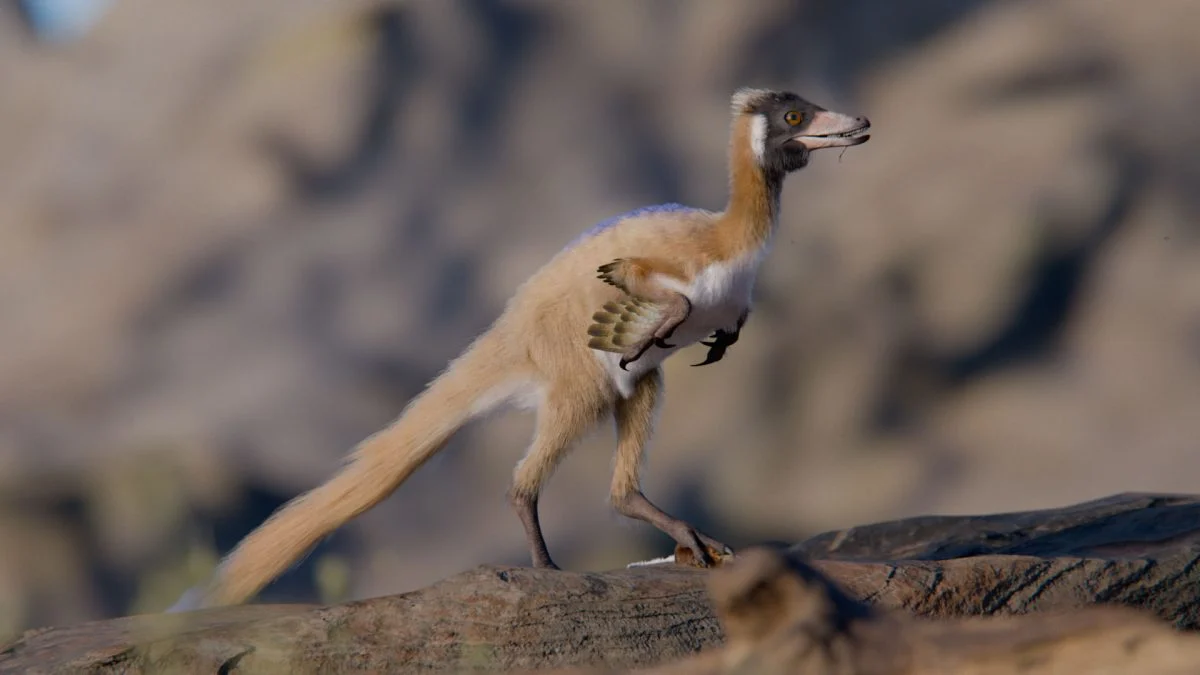
Copyright infringement not intended
Picture Courtesy: SCITECHDAILY
Context
Scientists announced the discovery of a nearly complete 90-million-year-old fossil of a tiny dinosaur named Alnashetri cerropoliciensis in the Patagonia region of Argentina.
What is Alnashetri cerropoliciensis?
Alnashetri cerropoliciensis is a genus of small, bird-like alvarezsauroid theropod dinosaur that lived during the early Late Cretaceous period (approximately 90 to 95 million years ago) in what is now Patagonia, Argentina.
Key Characteristics
Miniature Size
It is one of the smallest non-avian dinosaurs ever discovered in South America, weighing less than 1 kg.
Anatomy
Unlike later members of its group (alvarezsaurs) which had stubby arms for digging, Alnashetri possessed longer, well-developed arms and larger teeth, suggesting it had not yet adapted for a specialized diet of ants and termites.
Diet
It was a small predator that likely hunted insects and tiny vertebrates like lizards, snakes, and early mammals in a desert environment.
Recent Discovery
Location: Found at the La Buitrera fossil area in northern Patagonia, a site known for preserving delicate Cretaceous vertebrates like primitive snakes and small mammals.
Naming: The genus name Alnashetri comes from the Tehuelche language meaning "slender thighs," referring to its long, thin legs. The species name cerropoliciensis honors the nearby village of Cerro Policía.
Specimen: Histological analysis of the "Alna" specimen revealed it was a female adult about four years old when it died.
Source: SCITECHDAILY
|
PRACTICE QUESTION Q. With reference to the recently discovered dinosaur Alnashetri cerropoliciensis, consider the following statements: 1. It was a giant herbivore that lived during the Jurassic period. 2. It belongs to the Alvarezsaur group, known for their unique evolutionary transition toward miniaturization. 3. The fossil was discovered in the Patagonia region of Argentina. Which of the statements given above is/are correct? (a) 1 and 2 only (b) 2 and 3 only (c) 3 only (d) 1, 2, and 3 Answer: b Explanation: Statement 1 is incorrect: Alnashetri was not a giant; it was tiny (roughly the size of a chicken or crow, weighing less than 1 kg). It was also a predator (carnivore), not a herbivore, likely preying on small animals or invertebrates. Statement 2 is correct: Alnashetri cerropoliciensis is a member of the Alvarezsaur group. This clade is scientifically significant for its miniaturization, evolving from larger ancestors into some of the smallest non-avian dinosaurs known. Statement 3 is correct: The fossil remains were unearthed at the La Buitrera site in the Patagonia region of Argentina. |
Alnashetri cerropoliciensis is a species of a tiny, bird-like dinosaur that lived about 90 million years ago. Its nearly complete fossil, found in Patagonia, Argentina, has provided crucial insights into the evolution of a group of dinosaurs called alvarezsaurs.
It is called a "Rosetta Stone" because its near-complete and well-preserved skeleton provides a key reference point. It helps scientists correctly interpret previously found fragmentary fossils and understand the complete evolutionary history and distribution of alvarezsaurs.
The fossil shows that Alnashetri was very small but had less specialized features (like longer arms) than its later relatives. This indicates that the evolutionary trend of miniaturization (shrinking in size) happened before the development of specialized traits for eating insects.



© 2026 iasgyan. All right reserved