The Climate TRACE 2025 report shows global emissions reached a record 60.63 BtCO₂e, mainly from fossil fuels and methane. Power-sector emissions slightly declined. India recorded the largest reduction among major economies, reflecting renewable expansion and partial decoupling of economic growth from power-sector emissions.
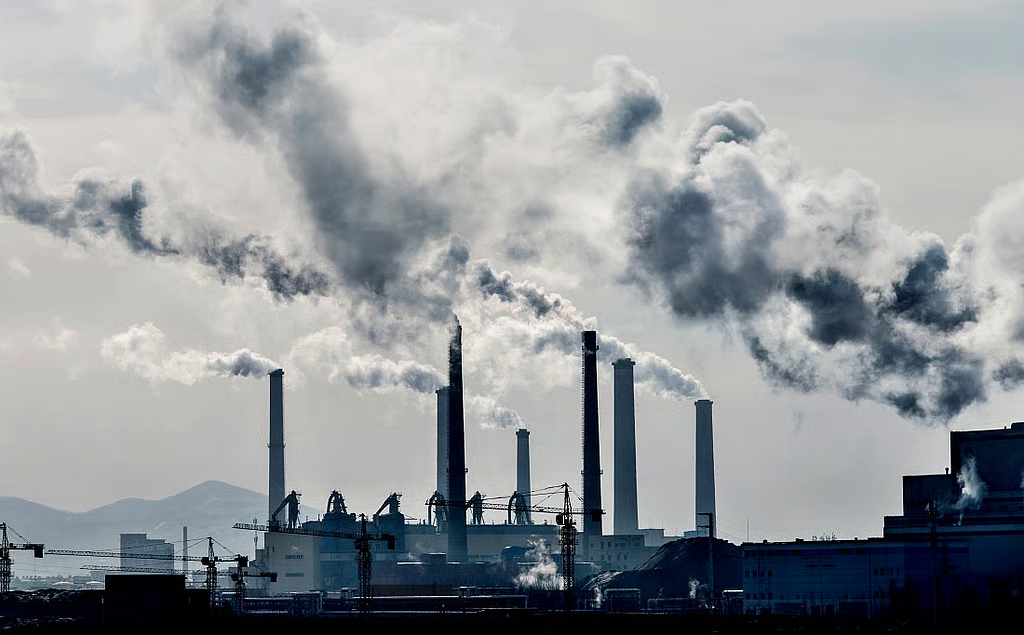
Copyright infringement not intended
Picture Courtesy: DOWNTOEARTH
Context
A recent report by Climate TRACE, an independent emissions monitoring group, reveals that global greenhouse gas (GHG) emissions reached a record high of 60.63 billion tonnes of CO2 equivalent (BtCO2e) in 2025.
What are the Key Findings of the Report?
Record-High Emissions
Global GHG emissions peaked in 2025, with nearly every month showing higher emissions than the corresponding month in the previous year.
Primary Drivers
The increase was primarily driven by sectors like fossil fuel operations (up by 1.56%), transportation, and manufacturing. Emissions from oil and gas production alone jumped by 4.1%.
Resurgence of Methane (CH4)
After a brief decline, global methane emissions grew by 1.03% to a new record of 412.59 million tonnes (Mt). Methane is a potent GHG responsible for about 30% of the rise in global temperatures since the industrial era. (Source: IEA)
A Silver Lining in the Power Sector
In a positive development, emissions from the global power sector, the largest single source of GHGs (26%), saw a slight decrease of 0.13%. This is the first such decline since the COVID-19 pandemic.
Emission Trends by Major Economies
|
Country |
Emission Trend in 2025 |
Key Drivers |
|
India |
Largest decrease among major nations, with a drop of 27.5 Mt (0.65%). |
A 2.6% fall in power sector emissions, driven by a rapid expansion of renewable energy capacity. |
|
Russia |
Steepest increase in emissions, rising by 51.6 Mt (1.64%). |
Expansion of oil and gas production and related activities. |
|
China |
Emissions growth slowed to just 0.28%, the lowest since 2015. |
Record installation of clean energy (300 GW solar, 100 GW wind), causing a 0.4% drop in power sector emissions. |
|
USA |
Emissions remained relatively flat with a minor increase of 0.23%. |
Mixed trends across different sectors. |
What are the Implications of the rising GHG emissions?
Economic Vulnerability for India
Climate change jeopardizes agriculture, damages infrastructure, and poses public health risks, necessitating trillions of dollars in investment for a low-carbon economy transition by 2050.
Geopolitical Pressures
Diverging emission trends are creating new friction points in global trade. Measures like the EU's Carbon Border Adjustment Mechanism (CBAM) can impact the export competitiveness of nations like India if their manufacturing sectors are deemed too carbon-intensive.
Influence on Climate Negotiations
Data Crucial for the Global Stocktake under the Paris Agreement and will increase pressure on high-emitting nations to strengthen their Nationally Determined Contributions (NDCs) at forums like the upcoming COP31.
India's Climate Action & Commitments
Updated Nationally Determined Contributions (NDCs)
In 2022, India committed to:
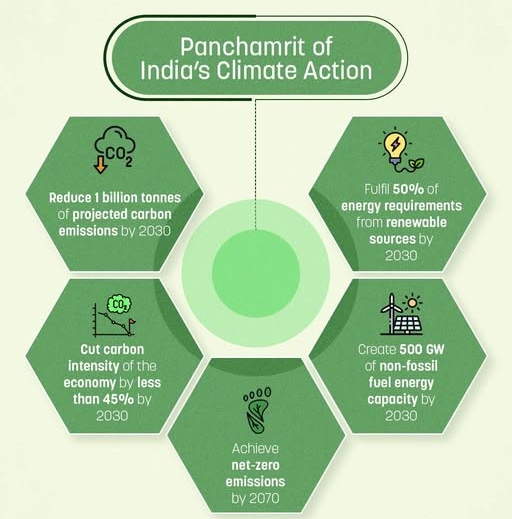
Panchamrit and Net Zero Goal
At COP26, India announced its "Panchamrit" (five nectars) strategy, which includes the ambitious target of achieving Net Zero emissions by 2070.
Way Forward
Accelerate the Energy Transition
Governments must create enabling policies and de-risk investments to rapidly scale up renewable energy deployment globally.
Tackle Methane Emissions
Immediate action is needed to plug methane leaks from fossil fuel infrastructure, which can provide significant near-term climate benefits at a low cost.
Strengthen International Cooperation
Developed nations must fulfill their financial commitments to support developing countries. Technology transfer and capacity building are crucial for a just global transition.
Enhance Ambition
All major emitters must submit stronger, more ambitious NDCs backed by concrete implementation plans to translate goals into tangible emission reductions.
Learn from Global Best Practices
Carbon Pricing
The EU's Emissions Trading System (ETS) is a 'cap and trade' system that limits emissions and creates a carbon allowance market, making pollution costly and encouraging reduction.
Green Hydrogen
Produced with renewable energy, green hydrogen can decarbonize tough sectors like heavy industry and transport. The National Green Hydrogen Mission aims to establish the country as a global production hub.
Carbon Capture, Utilization, and Storage (CCUS)
These technologies capture industrial CO2 for underground storage or conversion. CCUS is essential for deep decarbonization in sectors such as cement and steel.
Conclusion
The Climate TRACE report is a critical wake-up call, highlighting alarming record emissions and the insufficient pace of change to meet the 1.5°C target, despite viable progress in the power sectors of India and China.
Source: DOWNTOEARTH
|
PRACTICE QUESTION Q. Regarding India’s National Action Plan on Climate Change (NAPCC), which of the following is NOT one of the eight core missions? A. National Solar Mission B. National Mission for Green India C. National Mission on Sustainable Agriculture D. National Mission on Waste-to-Energy Answer: D Explanation: India’s National Action Plan on Climate Change (NAPCC), launched in 2008, consists of eight core national missions aimed at mitigation and adaptation. While waste management (including waste-to-energy) is a component under the National Mission on Sustainable Habitat, there is no standalone "National Mission on Waste-to-Energy" among the eight core missions. |
The report's main finding is that global greenhouse gas (GHG) emissions reached an all-time high of 60.63 billion tonnes of CO2 equivalent in 2025, indicating that the world is not on track to meet its climate targets.
India's emissions decreased by 0.65%, the largest drop among major countries, primarily due to a 2.6% fall in its power sector emissions. This was achieved through a rapid expansion of renewable energy capacity, which was sufficient to meet the rise in electricity demand, allowing for a reduction in coal-fired power generation.
The report highlights a 1.03% resurgence in global methane emissions. A significant contributor is the fossil fuel operations sector, including emissions from oil and gas production and methane released from abandoned oil wells and coal mines.



© 2026 iasgyan. All right reserved