The GRAPES-3 experiment in Ooty operates the world's largest muon telescope to study cosmic rays, thunderstorms, and solar storms. By tracking galactic particles, it successfully recorded a crack in Earth's magnetic shield and serves as a vital early warning system for space weather.
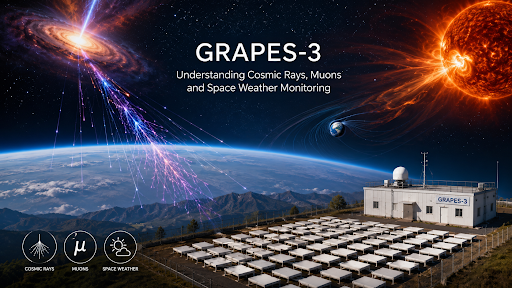
The GRAPES-3 observatory in Ooty currently undergoes a massive capacity expansion by repurposing recycled iron pipes from the decommissioned Kolar Gold Field (KGF).
Full Form: The acronym stands for Gamma Ray Astronomy PeV EnergieS Phase-3.
Location: The facility operates at an altitude of 2,200 meters above mean sea level at the Cosmic Ray Laboratory in Ootacamund (Ooty), Tamil Nadu.
Scientific Collaboration: The observatory functions as a premier international partnership between India’s Tata Institute of Fundamental Research (TIFR) and Japanese institutions, including Osaka City University and Nagoya Women's University.
Cosmic Rays and Muons
Cosmic Ray Origins: Primary cosmic rays originate from extreme astrophysical phenomena, including supernovas, active galactic nuclei, and the solar corona.
Atmospheric Interaction: Primary cosmic rays bombard nitrogen and oxygen molecules in the upper atmosphere, triggering a cascading effect known as an extensive air shower.
Muon Characteristics: Muons act as short-lived elementary particles generated during the decay of pions and kaons. Because they penetrate deep into the Earth's surface, GeV (Giga-electron volt) muons serve as ideal proxies for studying near-earth phenomena like thunderstorms and solar events.
Operational Infrastructure
Muon Detection System: The facility houses the world’s largest 560 m² tracking muon telescope, which records approximately four billion muons above 1 GeV daily.
Sustainable Innovation: Scientists actively refurbish over 7,500 iron proportional counters retrieved from the 2,300-meter-deep Kolar Gold Field to double the telescope's surface area.
Air Shower Array: The system utilizes 400 plastic scintillator detectors spread across a 25,000 m² area to record the density and arrival time of charged particles.
Computing Power: An in-house 1280-core computing farm processes massive influxes of raw data to trace cosmic ray intensity variations back to specific solar or galactic triggers.
Scientific and Strategic Importance
Space Weather Forecasting: The observatory predicts the propagation of Coronal Mass Ejections (CMEs) from the Sun’s L1 point (1.5 million kilometers away) to their impact point on Earth.
Magnetic Shield Monitoring: GRAPES-3 detected a 20 GeV galactic cosmic ray burst, proving that a solar plasma cloud compressed Earth’s magnetosphere from 11 to 4 Earth radii, creating a temporary "crack" in the magnetic shield.
Infrastructure Protection: The system provides early warnings to safeguard low-earth orbit (LEO) satellite constellations, Global Positioning Systems (GPS), and global electrical power grids from radiation-induced blackouts and power surges.
Atmospheric Research: GRAPES-3 utilizes muon imaging to measure the electrical potential of thunderclouds, recording potentials as high as 1.3 billion volts.
Source: RESEARCHMATTERS
|
PRACTICE QUESTION Consider the following statements regarding the GRAPES-3 Experiment:
Which of the statements given above are correct? A) 1 and 2 only B) 2 and 3 only C) 1 and 3 only D) 1, 2, and 3 Answer: B Explanation: Statement 1 is incorrect: The GRAPES-3 (Gamma Ray Astronomy at Pev EnergieS) experiment is a ground-based observatory located in Ooty, India, designed to study cosmic rays and solar/thunderstorm phenomena. It is not placed at the Lagrange Point 1 (L1). The space-based solar observatory positioned at L1 to study coronal mass ejections is India's Aditya-L1 mission. Statement 2 is correct: GRAPES-3 is an collaborative international project operated by the Indian Tata Institute of Fundamental Research (TIFR) in partnership with Japanese universities (such as Osaka City University). Statement 3 is correct: The facility in Ooty houses the world's largest tracking muon telescope. To upgrade and double its detecting capacity, researchers repurposed and recycled materials (like iron tubes) from the decommissioned Kolar Gold Field (KGF) experiments. |
GRAPES-3 (Gamma Ray Astronomy at PeV EnergieS - Phase 3) is a high-density cosmic ray observatory in Ooty, Tamil Nadu, operated by India's Tata Institute of Fundamental Research (TIFR) in collaboration with Japan to study particle acceleration using an advanced tracking muon telescope.
Cosmic rays are the universe's most energetic, high-speed subatomic particles—mostly protons—that travel through space at nearly the speed of light after being violently expelled by supernovas and black holes.
Muons are heavy, fast-moving secondary subatomic particles raining down to Earth, generated instantly when incoming primary cosmic rays collide with oxygen and nitrogen molecules in our upper atmosphere.
Monitoring space weather is critical to safeguard modern technological infrastructure by providing advance warnings before intense solar flares and geomagnetic storms corrupt global communication satellites, scramble GPS tracking, and destroy ground-level electrical power grids.




© 2026 iasgyan. All right reserved