A Glacial Lake Outburst Flood (GLOF) occurs when unstable moraine dams burst, releasing massive floodwaters downstream. Triggered by climate change, earthquakes, and cloudbursts, GLOFs severely threaten the Indian Himalayas. Effective mitigation demands robust hazard mapping, remote sensing, and community-based Early Warning Systems.
Why In News?
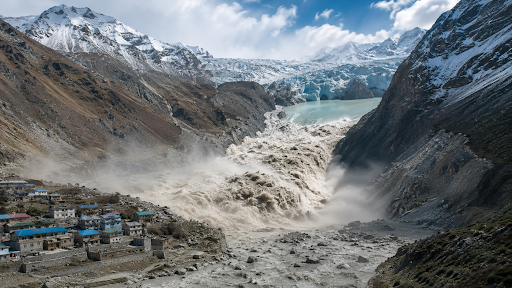
Kashmir's melting glaciers are rapidly expanding high-altitude lakes, creating a severe Glacial Lake Outburst Flood (GLOF) hazard that directly threatens unmapped, unwarned downstream villages.
What is a GLOF?
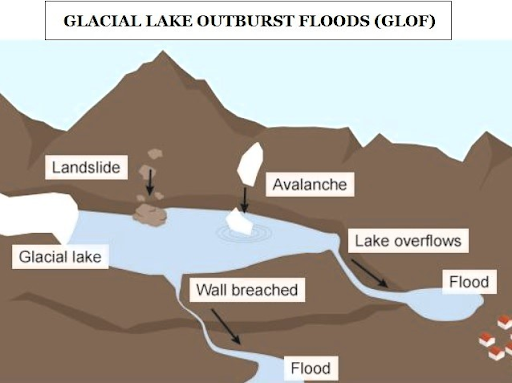
A Glacial Lake Outburst Flood (GLOF) is a catastrophic outburst flood that occurs when a dam containing a glacial lake completely fails.
This sudden phenomenon releases massive volumes of water dammed by either a glacier front (marginal lake) or a moraine.
Experts also label sub-glacial lake bursts as jökulhlaups, an Icelandic term describing abrupt sub-glacial water releases.
Formation of Glacial Lakes
Mechanism of Outburst Floods
Causes of GLOFs
Rapid Glacier Retreat: Climate change drives glacier shrinkage in the Hindu Kush Himalaya. With 89% of years showing a negative mass balance, glacial lakes are growing to dangerous sizes.
Moraine Dam Failure: Unstable dams made of loose debris collapse due to erosion, water pressure, or internal ice melt.
Earthquakes and Landslides: Seismic activity fragments moraines, while rock avalanches displace water, triggering instant outbursts.
Extreme Rainfall Events: Intense cloudbursts and heavy rains rapidly overfill lakes, causing overtopping and violent floods.
Impact of GLOFs
Casualties and Property Damage
GLOFs devastate downstream areas, causing heavy fatalities and injuries. For instance, the October 2023 Sikkim disaster killed 178 people and razed thousands of homes.
Infrastructure Destruction
Violent floods carry ice and boulders that crush bridges, roads, and hydropower plants. These outbursts sever vital communication and transport links, hindering rescue efforts.
Agricultural Impact
Inundation ruins cropland, orchards, and livestock in downstream valleys, leading to severe food shortages and the loss of essential agricultural assets.
Ecosystem Disruption
Extreme floodwaters cause geomorphological hazards by reshaping valleys and riverbeds. These torrents permanently damage local ecosystems, burying habitats under massive debris.
Government Initiatives
National Disaster Management Authority (NDMA)
Glacier Monitoring Programmes
Early Warning Systems
Mitigation Measures
Remote Sensing and Satellite Monitoring
Community-Based Warning Systems
Hazard Mapping
Conclusion
Implementing robust Early Warning Systems and localized hazard mapping is essential to mitigate the impacts of Glacial Lake Outburst Floods amid escalating climate change in the fragile Himalayas.
Source: DOWNTOEARTH
|
PRACTICE QUESTION Q. Which of the following factors contribute to the triggering of a Glacial Lake Outburst Flood (GLOF)?
Select the correct code: A) 1 and 2 only B) 2 and 3 only C) 1 and 3 only D) 1, 2, and 3 Answer: D Explanation: Statement 1 is correct: As global temperatures rise, glaciers melt and recede. This meltwater accumulates behind weak, natural dams formed by moraines (glacial debris). The growing water volume puts immense hydrostatic pressure on the dam, driving it closer to a structural breach. Statement 2 is correct: Earthquakes and seismic activity shake the fragile high-altitude landscape. This vibration directly fractures or destabilizes the loosely packed, unconsolidated sediment walls of a moraine dam, leading to its sudden failure. Statement 3 is correct: Rapid cloudbursts bring intense, heavy rainfall over a short period. This suddenly floods the lake with excess water, creating massive displacement waves or causing water to overtop and erode the dam structure instantly. |
A Glacial Lake Outburst Flood occurs when an unstable natural dam containing a high-altitude glacial lake suddenly breaches or collapses, releasing catastrophic volumes of water and debris downstream.
Accelerated global warming is rapidly melting Himalayan glaciers, causing proglacial lakes to expand exponentially while destabilizing the surrounding moraine dams.
The high-altitude border states of Sikkim, Uttarakhand, Himachal Pradesh, and the Union Territory of Jammu & Kashmir face the highest risk of devastating glacial flood waves.
Disaster authorities can mitigate risks by installing automated early warning siphons, pipe-draining water out of expanding lakes, and strictly banning heavy infrastructure development in vulnerable downstream valleys.

© 2026 iasgyan. All right reserved