Following the success of 'Operation Antim Prahar', Gadchiroli was declared Naxal-free. Consequently, the MHA announced zero Indian districts remain LWE-affected, shifting the nation's focus toward socio-economic development and preventing insurgent resurgence in "Legacy and Thrust" areas.
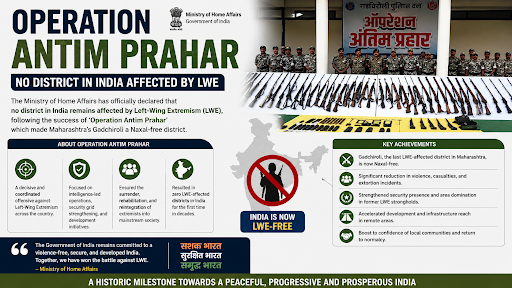
The Ministry of Home Affairs declared that no district in India remains affected by Left-Wing Extremism (LWE), following the success of 'Operation Antim Prahar'.
|
Read all about: NAXALISM: INTERNAL SECURITY CHALLENGE l END OF THE RED CORRIDOR l LEFT-WING EXTREMISM INDIA EXPLAINED l COUNTERING EXTREMISM IN INDIA |
Operation Antim Prahar was an anti-Naxal drive conducted in Maharashtra to eliminate the final remnants of armed insurgency in the region.
The Gadchiroli Police's Special Campaign Squad and the Central Reserve Police Force (CRPF) jointly execute the operation.
Following the operation, the police administration declares Gadchiroli district as “Naxal-free,” noting that no Maoists remain on the official “wanted” list.
The reduction in Left-Wing Extremism (LWE) results from a multi-pronged government strategy that integrates aggressive security measures with pro-people development.
Source: NEWSONAIR
|
PRACTICE QUESTION Q. Consider the following statements about 'Operation Antim Prahar':
Which of the statements given above is/are correct? A) 1 only B) 2 only C) Both 1 and 2 D) Neither 1 nor 2 Answer: C Explanation: Statement 1 is correct: 'Operation Antim Prahar' was an intense anti-insurgency campaign jointly executed by the Gadchiroli Police (including its specialized C-60 commando unit) and the Central Reserve Police Force (CRPF). The operation targeted the remaining active armed Maoist cadres operating along the borders and forest areas. Statement 2 is correct: Following the decisive success of this 100-hour crackdown—which resulted in the arrest of eight active Maoists and the surrender of five senior cadres—no active Maoists were left on the district's official "wanted" list. Consequently, the police administration officially declared Gadchiroli a "Naxal-free" district. |
It was a definitive, intelligence-backed joint security operation executed by the Gadchiroli Police, C-60 commandos, and the CRPF to neutralize the last remaining active armed Maoist cells in the region.
According to a recent assessment by the Ministry of Home Affairs (MHA), no district in India currently falls under the LWE-affected category.
The Maoist insurgency was heavily fueled by deep-seated socio-economic grievances, including widespread poverty, severe malnutrition, inadequate healthcare infrastructure, and the social marginalization of tribal communities.

© 2026 iasgyan. All right reserved