The Union Home Minister declared India Naxal-free, shifting the focus from military operations to tribal reconciliation and inclusive development in former extremist strongholds.
|
Read all about: BILL ON URBAN NAXALISM l NAXALISM: INTERNAL SECURITY CHALLENGE l URBAN NAXALISM l BILL ON URBAN NAXALISM |
Left-Wing Extremism (LWE), popularly known as Naxalism, refers to armed insurgent movements that adhere to the Maoist ideology.
Origin: The movement traces its roots to a peasant uprising in 1967 in Naxalbari, West Bengal, led by Charu Majumdar and Kanu Sanyal.
Ideology: It rejects parliamentary democracy and uses violence as the primary weapon to target the "state machinery," including police, railways, and government infrastructure.
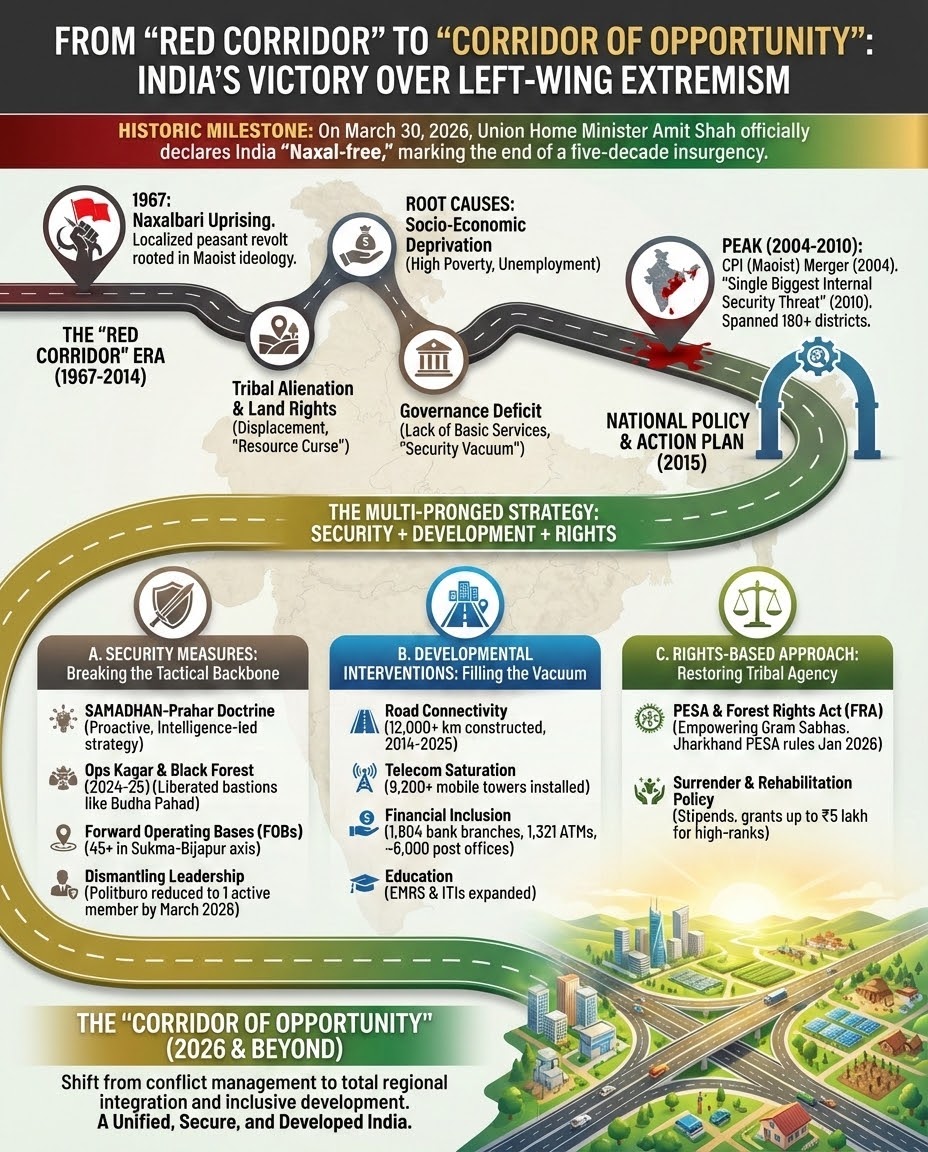
The "Red Corridor": Historically, the affected area was known as the Red Corridor, spanning states like Chhattisgarh, Jharkhand, Odisha, and Bihar. However, the geographical spread has shrunk in recent years.
Current Status (2025-26)
The number of LWE-affected districts has reduced from 126 in 2013 to 38 in 2024, and further to just 2 in 2026. (Source: PIB)
Violent incidents have dropped by 77% and deaths of security forces have reduced by 85% between 2010 and 2024. (Source: Ministry of Home Affairs)
 What are the Core Causes of Left-Wing Extremism?
Land and Agriculture
Evasion of Land Ceilings: In many LWE-affected states, land reforms were poorly implemented. Landlords evaded land ceiling laws, leaving the landless peasantry without legal rights to the soil they tilled.
Encroachment on Common Property: Loss of traditional rights over "Jal, Jungle, Zameen" (Water, Forest, Land) due to encroachment on Common Property Resources (CPR) has been a major grievance for tribal populations.
Displacement and Forced Eviction
Development vs Displacement: Large-scale displacement of tribal communities for mining, irrigation, and industrial projects without proper rehabilitation has created a "trust deficit" between the tribals and the State.
Forest Rights Issues: Delays in the implementation of the Forest Rights Act (FRA), 2006, led to the rejection of legitimate tribal claims over forest lands, making them vulnerable to Maoist propaganda.
Governance Deficit
The "Vacuum" Theory: The MHA has noted that LWE thrives in areas where there is a "governance vacuum"—a lack of schools, roads, hospitals, and police stations. Maoists step in to fill this gap, setting up their own parallel administration or "Janatana Sarkar".
Incompetent Administration: Corruption and apathy among local administration in remote tribal belts have historically alienated the local population, pushing them towards extremism for "quick justice".
Socio-Economic Deprivation
Poverty and Unemployment: The "Red Corridor" districts consistently rank lowest on the Human Development Index (HDI). The lack of livelihood opportunities for the youth makes them easy recruits for insurgent cadres.
Social Exclusion: Caste-based discrimination and the marginalization of Adivasis are potent tools used by LWE groups to mobilize support against the "establishment".
Operational Doctrine: SAMADHAN (2017)
To give a sharper focus to the anti-LWE strategy, the Ministry of Home Affairs (MHA) introduced the SAMADHAN doctrine, which serves as the operational blueprint for security forces and administration.
The Three-Pillar Strategy
The government's approach is often summarized as "Clear, Hold, and Build":
Security Related Measures
Deployment of Forces: Massive deployment of Central Armed Police Forces (CAPFs) like CRPF’s CoBRA (Commando Battalion for Resolute Action) alongside state police forces (e.g., Greyhounds in Telangana, District Reserve Guard in Chhattisgarh).
Filling the Security Vacuum: Establishment of Forward Operating Bases (FOBs) in core insurgent areas (e.g., Abujhmaad, Chhattisgarh) to cut off supply lines.
Fortified Police Stations (FPS): The Centre funds the construction of fortified police stations to withstand attacks.
Choking Finances: A dedicated vertical in the National Investigation Agency (NIA) and the Enforcement Directorate (ED) targets the funding ecosystem of LWE groups, seizing assets and freezing accounts.
Developmental Interventions
Infrastructure Connectivity
Special Central Assistance (SCA): Funds are provided to the most LWE-affected districts to fill gaps in public infrastructure like schools and health centers.
Aspirational Districts Programme: Launched by NITI Aayog, this focuses on rapidly transforming 112 under-developed districts (many LWE-affected) by monitoring real-time progress in health, education, and agriculture.
Ensuring Rights & Entitlements
Surrender-cum-Rehabilitation Policy: State governments, supported by the Centre, offer attractive financial packages, vocational training, and housing to surrendered cadres to integrate them into the mainstream.
Civic Action Programme (CAP): Security forces conduct medical camps, distribute essential goods, and organize sports events to bridge the "trust deficit" between the state and tribal populations.
"Security Vacuum" Risk
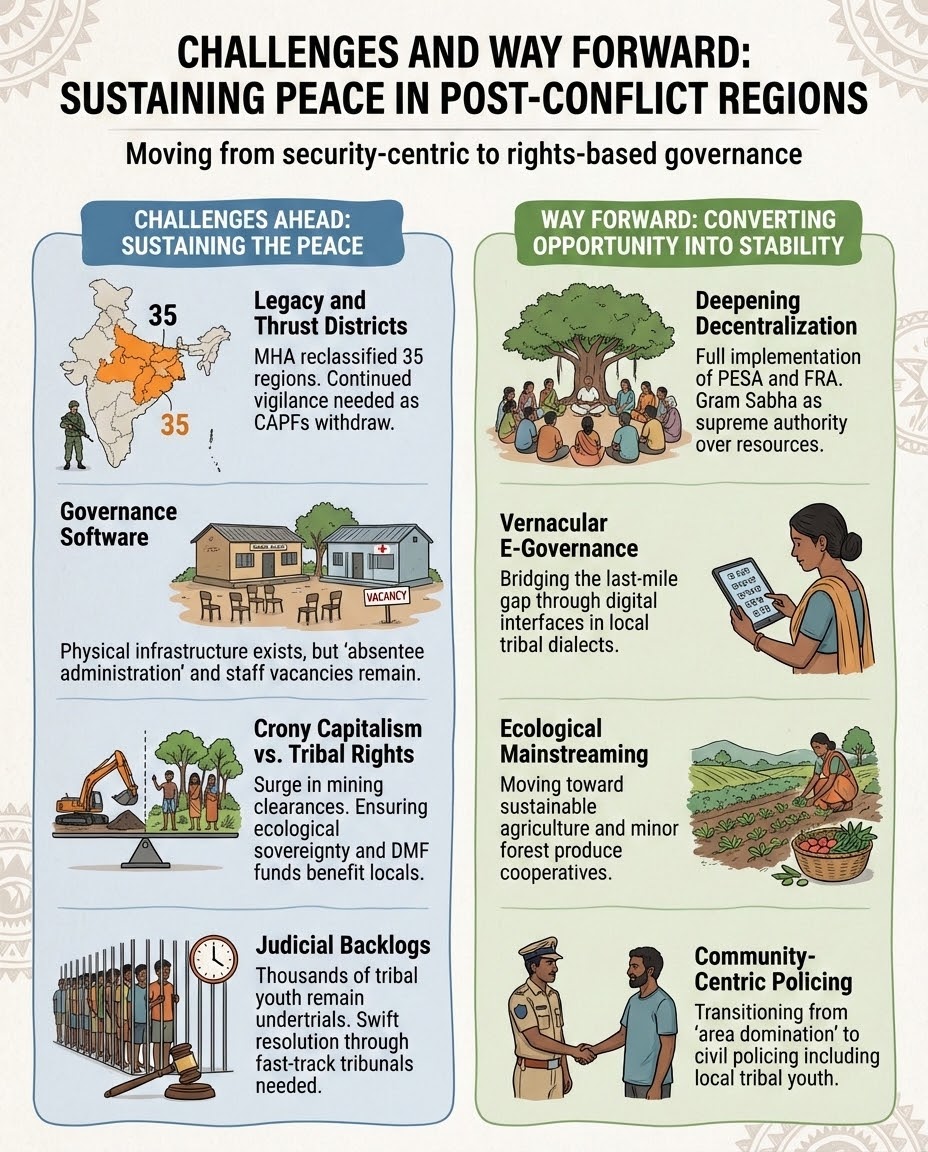
Transition Gaps: When CAPFs withdraw, a security vacuum may emerge, enabling insurgents or criminal gangs to re-occupy areas if local state police capabilities are insufficient.
Asymmetric Warfare (IEDs): Maoists, unable to fight direct battles, have shifted to asymmetric warfare using Improvised Explosive Devices (IEDs) as a 'force multiplier'.
"Absentee Administration" Syndrome
Hardware vs Software: Government infrastructure built in LWE-affected districts are often ineffective because staff (doctors, teachers, and block officers) are chronically absent due to fear of violence.
Last-Mile Exclusion: In newly liberated zones, essential services like the Public Distribution System (PDS) and banking often fail to reach the "last mile" due to connectivity issues, forcing tribals to rely on money lenders.
Morphing into Organized Crime
The Mafia Transformation: Splinter groups in Jharkhand and Chhattisgarh are shifting from Maoist ideology to organized crime, focusing on extortion from mining and local contractors.
Urban & Ideological Fronts
The MHA flags "Urban Naxals" as persistent city-based overground networks providing legal and logistical aid to sustain the LWE ideology amid the armed movement's collapse.
 Way Forward
Strengthen Governance & Rights
Strict Implementation of PESA: The most effective weapon against Maoist propaganda is the empowerment of Gram Sabhas under the PESA Act (1996).
Forest Rights Act (FRA) Saturation: The state must prioritize clearing pending land title claims under the FRA, 2006. Rejection of legitimate claims creates fertile ground for insurgent recruitment.
Security Strategy 2.0
The "Greyhounds" Model: All affected states must replicate the Andhra Pradesh/Telangana "Greyhounds" model—creating elite, localized special forces that know the terrain and culture better than the insurgents.
Choking Finances: The National Investigation Agency (NIA) must continue its crackdown on the "urban-forest" financial nexus, seizing assets created from extortion proceeds to bankrupt the movement.
Ensure Good Governance
Universal Coverage: Focus must be on 100% saturation of welfare schemes—Aadhaar, Jan Dhan, Ayushman Bharat, and Eklavya Schools—in the "Districts of Concern." This effectively ends the "governance deficit".
Infrastructure Maintenance: Building roads is not enough; maintaining them is key. The Road Connectivity Project for LWE Areas (RCPLWE) must ensure that roads built remain motorable to prevent re-isolation of villages.
Rehabilitation & Perception Management
Beyond Cash Surrenders: The Surrender-cum-Rehabilitation Policy must offer long-term livelihood tracking to prevent "recidivism" (returning to violence). Vocational training in ITIs must be linked to guaranteed jobs.
Counter-Narrative: Use community radio and local dialects to broadcast success stories of development, directly countering the insurgents' "anti-state" propaganda.
Conclusion
Lasting peace requires a transition from security-led operations to rights-based governance, focusing on the saturation of development schemes, strict implementation of the Forest Rights Act, and the empowerment of Gram Sabhas to permanently eliminate the socio-economic alienation that fuels insurgency
Source: THE HINDU
|
PRACTICE QUESTION Q. The operational success against Left-Wing Extremism is a milestone, but the battle for the 'hearts and minds' of the tribal population is far from over. Discuss. 150 words |
As of 2026, the Indian government has officially declared the country "Naxal-free." The heavily affected "Red Corridor" has drastically contracted from over 200 districts in 2005 to just two districts: Bijapur in Chhattisgarh and West Singhbhum in Jharkhand.
The insurgency thrived on systemic socio-economic failures. These included extreme poverty, historical marginalization of tribal populations, land alienation by extractive industries without adequate compensation, and a massive governance vacuum in remote forest terrains.
Launched in 2017 by the Ministry of Home Affairs, Operation SAMADHAN is a comprehensive counter-insurgency doctrine. It stands for Smart Leadership, Aggressive Strategy, Motivation, Actionable Intelligence, and Harnessing Technology, a framework that successfully dismantled the Maoist military core.
© 2026 iasgyan. All right reserved