Adolescent malnutrition in India presents a "double burden" of persistent stunting alongside rising obesity and metabolic risks. Addressing this requires transforming schools into health hubs via improved PM POSHAN meals, strict junk-food regulations, community participation, and localized nutritional education programs.
Why In News?
Recent findings from the National Family Health Survey-6 (NFHS-6) highlight a severe dual crisis of rising adult obesity and persistent adolescent stunting.
What is Adolescent Malnutrition?
Growth Deficit: Malnutrition during the transient phase of 10-19 years alters physical, psychological, and cognitive development, stunting future human capital.
Undernutrition: It manifests primarily as stunting (Height-for-age Z score < -2 SD) and thinness (BMI-for-age Z score < -2 SD).
Micronutrient Deficiencies: Adolescents suffer from acute deficiencies in iron, folic acid, vitamin B12, and vitamin A, which heavily impact work capacity and immunity.
Hidden Hunger: Individuals consume sufficient calories but fail to ingest essential vitamins and minerals, a gap often exacerbated by cereal-heavy diets lacking protein.
Overnutrition: An increasing dependency on sugary drinks and fast foods drives an epidemic of early-onset Type 2 diabetes, hypertension, and cardiovascular diseases.
Why is Adolescence a Critical Stage?
Rapid Physical Growth: During this phase, individuals achieve 45% of potential skeletal growth, 15-25% of adult height gain, and 37% of total bone mass accumulation.
Cognitive Development: Adequate nutrition forms the bedrock for rapid neurological maturation, directly influencing school performance and retention.
Future Human Capital: Undernutrition impairs adult work capacity and economic productivity, perpetuating the intergenerational cycle of poverty.
Intergenerational Health: For adolescent girls, iron deficiency anemia directly leads to perinatal loss, prematurity, and low birth weight in future pregnancies.
Status of Adolescent Nutrition in India
Anaemia Burden: 59.1% of adolescent girls (15-19 years) and 31.1% of adolescent boys suffer from anaemia.
Stunting and Underweight: Approximately 27.4% of Indian adolescents are stunted, and 24.4% face severe thinness.
Gender Dimensions: Stunting levels remain higher in girls and late adolescents, whereas thinness disproportionately affects boys and early adolescents.
Geographic and Social Disparities: Adolescents from the lowest wealth index families, rural residences, and marginalized communities (Scheduled Castes and Tribes) display higher odds of stunting and thinness.
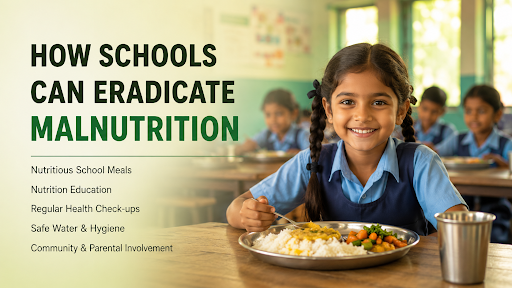
How Schools Can Address Malnutrition?
Improved PM POSHAN Meals: Schools transition from cereal-heavy plates to balanced diets incorporating protective foods like milk, dairy, and animal proteins.
Healthier School Canteens: CBSE guidelines mandate that schools eliminate the sale of High Fat, Sugar, and Salt (HFSS) foods within canteens and a 200-meter radius.
Nutrition Education: Institutions implement skill-based education, teaching students to read food labels and recognize marketing tactics for Ultra-Processed Foods (UPFs).
Regular Health Screening: Schools conduct mandatory, periodic monitoring of BMI, height, and weight to identify growth faltering early.
Promotion of Fruits and Vegetables: Institutions enforce the Dietary Guidelines for Indians 2024, ensuring half the plate consists of fresh produce.
Structured Physical Activity: Schools treat sports as core educational components to combat sedentary habits.
School Kitchen Gardens: Programs supported by the Indian Institute of Horticulture Research (IIHR) establish gardens to provide fresh vegetables and build life skills.
Government Initiatives
PM POSHAN Scheme: Provides 700 calories and 20 grams of protein to upper primary children, with universal fortification of iron, folic acid, and vitamin B12.
Poshan Abhiyaan: A flagship mission that targets aggressive reductions in stunting and anemia using real-time tracking.
Anaemia Mukt Bharat: Utilizes the 6x6x6 Strategy, providing Weekly Iron and Folic Acid Supplementation (WIFS) and bi-annual deworming.
Rashtriya Kishor Swasthya Karyakram (RKSK): Shifts focus to preventive health promotion via Adolescent Friendly Health Clinics.
Ayushman Bharat - School Health and Wellness Programme (AB-SHWP): Trains two teachers per school as Health and Wellness Ambassadors to lead health promotion.
Challenges
Funding Constraints: The government frequently fails to update cooking cost norms in line with inflation, hindering the procurement of nutrient-dense items.
Food Quality Monitoring: Centralized kitchen inefficiencies often result in bland, homogenous diets that students reject.
Nutrition Awareness Gaps: Aggressive UPF marketing targets children, while awareness regarding hidden sugars remains low.
Implementation Gaps: Current policies exclude over 30 million out-of-school children who face the highest risk of malnutrition.
Way Forward
Whole-School Nutrition Approach: Schools integrate healthy meals, UPF-free zones, and clinical screenings into one unified mandate.
Nutrition-Sensitive Education: The state adopts the ICMR Let's Fix Our Food (LFOF) model curriculum.
Community Participation: Schools sensitize parents during meetings regarding the dangers of HFSS foods.
Local Sourcing: India emulates the Brazil PNAE model by mandating that 30% of school meal supplies are procured from local smallholder farmers.
Digital Tracking: Scaling digital infrastructure like the PM Family Care Tracker to monitor adolescent health metrics in real-time.
Conclusion
Ending adolescent malnutrition necessitates turning Indian schools into health hubs. By combining nutritious meals, junk-food bans, and health tracking, India can protect its human capital and end intergenerational poverty.
Source: thehindu
|
PRACTICE QUESTION Q. The "Double Burden of Malnutrition," recently highlighted in India's demographic transition, refers to: A) The simultaneous prevalence of both micronutrient deficiencies and severe infectious diseases in a demographic. B) The coexistence of undernutrition alongside overnutrition within the same population. C) The financial burden of malnutrition borne equally by the State and Central governments. D) The combined effects of poor maternal health and inadequate sanitation infrastructure on child development. Answer: B Explanation: The Double Burden of Malnutrition (DBM) occurs when undernutrition (e.g., stunting, wasting, micronutrient deficiencies) and overnutrition (e.g., overweight, obesity, diet-related non-communicable diseases) are found together within the same population, community, household, or even individual. In India, this is largely driven by a combination of entrenched undernutrition and rapid economic and nutritional transitions. |
Adolescent nutrition is critical because it powers the second fastest growth spurt in the human lifecycle, a vital developmental window where individuals gain roughly 50% of their adult skeletal mass and undergo rapid neurodevelopmental changes.
Pradhan Mantri Poshan Shakti Nirman (PM POSHAN) is a centrally sponsored scheme that provides one hot cooked meal per day to eligible school children, improving their nutritional status and boosting regular school attendance.
Adolescents face a "triple burden" of malnutrition comprising widespread iron-deficiency anaemia, severe micronutrient deficiencies in vitamins and minerals, and a rising prevalence of obesity triggered by the consumption of highly processed foods.
Proper nutrition directly boosts academic performance by improving cognitive function, memory, and concentration levels, while reducing illness-related school absenteeism among students.




© 2026 iasgyan. All right reserved