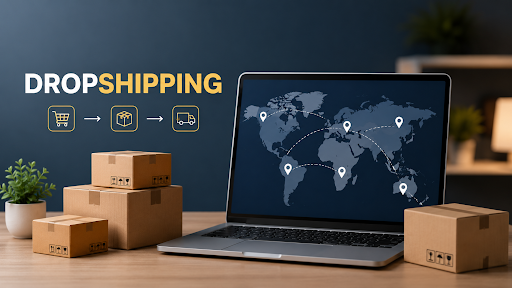
Dropshipping is an inventory-free retail model where sellers forward orders to suppliers who ship directly to consumers. While it offers low-risk entrepreneurship, it requires strict adherence to GST, customs, and consumer protection laws to mitigate supply chain and fraud risks.
Why In News?
The rapid proliferation of AI-generated advertisements on social media platforms exposes consumers to misleading product claims, highlighting the urgent need for oversight in the booming dropshipping economy.
What is Drop Shipping?
Drop shipping functions as an inventory-free retail model where a middleman (the dropshipper) facilitates sales without ever physically handling or storing the products.
Operational Flow: The seller manages the storefront and marketing, while a third-party supplier or wholesaler fulfills the order by shipping items directly to the end consumer.
Revenue Mechanism: The dropshipper earns a profit by setting a retail price that includes a markup over the base wholesale price paid to the supplier.
Key Features and Advantages
Zero Inventory Requirement: Sellers eliminate the need for capital-intensive warehouses, storage space, or large-scale staffing.
Low Initial Capital: AI-driven automation and e-commerce tools allow entrepreneurs to launch digital stores with minimal financial investment.
Scalability: Sellers expand marketing and sales volume rapidly because they outsource physical logistics to external suppliers.
Trend Capitalization: Entrepreneurs leverage Market-Gap Fulfillment to quickly pivot toward viral products or localized niche markets.
Challenges and Risks
Quality Control: Reliance on unverified international wholesalers often results in the distribution of counterfeit goods and defective items.
Logistical Instability: Consumers frequently experience protracted delivery timelines and unfulfilled shipments due to a lack of direct control over the supply chain.
Customer Service Burden: Sellers bear full legal and brand responsibility for returns, refunds, and complaints despite having no physical oversight of the dispatched inventory.
Profit Squeeze: Heavy market competition and supplier-imposed costs significantly reduce the net profit margins for the dropshipper.
Regulatory Framework
GST Compliance: Dropshippers must register for GST if their annual turnover exceeds ₹40 lakhs for goods or ₹20 lakhs for services.
Tax Classification: Businesses must accurately apply CGST, SGST, and IGST based on the nature of the transaction, utilizing precise HSN code mapping.
Consumer Protection: All operations must align with the Consumer Protection (E-Commerce) Rules, 2020, which mandate transparent pricing, clear return policies, and accurate product specifications.
Data Privacy: Entities must secure buyer data in accordance with the Information Technology Act, 2000.
Cross-Border Requirements: International dropshipping mandates a 10-digit Import-Export Code (IEC) issued by the Directorate General of Foreign Trade (DGFT).
Way Forward
While dropshipping democratizes e-commerce by lowering capital barriers, ensuring strict GST compliance, robust supplier vetting, and transparent consumer protection frameworks remain significant to sustain legitimate digital economic growth.
Source: THEHINDU
|
PRACTICE QUESTION Q. Consider the following statements regarding the 'Drop Shipping' model:
Which of the statements given above is/are correct? A) 1 and 2 only B) 2 and 3 only C) 1 and 3 only D) 1, 2, and 3 Answer: B Explanation: Statement 1 is incorrect: The primary hallmark of the dropshipping model is that the seller does not keep products in stock or hold physical inventory. The Consumer Protection (E-Commerce) Rules, 2020 do not require dropshippers to maintain a minimum physical inventory. Instead, they require dropshippers to take liability for the goods and services they provide, such as taking back defective goods and processing refunds. Statement 2 is correct: In India, under the regular Goods and Services Tax (GST) regime, businesses engaged exclusively in the supply of goods are generally required to obtain GST registration if their aggregate annual turnover exceeds ₹40 lakhs. Statement 3 is correct: This accurately describes the core dropshipping business model. The primary seller acts as a storefront, and the original manufacturer, wholesaler, or third-party supplier handles the logistics and ships the product directly to the end consumer. |
Drop shipping is an e-commerce retail model where a store sells products without keeping any physical inventory in stock by transferring customer orders and shipping details directly to a third-party supplier.
Unlike traditional brick-and-mortar or e-commerce stores, drop shipping businesses completely bypass purchasing upfront inventory, leasing large warehouses, or managing daily order packaging and shipping logistics internally.
The business model offers huge benefits by requiring minimal initial startup capital, enabling rapid scaling, allowing operations from any location, and offering the flexibility to instantly test new trending products without financial risk.
The model carries significant challenges including razor-thin profit margins due to intense competition, a complete lack of direct control over product quality, lengthy shipping delays, and complex supplier coordination issues.





© 2026 iasgyan. All right reserved