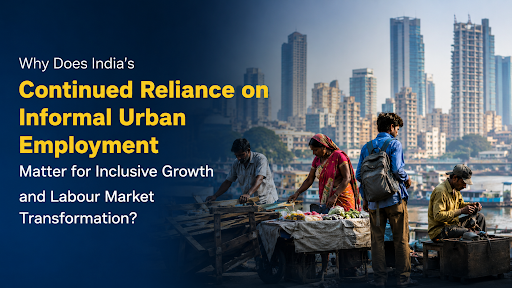
Declining trade unionization in India fuels wage stagnation and informalization. Driven by post-1991 reforms and restrictive Labour Codes, this fragmentation weakens worker bargaining power. To ensure inclusive growth, India must formalize informal rights and adopt global models like sectoral bargaining.
Trade union decline, with membership at 6.3% overall and 1.8% in the private sector, has weakened worker bargaining power, causing wage stagnation and a shift toward bare minimum pay.
Trade unionisation involves workers forming Trade Unions for collective bargaining to secure improved outcomes. Acting as a unified body, unions protect worker interests regarding wages and safety.
Primary Objective: To protect and promote the interests of workers regarding wages, working conditions, benefits, and safety standards.
Constitutional Basis: The right to form unions is a Fundamental Right under Article 19(1)(c).
Legal Framework: Registration and regulation of these bodies are governed by the Trade Unions Act, 1926.
Tripartite Structure: Unions are a critical pillar of the tripartite system, which involves the Government, Employers, and Workers in policy-making.
The "weakening of unionisation" (also known as deunionisation) refers to the decline in the density, influence, and bargaining power of trade unions over the workforce.
Declining Membership: The overall unionisation rate in India is currently estimated at only 6.3% of the total workforce. (Source: The Hindu)
Sectoral Collapse: While the public sector has a unionisation rate of 11.8%, the private sector has seen a sharp drop to just 1.8%. (Source: The Hindu)
Loss of Bargaining Power: Unions are unable to prevent the informalisation of jobs, where permanent roles are replaced by contract or gig work.
Fragmentation: Unions have suffered from political divisions, leading to multiple small, competing unions within the same factory, which weakens their collective "voice."
|
Key Indicators of Weakening Unions
|
Informalisation of the Workforce: Post-1991, most jobs emerged in the informal sector or through formal contractualisation. Such workers lack the legal status and security required for unionisation.
Shrinking Public Sector: The decline of trade unions stems from disinvestment and PSU closures, which eliminated many permanent, unionized roles once central to the public sector.
Shift to Service & Gig Economy: Growth in IT and the gig economy fosters individualized work cultures where workers are often classified as "partners." This status hinders their legal right to collective bargaining.
Fragmentation & Political Ties: Indian unions often function as political party extensions. This creates numerous competing small unions, weakening their collective influence and deterring younger workers.
Tighter Legal Constraints: The Industrial Relations Code, 2020, raised the union formation threshold to 10% of the workforce or 100 employees, up from the previous seven-worker requirement.
Wage-Productivity Gap: Without the pressure of unions, real wages for workers have not kept pace with the massive gains in corporate productivity and inflation.
Erosion of Social Security: Transitioning to fixed-term and contractual roles has deprived millions of workers of benefits like Provident Fund (PF) and Employee State Insurance (ESI).
The "Minimum Wage" Trap: Without strong unions, the focus has shifted from a decent "living wage" to an insufficient "minimum wage," which fails to meet urban subsistence needs.
Diminished Safety & Redressal: The decline of unions, once key safety monitors, has left workers—notably in manufacturing—exposed to hazardous conditions and arbitrary dismissal without formal appeals.
Waning Policy Influence: As vital members of the tripartite dialogue, weakening unions result in the workers' perspective being marginalized in national economic policy.
Inclusive Organizing: Unions need to expand beyond the permanent workforce to organize contractual, platform, and gig workers. As the fastest-growing labor segment, these workers currently lack any collective representation.
Decoupling from Political Parties: Unions should pursue ideological and financial autonomy from political parties to decrease fragmentation and win back younger workers who see traditional unions as politically compromised.
Virtual and Digital Unionisation: Unions should utilize digital platforms to unite workers across fragmented workplaces. "Digital collectivism" enables gig workers to collectively bargain for insurance and algorithmic transparency.
Strengthening Tripartite Mechanisms: To ensure workers are consulted on the Four Labour Codes and their implementation, the government must revive the Indian Labour Conference (ILC) and other tripartite bodies.
Focus on Skill Development: Unions should evolve into "proactive" partners, collaborating with employers to offer reskilling and upskilling to safeguard worker employability against AI and automation.
Trade unions remain democratic pillars critical for Social Justice and Income Equality. Despite digital shifts, a collective voice is vital for worker welfare. To achieve "Viksit Bharat" by 2047, India needs an independent union movement to ensure labor benefits from economic growth.
Source: THE HINDU
|
PRACTICE QUESTION Q. The systematic weakening of trade unions has exacerbated economic vulnerabilities among the Indian workforce. Analyze. 150 Words |
Under the new Industrial Relations Code, forming a trade union requires the support of at least 10% of the workforce or 100 workers, whichever is lower. This makes organizing much harder compared to the old Trade Unions Act of 1926, which only required seven workers.
Contractualisation replaces secure, permanent jobs with short-term, flexible work arrangements lacking comprehensive social protection. Currently, nearly 90% of all Indian workers lack secure employment contracts, leaving them highly vulnerable to economic shocks.
Gig economy platforms classify workers as "independent contractors" or "partners" rather than formal employees. This algorithmic management strips them of statutory unionizing rights, minimum wage protections, and traditional employee benefits.




© 2026 iasgyan. All right reserved