The 2026 Bonn Climate Conference (SB64) focused on operationalizing the $300 billion NCQG, introducing a 35% global electrification target by 2035, and finalizing Article 6 carbon market rules. India fiercely defended CBDR-RC, opposing new obligations and demanding equitable, grant-based climate finance.
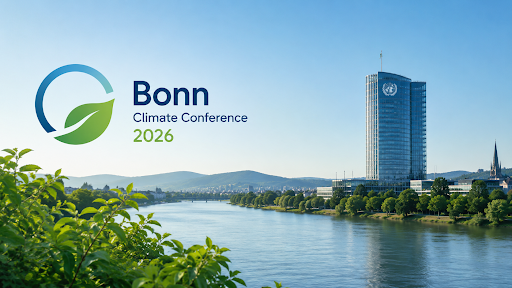
The 64th Bonn Climate Conference (SB64) concludes in Bonn, Germany, establishing a landmark 35% global electrification target by 2035 and operationalising the $300 billion New Collective Quantified Goal (NCQG)
The conference serves as the annual mid-year climate negotiation gathering under the United Nations Framework Convention on Climate Change (UNFCCC) to draft negotiable texts and resolve complex technical disagreements before the year-end COP summits.
The platform translates high-level political commitments like the Paris Agreement into actionable frameworks while scrutinising Nationally Determined Contributions (NDCs) to enforce transparency
|
UNFCCC Adopted in 1992 at the Rio Earth Summit, it serves as the foundational legal framework for all modern global climate negotiations, including the landmark Kyoto Protocol and the Paris Agreement. UNFCCC Secretariat: Headquartered in Bonn, the Secretariat manages the complex logistics and administrative tracking required to enforce global climate treaties. Subsidiary Body for Scientific and Technological Advice (SBSTA): SBSTA evaluates real-time scientific data from the Intergovernmental Panel on Climate Change (IPCC) and creates methodological rules for mechanisms like Article 6 carbon markets. Subsidiary Body for Implementation (SBI): SBI monitors how effectively countries implement pledged NDCs and tracks financial flows for global adaptation and mitigation. |
Global Deforestation
Negotiators debate the COP30 roadmap to halt and reverse deforestation and forest degradation by 2030.
Climate Finance Commitments
Vulnerable nations and the Global Climate and Health Alliance (GCHA) push developed countries to triple public adaptation finance to $120 billion annually by 2035.
Just Transition Pathways
Delegates operationalise the new Just Transition Mechanism to provide technical assistance, preventing job losses in fossil-fuel-dependent economies during decarbonisation.
Adaptation and Resilience
Technical committees advance the UAE-Belém Work Programme and finalise 59 Belém Adaptation Indicators to measure national resilience under the Global Goal on Adaptation (GGA).
Carbon Markets
The conference refines Article 6.2 (bilateral trading) and Article 6.4 (centralised UN marketplace) rules to prevent double-counting of emissions.
Article 6.4 Case
The UN faces severe backlash after issuing its first-ever Article 6.4 carbon credits for a clean-cooking project in Myanmar due to links with the sanctioned military junta and flawed verification methodologies.
The Climate Finance Debate
Developed Country Responsibilities: Developing nations demand strict enforcement of Article 9.1 of the Paris Agreement, which obligates developed nations to provide grant-based financial resources instead of debt-creating loans.
Adaptation Finance Gap: Developing nations warn that over 90% of climate finance targets mitigation, while a mere 3.4% reaches crucial adaptation projects.
Loss and Damage Depletion: The Fund for Responding to Loss and Damage (FRLD) faces total depletion by 2027, holding only $822 million in pledges against an annual requirement of $400 billion.
NCQG Operationalisation: Prioritises the New Collective Quantified Goal (NCQG) adopted at the UN Climate Change Conference (COP29) in Baku, to deliver $300 billion annually by 2035 to developing nations, aiming to unlock $1.3 trillion via private investments.
Deforestation and Land Use Policies
Forest Conservation Targets: The European Union pushes for binding land-use targets and promotes the EU Deforestation Regulation (EUDR), banning imports of six deforestation-linked commodities.
Sovereign Payments: Rainforest nations like Guyana and Suriname challenge the EU, demanding predictable sovereign-level payments for maintaining low deforestation rates.
Indigenous Forest Governance: Civil society watchdogs demand direct legal land tenure rights for local communities, noting that less than 1% of climate-related official development assistance reaches indigenous peoples.
Climate Justice: India links climate action directly to poverty eradication, asserting that climate negotiations must align with development imperatives and rising per capita incomes.
CBDR-RC Framework: India defends the Common But Differentiated Responsibilities and Respective Capabilities (CBDR-RC) framework, refusing forced fossil fuel phase-outs that ignore historical emissions.
Sustainable Lifestyle (LiFE): India promotes the LiFE initiative, treating climate action and economic growth as aligned goals, highlighted by its 150,000 MW of domestic solar capacity.
Trade Barriers and Trust Deficit: India opposes unilateral trade measures like the Carbon Border Adjustment Mechanism (CBAM) and highlights the trust deficit caused by declining Western Official Development Assistance (ODA).
35x35 Target
The COP31 Presidency (Türkiye and Australia) launches the 35x35 target to raise electricity's share of final global energy demand from 20% to 35% by 2035.
Clean Energy Consensus
Negotiators leverage geopolitical shocks, such as the Strait of Hormuz crisis, to accelerate consensus on clean energy independence and grid modernisation.
COP31 Action Agenda
The roadmap outlines immediate goals to halve global waste growth and reduce building sector energy intensity by 25% by 2035 under the Resilient Cities initiative.
Funding Gaps
Global climate finance reaches $1.9 trillion in 2023, yet the world requires $6 trillion to $7.4 trillion annually to prevent catastrophic economic damage.
Political Divides
Developed countries push to expand the contributor base to emerging economies, while the G77 and China demand strict accountability under Article 9.1.
Implementation Deficit
Developing nations face complex access procedures, debt-inducing loans, and underfunded Multilateral Development Banks (MDBs) that refuse to absorb upfront transition risks.
Global Financial Reform
Nations must reform the financial architecture through initiatives like the Bridgetown Initiative, utilising debt-for-climate swaps to generate savings for vulnerable economies.
Transparent Climate Financing
Developing nations must emulate Rwanda by integrating climate risk into national budgeting, and Uganda by establishing a dedicated Climate Finance Unit to track its $26.5 billion commitment gap.
Environmental Integrity
The Article 6.4 Supervisory Body adopts a mandatory Sustainable Development Tool to ensure carbon markets respect human rights and reduce emissions without displacing local communities.
The Bonn Climate Conference 2026 emphasizes that meeting global climate goals necessitates a transition from rhetoric to concrete, grant-based funding that respects the historical responsibilities of developed nations toward the developing world.
Source: DOWNTOEARTH
|
PRACTICE QUESTION Q. The "35x35" target, prominently discussed at the Bonn Climate Conference 2026, aims to: (a) Protect 35% of the world's tropical rainforests by 2035. (b) Reduce global methane emissions from agriculture by 35% by 2035. (c) Increase electricity's share of global final energy demand to 35% by 2035. (d) Mandate developed nations to contribute 35% of their GDP to the Loss and Damage Fund by 2035 Answer: C Explanation: The "35x35" target proposed at the Bonn Climate Conference 2026 aims to increase electricity's share of global final energy demand to 35% by 2035. |
The Bonn Climate Conference is an annual mid-year UN technical session held in Germany that brings together international delegates to draft negotiable texts and iron out policy frameworks ahead of the main year-end summits.
The conference functions as the essential, preparatory subsidiary body meeting (SB) that directly shapes the agenda and refines the official text to be formally signed at the year-end Conference of the Parties (COP) summits.
Funding remains highly controversial because developing nations demand massive, predictable public grants from developed countries to counter historical emissions, while wealthy nations frequently fail to meet their monetary commitments.
India operates as a powerful, leading voice for the Global South, aggressively advocating climate justice and equity while demanding strict accountability regarding technology transfers and needs-based funding.


© 2026 iasgyan. All right reserved