The Fund for Responding to Loss and Damage (FRLD) faces depletion by 2027, with only $448 million provided against a $400 billion annual requirement. This funding gap threatens vulnerable nations like India. Experts advocate for mandatory reparations through innovative climate taxes.
A coalition of over 200 civil society organizations warns that the Global Loss and Damage Fund (FRLD) faces insolvency by 2027 unless developed nations increase contributions.
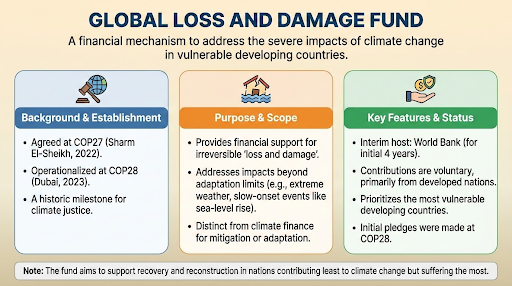
The Global Loss and Damage Fund provides financial aid to developing nations vulnerable to climate change, addressing both economic and non-economic losses.
Key Features of the Global Loss and Damage Fund
Establishment and Operationalization: Decision to establish the fund was reached at COP27 in Sharm el-Sheikh, Egypt, in 2022, and it was formally operationalized on the first day of COP28 in Dubai in 2023.
Objective: Assist developing countries in responding to loss and damage from both extreme weather events (such as floods and cyclones) and slow-onset events (such as sea-level rise, salinization, and desertification).
Governance Structure: Fund is governed by a 26-member Board, which includes 12 members from developed countries and 14 members from developing countries to ensure equitable representation.
Host Institution: The World Bank serves as the interim trustee and host of the fund's secretariat for an initial four-year period, operating as a Financial Intermediary Fund (FIF).
Funding Mechanism: Contributions to the fund are voluntary, with developed nations urged to contribute, while other countries (including major emerging economies) are encouraged to support voluntarily.
Target Beneficiaries: Fund prioritizes developing countries that are "particularly vulnerable" to climate change, though the specific definition includes Small Island Developing States (SIDS) and Least Developed Countries (LDCs).
Scope of Coverage: It covers a wide range of impacts, including economic losses (infrastructure damage, agricultural loss) and non-economic losses (loss of cultural heritage, displacement, and loss of life).
Inadequate Funding Scale: By early 2026, fund pledges reached $882 million, with only $448 million paid. This represents under 0.1% of the $400 billion annually required by developing nations. (Source: UNEP)
World Bank Governance Concerns: Developing nations oppose the World Bank hosting the fund, citing high fees, loan-centric financing, and Western influence.
Voluntary vs Mandatory Contributions: A major critique is the voluntary nature of contributions. The COP28 agreement lacks legal obligations for developed nations, undermining the principle of historical liability for past emissions.
Exclusion Risks: Pressure to restrict eligibility to SIDS and LDCs threatens to exclude major developing economies like India from climate funding despite their significant risk exposure.
Lack of Clear Definition: There is no universally agreed definition of "loss and damage," making it difficult to determine whether funds should cover slow-onset events (like sea-level rise) or only sudden disasters.
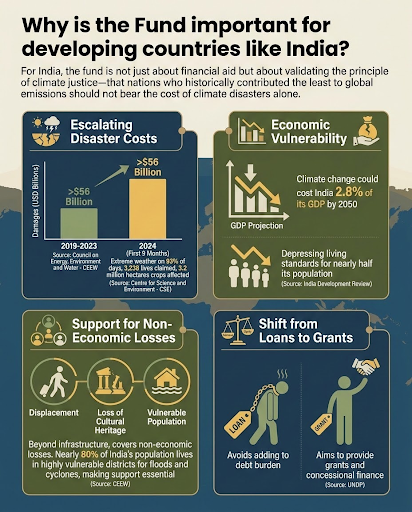
CBDR-RC Adherence: India maintains the fund must follow Common But Differentiated Responsibilities and Respective Capabilities, citing developed nations' historical emissions obligations.
Resisting Donor Expansion: India opposes expanding the donor base to emerging economies, arguing this avoids historical accountability.
Grant-Centric Aid: To prevent further debt for vulnerable nations, India advocates for grants instead of loans .
Universal Developing Eligibility: India rejects limiting funds to SIDS or LDCs, asserting that all climate-vulnerable developing populations need access.
Sovereign Management: India insists the fund supports nationally led recovery, allowing countries to address specific local needs.
Scaling Up Finance: To ensure the fund's efficacy, experts recommend a predictable, mandatory replenishment system instead of voluntary pledges, targeting $400 billion annually by 2030.
Direct Access Modalities: Enable direct access for local and sub-national entities to bypass international bureaucratic delays.
Independent Governance: Shift control from the World Bank to an independent UNFCCC entity, ensuring developing nations have significant or majority influence.
Inclusion of Non-Economic Losses: Guidelines should be reformed to quantify non-economic losses like biodiversity loss, cultural heritage, and psychological displacement impacts.
Fast-Track Emergency Windows: The fund needs a rapid response mechanism for instant extreme-weather payouts, providing insurance-like protection to developing countries without expensive premiums.
Bridging the Finance Gap: Developed nations must meet and exceed the New Collective Quantified Goal (NCQG) on climate finance, moving beyond the $100 billion annual target to trillions needed for the Global South.
Operationalizing Climate Justice: Governance must transition from voluntary contributions to mandatory, scale-based funding for the Loss and Damage Fund to reflect historical responsibility.
Fossil Fuel Phase-Out: Effective governance requires a legally binding framework to achieve the "transitioning away from fossil fuels" goal set at COP28, coupled with the tripling of renewable energy capacity by 2030.
Accountability Mechanisms: Implementing stricter transparency frameworks is essential to track whether countries are meeting their Nationally Determined Contributions (NDCs) and to prevent "greenwashing".
Reforming Global Financial Architecture: Need to reform the World Bank and IMF to offer lower-interest climate loans and debt-for-climate swaps, ensuring developing nations are not trapped in debt cycles.
Integrating Technology Transfer: Governance must facilitate the non-commercial transfer of green technologies to developing nations, treating climate solutions as global public goods.
The Loss and Damage Fund currently lacks legal accountability. Success requires a transition from voluntary pledges to predictable, mandatory funding. Developed nations must fulfill their historical responsibilities to ensure the fund becomes more than just a symbolic gesture.
Source: DOWNTOEARTH
|
PRACTICE QUESTION Q. With reference to the Fund for Responding to Loss and Damage (FRLD), consider the following statements:
Which of the statements given above is/are correct? A. 1 only B. 1 and 2 only C. 2 and 3 only D. 1, 2, and 3 Answer: A Explanation: Statement 1 is Correct: The decision to establish a Fund for Responding to Loss and Damage (FRLD) was a historic outcome of COP27 held in Sharm el-Sheikh, Egypt, in 2022. It was designed to provide financial assistance to developing countries that are particularly vulnerable to the adverse effects of climate change. Statement 2 is Incorrect: While the World Bank has been invited to host the fund's secretariat and serve as a trustee, it does so only as an interim (temporary) host for an initial period of four years. The fund is intended to have its own independent board and legal personality, and it is not a permanent organ of the World Bank. Statement 3 is Incorrect: Currently, contributions to the fund are voluntary. There is no mandatory legal framework or "binding" scale of assessments under the Paris Agreement that forces developed nations to pay a specific amount. At COP28, several countries (including the UAE, Germany, and the UK) made initial pledges, but these remain voluntary commitments rather than legal obligations. |
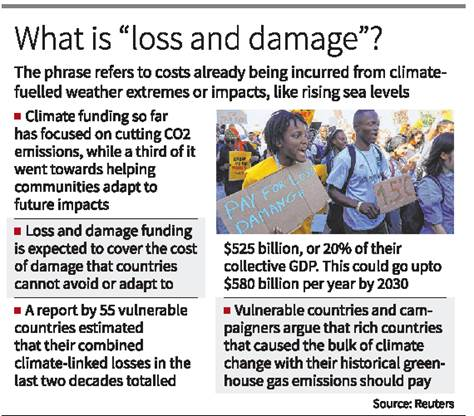
The FRLD is a financial mechanism established by the UNFCCC at COP27 to compensate developing nations for unavoidable and irreversible economic and non-economic losses caused by the impacts of climate change.
Mitigation refers to efforts to reduce global greenhouse gas emissions. Adaptation involves preparing for and minimizing future climate impacts. Loss and damage focuses on providing compensation for permanent, unavoidable destruction that has already occurred when mitigation and adaptation have failed.
Windfall taxes are levies imposed on the hyper-profits of fossil fuel and energy companies. Climate experts propose using these taxes to directly fund the FRLD, effectively capturing polluter profits for public environmental goods, similar to the UK's Energy Profits Levy.

© 2026 iasgyan. All right reserved