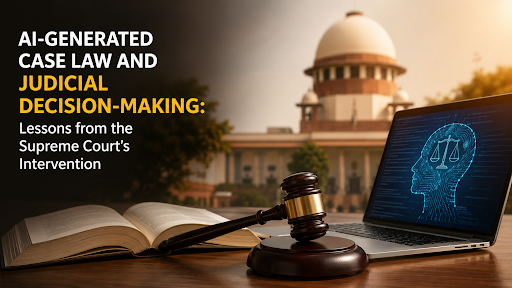
The Supreme Court quashed an NCLT order citing AI-hallucinated fake precedents, equating the damage to the rule of law with a chemical disaster. This highlights the urgent need for mandatory human verification, AI ethics guidelines, and robust judicial governance frameworks.
Why In News?
The Supreme Court overturns an NCLT ruling in the Essel Infraprojects insolvency case, citing the tribunal's reliance on "non-existent, fake, and hallucinated" AI-generated judicial precedents.
|
Read all about: Role of AI in Judiciary l AI Integration in Judiciary |
What is the Issue Relating to AI-Generated Case Law?
The Supreme Court sets aside an National Company Law Tribunal (NCLT) Mumbai order after discovering that the tribunal’s internal research relied on fabricated precedents generated by Artificial Intelligence tools.
Core Concern: Generative AI models function as prediction engines that calculate statistically likely word sequences rather than retrieving documents from verified legal databases, leading to "AI hallucinations."
Professional Misconduct: Submitting fabricated case law breaches statutory ethical mandates under the Bar Council of India (BCI) Rules and constitutes a severe subversion of the Rule of Law and professional misconduct under Supreme Court Judgment, 2026.
What are the Significances of the Supreme Court's Ruling?
Protects Judicial Integrity: The Court likens fake AI material to the release of methyl isocyanate, noting that it invisibly contaminates the lifeblood of judicial determination.
Reinforces Rule of Law: The ruling asserts that adjudication based on hallucinated material is unsustainable and holds no standing in the eyes of the law.
Preserves Precedents: Under Article 141 of the Constitution, precedents bind all Indian courts; inserting fake judgments undermines this constitutional hierarchy.
Promotes Responsible Use: The Court differentiates between using AI as an administrative aid versus delegating core cognitive reasoning to algorithms.
Strengthens Public Confidence: By mandating a zero-tolerance policy, the Court ensures citizens retain trust in the justice delivery system.
Triggers Regulatory Action: The Court directs the BCI to constitute a committee to frame strict guidelines and disciplinary actions against lawyers submitting unverified AI precedents.
What are the Key Features of AI Use in the Judiciary?
Legal Research Assistance: AI platforms scan thousands of judgments and statutes within seconds to identify relevant principles.
Document Analysis: AI-powered tools review large volumes of contracts and pleadings to detect risks and inconsistencies.
Case Management Support: Intelligent e-filing systems automatically detect document defects and generate cause lists.
Predictive Analytics: Advanced AI analyzes past decisions to forecast case outcomes and estimate litigation timelines.
Administrative Efficiency: Tools like SUPACE (Supreme Court Portal for Assistance in Courts Efficiency) organize legal materials to reduce administrative workloads.
Language Accessibility: Software such as SUVAS (Supreme Court Vidhik Anuvaad Software) translates complex judgments into multiple Indian languages.
What Benefits Can Artificial Intelligence Offer to the Judicial System?
Faster Legal Research: Automated platforms eliminate routine manual research, drastically reducing time spent locating statutory provisions.
Improved Efficiency: Initiatives like TERES (Transcription and Recording of Evidence System) provide AI-assisted transcription for accurate real-time digital records.
Reduced Administrative Burden: AI handles repetitive tasks such as defect scrutiny and auto-generation of notices.
Better Case Management: Integration with the Inter-Operable Criminal Justice System (ICJS) facilitates seamless information exchange across police, courts, and prisons.
Enhanced Access to Justice: AI-driven chatbots provide basic legal guidance to marginalized communities at lower operational costs.
Precision and Consistency: Supervised AI algorithms maintain strict consistency in data extraction, reducing human error.
What are the Major Challenges Associated with AI in Judicial Processes?
AI Hallucinations: Large Language Models (LLMs) construct phantom precedents that deceive judicial officers.
Algorithmic Bias: Systems trained on historical data inherit social prejudices, threatening Article 14 (Right to Equality).
Lack of Transparency: Opaque "Black-Box" algorithms prevent litigants from understanding the reasoning behind recommendations.
Accountability Concerns: The absence of clear regulations creates an accountability vacuum for defective legal advice.
Data Privacy Risks: Processing sensitive data through external platforms risks breaches of the Digital Personal Data Protection (DPDP) Act, 2023.
Overdependence: Excessive reliance on AI may compromise independent judicial discretion, turning judges into "rubber-stamps."
Digital Divide: Unequal access to AI technologies widens the gap in the justice delivery ecosystem.
What Institutional, Legal and Policy Frameworks Support Responsible AI Use in the Judiciary?
Constitutional Principles: The framework relies on the mandate for natural justice and a fair trial, ensuring AI never supplants human authority.
e-Courts Mission Mode Project: Phase III standardizes digital infrastructure, including e-evidence submission and electronic summons.
Draft 'Regulations for Use of AI in Courts 2026': The Supreme Court AI Committee explicitly bans AI-based adjudication (verdicts, sentencing, bail).
Governance Frameworks: Deployment must comply with the Information Technology Act, 2000 and the DPDP Act, 2023.
BCI Professional Ethics: Rule 15 (duty not to mislead) and Rule 22 (duty of confidentiality) govern lawyer conduct regarding AI.
What Measures Can Strengthen Responsible AI Adoption in the Justice System?
Mandatory Human Verification: Courts must enforce a Human-in-the-Loop (HITL) protocol for all AI-generated citations.
AI Ethics Guidelines: The BCI must finalize specialized standards detailing disclosure obligations and penal actions.
Judicial Capacity Building: The National Judicial Academy must implement training on AI limitations and bias mitigation.
Transparency Standards: Litigants must file an AI Disclosure Note certifying that all facts underwent human verification.
Independent Audit Mechanisms: Courts must subject AI systems to periodic technical and ethical audits.
Establishment of an AI Secretariat: Dedicated bodies must monitor AI incidents and manage repositories of approved tools.
Conclusion
The judicial system must harness Artificial Intelligence as a powerful assistive tool through rigorous human verification and robust ethical frameworks, ensuring technology elevates efficiency without ever compromising the Rule of Law and the sanctity of independent judicial decision-making.
Source: THEHINDU
|
PRACTICE QUESTION Q. "While Artificial Intelligence can enhance judicial efficiency, its unregulated use may undermine the integrity of the justice system." Critically examine. (250 Words, 15 Marks) |
The Supreme Court quashed the National Company Law Tribunal (NCLT) insolvency order because the tribunal relied heavily on non-existent, fake judicial precedents that were generated through Artificial Intelligence tools.
AI hallucinations occur when Generative AI models produce information that appears highly plausible and confident but is entirely fabricated, factually incorrect, or unsupported by real-world data, such as inventing fake case names and citations.
No, AI cannot replace judges. The Draft 'Regulations for Use of AI in Courts 2026' explicitly ban AI from adjudication tasks—meaning AI is prohibited from deciding verdicts, assessing bail, or predicting recidivism. Human judgment must remain supreme.
AI can safely assist courts through strict "Human-in-the-Loop" (HITL) verification protocols. It is highly effective for administrative tasks, legal research (like the SUPACE portal), translating judgments (SUVAS), and transcribing oral arguments (TERES), provided all AI outputs are independently verified by legal professionals.



© 2026 iasgyan. All right reserved