The Supreme Court is currently examining the misuse of Aadhaar as proof of citizenship and age. Governed strictly by the Aadhaar Act 2016, Aadhaar merely establishes resident identity for subsidies but legally cannot determine Indian citizenship, domicile, or date of birth.
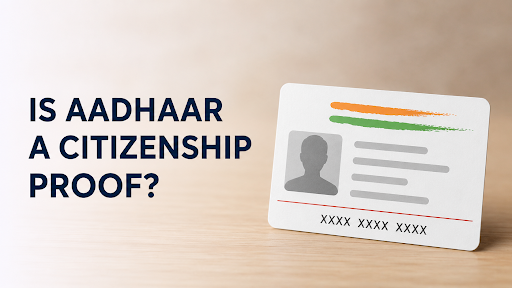
The Supreme Court issued notices to the Centre, States, Election Commission of India (ECI), and UIDAI regarding the misuse of Aadhaar as citizenship proof, citing violations of the Aadhaar Act, 2016.
An Aadhaar card is a 12-digit unique identification number issued to Indian residents by the Unique Identification Authority of India (UIDAI) based on their biometric and demographic data.
The Aadhaar (Targeted Delivery of Financial and Other Subsidies, Benefits and Services) Act, 2016 provides the legal framework for the Aadhaar ecosystem.
Section 9 Mandate: The Act explicitly declares that an Aadhaar number does not confer any right of, or proof of, citizenship or domicile.
Primary Objective: The Act streamlines the delivery of subsidies and services funded by the Consolidated Fund of India.
Authentication Framework: Section 4 allows holders to establish identity voluntarily through physical or electronic authentication.
Eligibility Criteria: Enrolment requires residency for at least 182 days in the preceding 12 months, meaning foreign nationals legally residing in India qualify for the card.
Infiltration Risks: Illegal immigrants and infiltrators exploit the Aadhaar system to project themselves as lawful residents, subsequently using the card to procure ration cards and driving licenses.
Electoral Subversion: The use of Aadhaar in Form-6 for voter registration allows non-citizens to infiltrate the electoral database, particularly in sensitive border states like Assam and West Bengal.
Administrative Overreach: While the ECI uses Aadhaar to weed out duplicate entries under Section 23(4) of the Representation of the People Act, 1950, treating it as substantive proof of demographic data creates severe constitutional risks.
Non-Citizenship Status: Aadhaar possesses zero legal validity as proof of Indian citizenship. The Ministry of Home Affairs (MHA) retains the sole authority to determine citizenship status.
Constitutional Rights: Citizenship is derived from Articles 5 to 11 of the Constitution, granting individuals fundamental rights (Articles 15, 16, 19) and political rights like voting (Article 326).
Valid Citizenship Proofs: Citizens must rely on the Birth Certificate (under the Registration of Births and Deaths Act, 1969), a valid Indian Passport, or a Citizenship Certificate issued by the MHA.
Judicial Precedent: In the K.S. Puttaswamy Case (2018), the Supreme Court upheld Aadhaar’s validity as a welfare delivery tool while definitively ruling out its capability to establish citizenship.
Age Determination: In Saroj vs IFFCO Tokio (2024), the Supreme Court rejected Aadhaar as proof of age, favoring documents like the School Leaving Certificate.
|
Constitutional Issues Involved Article 14 (Right to Equality): Allowing illegal immigrants to enter the electoral roll via Aadhaar destroys the level playing field between legitimate citizens and foreign infiltrators. Article 21 (Right to Life): Disenfranchising marginalized communities who lack passports but possess Aadhaar threatens their right to participate in the democratic process. Data Accuracy: The UIDAI biometric database cannot verify self-reported data like the date of birth, leading to frequent rejections in criminal and civil disputes. |
Way Forward
Enforce Legal Separation: The government must mandate a strict legal distinction between identity verification tools (Aadhaar) and entitlement determination documents (Passports/Birth Certificates) across all ministries.
Grassroots Awareness: State administrations must circulate the UIDAI Office Memorandum (August 2023), which explicitly warns that Aadhaar is not proof of citizenship or date of birth.
Technological Audits: The ECI should establish a high-powered monitoring committee, including cybersecurity experts, to audit Form-6 registrations and prevent illegal penetration of the voter base.
Documentation Reform: Authorities must simplify citizenship verification processes to ensure that vulnerable populations are not excluded due to the lack of high-level documents like passports.
Conclusion
While Aadhaar serves as a vital biometric tool for targeted welfare delivery, it holds no legal jurisdiction as proof of Indian citizenship. The Supreme Court’s intervention is a necessary step to curb systemic loopholes, protect national security, and safeguard the democracy from illegal infiltration.
Source: THEHINDU
|
PRACTICE QUESTION Q. The Election Commission of India's recent Special Intensive Revision (SIR) highlighted the friction between weeding out illegal immigrants and protecting the voting rights of marginalized citizens. 150 words |
The Supreme Court and the Aadhaar Act (Section 9) explicitly state that Aadhaar is solely a proof of identity and residence, not a valid document to establish Indian citizenship. a
Legal proof of citizenship is established primarily through an Indian Passport, a Birth Certificate (verifying birth in India within specific cut-off dates), or an official Citizenship Certificate issued under the Citizenship Act, 1955.
The Supreme Court issued notices to the Centre and States on a plea to strictly restrict Aadhaar usage, reiterating that it cannot be accepted as proof of date of birth or citizenship for voter registration (Form-6).
The distinction is critical because Aadhaar is available to any resident (including foreigners) who stays in India for 182 days, whereas citizenship confers exclusive constitutional rights like voting and holding public office that non-citizens cannot legally access.






© 2026 iasgyan. All right reserved