The Cabinet Committee on Economic Affairs approved a Fair and Remunerative Price of Rs 365 per quintal for sugarcane for 2026-27. This guide covers the FRP mechanism, SAP differences, Rangarajan Committee recommendations, and sugar industry reactions for your UPSC preparation.
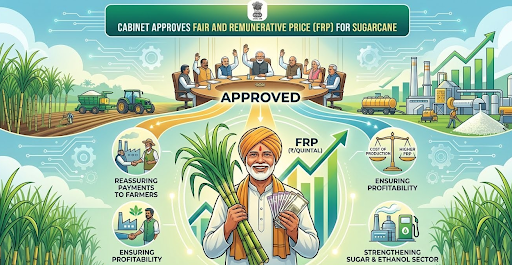
Why In News?
The Union Cabinet approved a Fair and Remunerative Price (FRP) of ₹365 per quintal for sugarcane for the upcoming 2026–27 season.
About Fair and Remunerative Price (FRP)
It is the legally mandated minimum price that sugar mills must pay to sugarcane farmers for their crop. It replaced the earlier Statutory Minimum Price (SMP) system in 2009.
Legal Framework: FRP is governed by the Sugarcane (Control) Order, issued under the Essential Commodities Act, 1955.
Approval Mechanism
Who Announces It? The FRP is approved and announced by the Cabinet Committee on Economic Affairs (CCEA), chaired by the Prime Minister.
Advisory Body: The price is based on the recommendations of the Commission for Agricultural Costs and Prices (CACP), an attached office of the Ministry of Agriculture and Farmers Welfare, after consulting with state governments and sugar industry stakeholders.
Factors Considered: Under the Sugarcane (Control) Order, the government fixes the FRP having regard to:
Key Features of the Sugarcane (Control) Order
Timely Payments: Sugar mills must pay farmers within 14 days from the date of cane delivery.
Penalty for Delay: If the producer fails to make the payment within 14 days, they are liable to pay interest at the rate of 15% per annum for the period of delay.
Assured Margins: The FRP system ensures that farmers receive their margins regardless of whether the sugar mills generate a profit or incur a loss.
Central FRP vs State Advised Price (SAP)
Rangarajan Committee Recommendations (2012)
Revenue-Sharing Model: Instead of the SAP, the committee proposed that farmers be paid the FRP upfront, followed by a 70% share in the value of the sugar and its by-products produced from their cane.
Dismantling Levy Obligation: Recommended freeing the industry from the burden of supplying subsidized PDS sugar below market prices.
De-reserving Cane Areas: Suggested phasing out the cane area reservation system to enable a competitive market, alongside removing the minimum distance criteria between sugar mills.
Trade & By-products: Favored stable import/export tariffs, dispensing with outright trade bans, and allowing the free movement of molasses without end-use quota restrictions.
Source: PIB
|
PRACTICE QUESTION Q. Regarding the Fair and Remunerative Price (FRP) of sugarcane, consider the following statements:
Which of the statements given above is/are correct? A) 1 and 2 only B) 1 and 3 only C) 3 only D) 1, 2, and 3 Answer: B Explanation: Statement 1 is correct: The Fair and Remunerative Price (FRP) is the minimum price that sugar mills are legally bound to pay to farmers for sugarcane. It ensures a guaranteed price to cane growers regardless of the mill's profit or loss. Statement 2 is incorrect: While the Commission for Agricultural Costs and Prices (CACP)—an attached office of the Ministry of Agriculture and Farmers Welfare—recommends the FRP, it is announced (and approved) by the Cabinet Committee on Economic Affairs (CCEA), which is chaired by the Prime Minister. Statement 3 is correct: The pricing and payment of sugarcane are governed by the Sugarcane (Control) Order, 1966, which was issued under the Essential Commodities Act (ECA), 1955. This order was amended in 2009 to replace the concept of "Statutory Minimum Price" with the "Fair and Remunerative Price." |
The FRP is the legally mandated minimum price that sugar mills must pay to sugarcane growers. It replaced the Statutory Minimum Price (SMP) in 2009 under the Sugarcane (Control) Order, 1966, ensuring margins for farmers regardless of whether mills make a profit.
The FRP is approved and announced by the Cabinet Committee on Economic Affairs (CCEA), chaired by the Prime Minister. This decision is based on the recommendations of the Commission for Agricultural Costs and Prices (CACP), following consultations with state governments and industry associations.
Industry bodies like ISMA argue that while FRP hikes benefit farmers, they increase the raw material cost for sugar mills. To prevent financial strain and ensure mills can pay farmers on time (within the mandated 14 days), millers are requesting a proportionate revision in the Minimum Selling Price (MSP) of sugar and ethanol procurement prices.





© 2026 iasgyan. All right reserved