The VBSA Bill seeks structural reform, however, its success depends on fiscal autonomy and federal trust. To reboot education, the regulator must transition from a restrictive controller to an empowering facilitator, balancing institutional freedom with robust student protections.
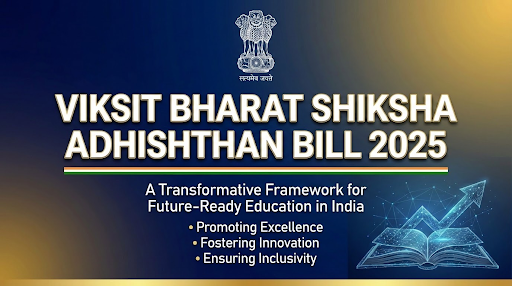
The Viksit Bharat Shiksha Adhishthan (VBSA) Bill 2025 proposes a central regulator to replace the UGC, implementing the NEP 2020’s "light but tight" approach.
This legislative framework overhauls higher education regulation, acting as the primary legal tool to realize the National Education Policy (NEP) 2020's "single regulator" vision.
The Bill aims to replace legacy regulators with a unified higher education authority.
The Bill introduces a "light but tight" regulatory architecture through a single body with three distinct vertical councils:
Separation of Powers: The Bill decouples regulation from funding. The regulator will no longer oversee financial grants; instead, the Ministry or an autonomous body will manage them directly.
Scope: It covers all higher education institutions, with the specific exclusion of Medical and Legal education.
Simplified Regulation: Merging UGC, AICTE, and NCTE eliminates overlapping approvals for diverse university courses, streamlining administrative processes.
Greater Autonomy: "Graded Autonomy" empowers top-tier institutions to independently design curricula and pursue global partnerships without constant regulatory oversight.
Outcome-Based Focus: Transitioning from infrastructure audits to learning outcomes like employability and research seeks to boost Indian universities' global rankings.
Digital Governance: A "faceless," tech-driven interface aims to eliminate corruption and bureaucratic delays in accreditation.
Federalism and Centralization: As Education is on the Concurrent List, critics claim the VBSA over-centralizes control, potentially weakening State authority and ignoring regional needs.
Funding and Political Control: Shifting grant powers to the Ministry of Education raises fears of politicized funding, removing the regulatory buffer that protects academic freedom.
The "Commercialisation" Concern: Self-financing models and foreign university entry spark fears of education becoming a "tradable commodity" that excludes marginalized students.
Transition Logistics: Consolidating the staff and databases of the UGC, AICTE, and NCTE poses a massive administrative challenge that may trigger years of "regulatory paralysis."
For Students:
For Faculty:
For University Administration:
For Private & Foreign Institutions:
An Independent Funding Body: Government should create an independent Higher Education Grants Council (HEGC), per the NEP 2020 draft.
Institutionalize "Cooperative Federalism": Create a National Council of Education Ministers (similar to the GST Council).
A "State University Support Mission": Launch a dedicated "Pradhan Mantri State University Upgradation Mission".
Decouple "Standardization" from "Homogenization": The VBSA Standards Council should establish "Minimum Learning Outcomes" as a baseline, avoiding a rigid "Uniform Curriculum."
Fill Faculty Vacancies: Link VBSA accreditation scores directly to Faculty Recruitment.
Safeguarding Access vs Commercialization: Foreign entry and self-financing models risk turning education into a luxury.
The VBSA Bill represents a structural reset of higher education governance, but its success will depend on balancing central coordination with institutional autonomy and federal sensitivity.
Source: THEHINDU
|
PRACTICE QUESTION Q. "The Viksit Bharat Shiksha Adhishthan (VBSA) Bill 2025 attempts to cure the 'regulatory cholesterol' of Indian higher education, but the treatment must not be worse than the disease." Critically analyze. 150 words |
It is a legislation introduced to overhaul the higher education system by replacing three legacy bodies (UGC, AICTE, and NCTE) with a single, unified statutory authority focused on regulation, standard-setting, and accreditation.
The UGC operated with a severe conflict of interest by acting as both a quality regulator and a grant-disbursing body. The VBSA Bill completely strips funding powers from the new regulator, allowing it to focus strictly on academic quality and outcomes.
Because education is on the Concurrent List, states fear that a highly centralized, New Delhi-based regulator with centrally appointed members will marginalize State Higher Education Councils and erode the autonomy of state universities.



© 2026 iasgyan. All right reserved