The VBSA Bill, 2025 proposes a single higher education regulator to implement NEP 2020, replacing UGC and AICTE. It promises outcome-based regulation and accountability but raises concerns over centralisation, institutional autonomy and transition challenges.
Copyright infringement not intended
Picture Courtesy: HINDUSTANTIMES
Context
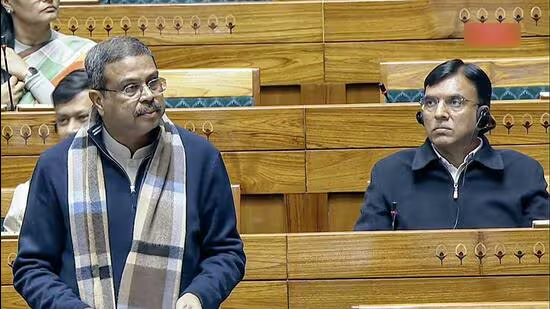
The Union education minister introduced ‘The Viksit Bharat Shiksha Adhishthan Bill 2025’ in Lok Sabha to create a single, unified regulatory authority for higher education in India.
The bill, earlier known as Higher Education Commission of India (HECI) Bill, aims to create a single, unified regulatory body for higher education, to achieve the goal of 'Viksit Bharat @2047'.
The bill seeks to replace the current fragmented regulatory system, which includes the University Grants Commission (UGC), the All India Council for Technical Education (AICTE), and the National Council for Teacher Education (NCTE).
The Gross Enrolment Ratio (GER) in higher education was 28.4% in 2021-22, with the National Education Policy 2020 (NEP) goal set at 50% by 2035. However, the system faces several challenges that the new Bill seeks to address:
The legislation proposes establishing the Viksit Bharat Shiksha Adhishthan (VBSA), a new apex commission for Indian higher education, requiring the repeal of several current acts.
Structure and Authority of VBSA
The VBSA will consist of a President and up to 12 Members (excluding ex officio and Member Secretary), all appointed by the President of India.
The VBSA's standards will apply to all higher educational institutions formerly under the Ministry of Education, UGC, AICTE, and NCTE.
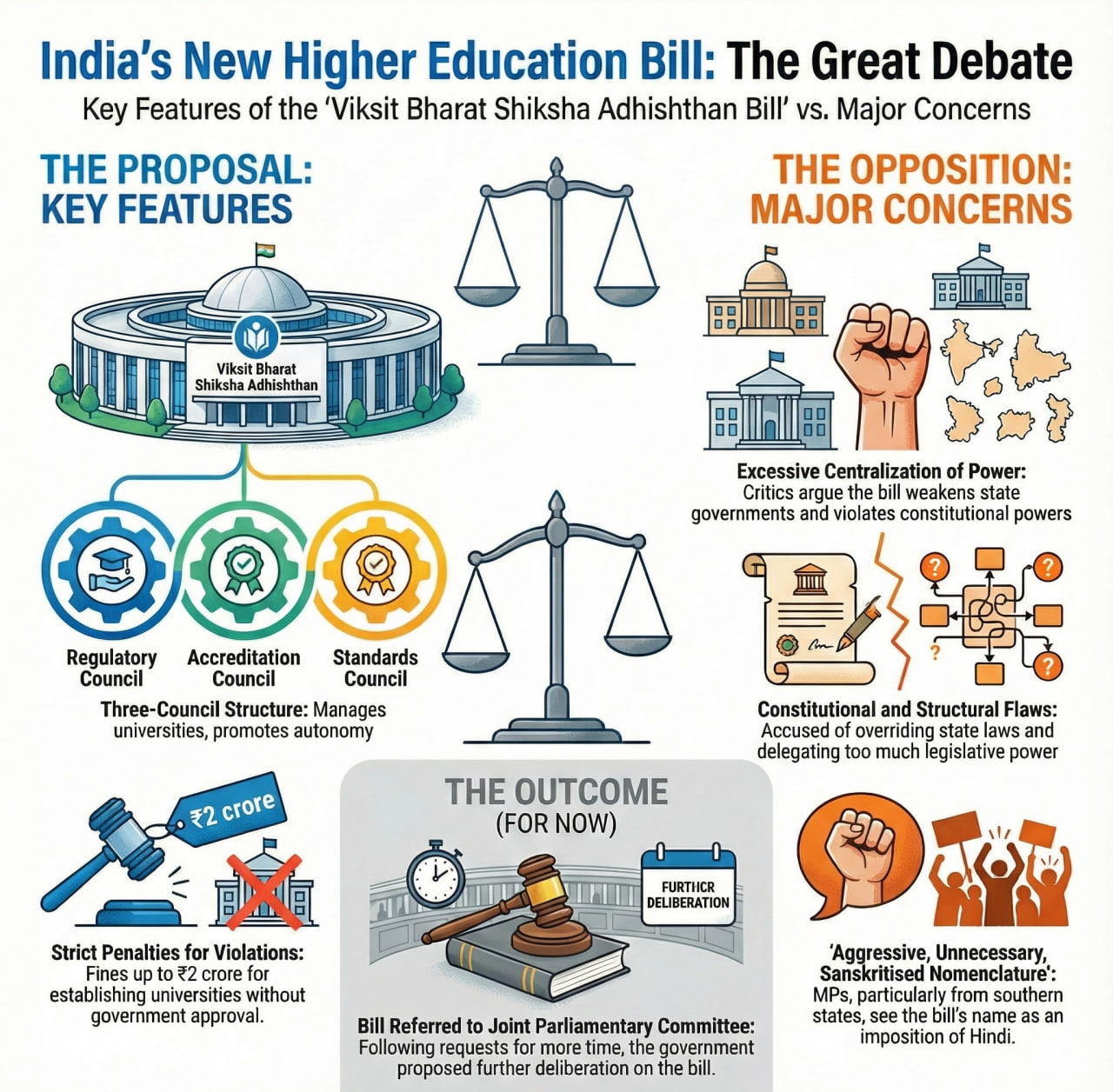
Sub-Councils: Three specialized Councils will operate under the VBSA:
Centrally funded higher education institutes are proposed to be excluded from VBSA funding scope.
Enforcement Powers and Other Bodies
The Regulatory Council has enhanced enforcement powers, able to levy penalties for violations from a minimum of ₹10 lakh up to ₹2 crore.
The Council of Architecture (CoA), set up by the Architects Act, 1972, will serve as a Professional Standard Setting Body (PSSB) as per the National Education Policy (NEP), 2020.
Over-centralisation and Federalism
Since education is a Concurrent List subject, critics argue that a single central regulator could undermine the autonomy of states in managing universities and colleges.
Threat to Institutional Autonomy
There are concerns that a powerful central body, despite its "light but tight" mandate, could lead to indirect control through performance metrics and funding, limiting genuine academic freedom.
Politicisation of Funding
Placing funding powers under the HEGC or directly with the Ministry of Education could make grant allocation susceptible to political influence rather than purely academic merit.
Impact on Equity and Access
A uniform, performance-based system could disadvantage under-resourced public universities in remote or underdeveloped areas serving marginalized communities, as they may struggle to meet standardized metrics.
 Way Forward
Ensuring Federal Consensus
Building consensus with state governments and incorporating their feedback is crucial for effective implementation and upholding the spirit of cooperative federalism.
Protecting Academic Freedom
Regulatory framework must clearly distinguish between administrative accountability and academic freedom, allowing institutions to innovate and pursue diverse research agendas.
Promoting Equity
Funding and accreditation models must be designed to support and uplift institutions in diverse geographical and socio-economic contexts, ensuring that quality enhancement does not come at the cost of access and equity.
Transparent Governance
Functioning of all four verticals of the HECI must be transparent, with clear accountability mechanisms and robust grievance redressal systems.
The Viksit Bharat Shiksha Adhishthan (VBSA) seeks to transform Indian higher education into a unified, outcome-oriented system to enhance quality and global competitiveness, though concerns about centralisation, autonomy, and equity must be addressed.
Source: HINDUSTANTIMES
|
PRACTICE QUESTION Q. The idea of a single, unified regulatory authority for higher education, was recommended by which of the following committees? (a) Kothari Commission (b) Ramamurti Committee (c) Yash Pal Committee (d) T.S.R. Subramanian Committee Answer: C Explanation: The idea of a single, unified regulatory authority for higher education, was first recommended by the Yash Pal Committee (2009). |
The VBSA Bill is a proposed legislation to create a single, unified regulatory authority for higher education in India. It aims to replace existing bodies like the University Grants Commission (UGC), the All India Council for Technical Education (AICTE), and the National Council for Teacher Education (NCTE) to streamline governance as envisioned in the National Education Policy (NEP) 2020.
The VBSA will replace the University Grants Commission (UGC), the All India Council for Technical Education (AICTE), and the National Council for Teacher Education (NCTE). It will not cover medical and legal education, which have their own regulatory bodies.
The VBSA Bill addresses the conflict of interest in the current system by separating regulation from funding. The VBSA will be the apex regulatory body, while the grant-disbursal function will be handled directly by the Ministry of Education.


© 2026 iasgyan. All right reserved