The SC declared safe highway travel a Fundamental Right (Art. 21), mandating safety-linked tolling and District Task Forces. To curb fatalities, India must adopt a "Safe System" approach, shifting accountability to contractors and prioritizing scientific crash investigations over administrative fixes.
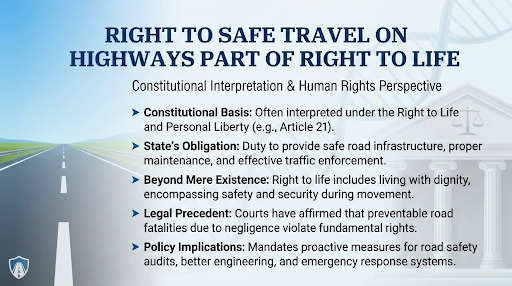
The Supreme Court ruled that the right to safe travel on highways is an integral part of the Right to Life under Article 21.
The Right to Life, under Article 21 of the Constitution, is the fundamental basis for all personal freedoms. It mandates that no person shall be deprived of life or personal liberty except through established legal procedures.
Core Definition and Scope
Transition from Procedure to Due Process
The A.K. Gopalan case (1950) originally interpreted "procedure established by law" as any valid state legislation. However, the Maneka Gandhi case (1978) mandated that such procedures must be "fair, just, and reasonable," integrating the concept of "Due Process" doctrine into Indian law.
Expansion of Derivative Rights
Rights of Prisoners and Accused
Corridors of Peril: High-speed expressways and national highways must not be allowed to become "corridors of peril" due to administrative lethargy or infrastructural gaps.
State Accountability: The "loss of even a single life to avoidable hazards" like illegal parking or known blackspots represents a fundamental failure of the "State’s protective umbrella".
Constitutional Mandate over Policy: Road safety is no longer just a matter of administrative policy but a constitutional obligation of the State.
No Financial Excuses: The Court warned that administrative or financial constraints cannot be used by the government to justify a failure to protect human lives on roads.
Disproportionate Fatality Rate: The Bench highlighted a stark imbalance: National Highways constitute only 2% of India's road network but account for nearly 36% of all road fatalities. (Source: IIT Delhi Road Safety Status Report)
According to the Ministry of Road Transport and Highways (MoRTH), while National Highways (NH) constitute only about 2% of India's total road network, they consistently account for over 30% of all road accident deaths.
Engineering Failures
Design Gaps: Approximately 59% of road fatalities occur without any traffic violation, highlighting that poor road design—such as sharp curves, lack of transition zones, and "blind" crossings—is a primary killer. (Source: SaveLIFE Foundation)
Infrastructure Deficits: Over 40% of National Highways lack basic safety features like lane markings, adequate shoulder width, or crash barriers. (Source: MoRTH)
Blackspots: There are over 13,700 identified accident-prone "black spots" nationwide that require long-term structural overhaul. (Source: MoRTH)
Substandard Maintenance: Highways deteriorate within 2 to 5 years due to the use of inferior materials and water seepage, leading to lethal potholes which claimed over 2,161 lives in 2023 alone. (Source: MoRTH)
Human & Behavioral Factors
Overspeeding: Largest cause of highway deaths, contributing to roughly 70% of fatalities in 2025. (Source: MoRTH)
Mixed Traffic & Encroachments: High-speed roads are dangerously shared with pedestrians and slow animal carts. Illegal heavy vehicle parking near roadside dhabas creates stationary hazards, causing severe collisions.
Non-compliance with Safety Gear: In 2023, the lack of helmet use accounted for 31.6% of all road deaths (54,568 lives), while not wearing seatbelts led to 16,025 fatalities. (Source: MoRTH)
Institutional & Enforcement Issues
Weak Licensing: Drivers frequently acquire licenses without proper training or strict testing, leading to a lack of necessary skills for high-speed highway environments.
Gaps in Trauma Care: Many victims die because they do not receive medical intervention within the "Golden Hour" (the first hour after a crash) due to a lack of nearby trauma centers and ambulances on highway stretches.
Fragmented Governance: Overlapping jurisdictions between central and state agencies often lead to delayed repairs and inconsistent enforcement of traffic laws.
The Government of India has adopted a comprehensive "4E" strategy—Engineering, Enforcement, Education, and Emergency Care—to improve highway safety and reduce road fatalities by 50% by 2030.
Engineering (Roads and Vehicles)
Black Spot Rectification: Government is investing ₹40,000 crore to permanently remediate over 8,500 high-risk "black spots" nationwide through road widening and geometric improvements.
Mandatory Safety Audits: Road safety audits are now mandatory at all stages of National Highway projects—design, construction, and operation—through third-party experts.
Bharatmala Pariyojana: Incorporates safety audits into all project phases—planning, construction, and operation—to build safer highway networks.
Vehicle Safety Standards: Government mandated six airbags in vehicles and established the Bharat New Car Assessment Program (BNCAP) to provide safety ratings for passenger cars.
Electronic Monitoring: Implementation of Advanced Traffic Management Systems (ATMS), which includes AI-based video incident detection, speed cameras, and Automatic Number Plate Recognition (ANPR) on high-density corridors.
Enforcement and Regulation
Motor Vehicles (Amendment) Act, 2019: Introduced tougher penalties for offenses like speeding and enabled e-challans.
National Road Safety Board (NRSB): A central agency established to coordinate and implement national road safety policies.
Digital Licensing and Testing: Digitalized licensing and over 200 training centers ensure driver competence.
Emergency Care
Cashless Treatment Scheme: Pilot programs in states like Haryana and Punjab offer cashless medical care for accident victims during the "Golden Hour."
Ambulance Network: NHAI has stationed ambulances with paramedics at every toll plaza on finished National Highway stretches.
Good Samaritan Protection: Legal safeguards now prevent the harassment of bystanders who help victims, supported by incentives like the ₹25,000 Rahveer reward.
Education and Awareness
National Road Safety Month: Held annually in January, this initiative promotes awareness via school outreach, driver training, and digital campaigns.
Centre of Excellence: The Centre of Excellence for Road Safety (CoERS) at IIT Madras integrates global road engineering standards into the Indian context.
Technology-Led Enforcement
AI Surveillance: Transitioning to Advanced Traffic Management Systems (ATMS) using AI cameras to detect speeding and hazards in real-time, instantly alerting highway patrols.
V2X Communication: Implementing Vehicle-to-Everything (V2X) tech on high-speed corridors for direct in-car alerts regarding accidents, weather, or blackspots ahead.
Engineering Accountability
Strict Liability: Holding contractors and designers financially and criminally accountable for accidents stemming from construction defects or design flaws.
Mandatory Scientific Audits: Replacing visual checks with Scientific Road Safety Audits utilizing LiDAR and 3D mapping to fix geometric errors prior to public access.
Medical & Emergency Response
Trauma Care Integration: Establishing Level-1 Trauma Centres and air-ambulances every 50-100 km on expressways to protect the "Golden Hour".
Universal Cashless Treatment: Scaling cashless schemes nationally to ensure immediate life-saving surgery for all accident victims, regardless of their ability to pay.
Behavioral Change & Education
Strict Licensing: Adopting automated testing tracks to remove bias and confirm driver skills for highways.
Local First-Responders: Training "Good Samaritans" like roadside vendors in life support as primary accident responders.
Road safety is a Constitutional mandate. Safe highways are vital for India's growth. Adopting a "Vision Zero" approach—combining design, enforcement, and rapid medical care—is crucial to eliminating fatal accidents.
SOURCE: THEHINDU
|
PRACTICE QUESTION Q. "Article 21 has evolved from a 'negative right' against the State to a 'positive mandate' for a dignified life." Discuss. 150 words |
The Right to Safe Travel is a judicial expansion of the Fundamental Right to Life guaranteed under Article 21 of the Indian Constitution. In April 2026, the Supreme Court ruled that the state has a positive, constitutional obligation to protect commuters from preventable road accidents.
The 4E Approach is the foundational framework followed by the Ministry of Road Transport and Highways (MoRTH) to combat road fatalities. It stands for Engineering (identifying and fixing structural blackspots), Enforcement (implementing traffic laws), Education (awareness drives), and Emergency Care (post-crash trauma response).
The ZFC is a collaborative domestic case study implemented on the Mumbai-Pune Expressway by the SaveLIFE Foundation, Maharashtra Police, and MSRDC. By addressing over 3,500 engineering flaws, installing crash barriers, and optimizing ambulance deployment, the project successfully reduced road crash deaths by 58.3% between 2016 and 2023.






© 2026 iasgyan. All right reserved