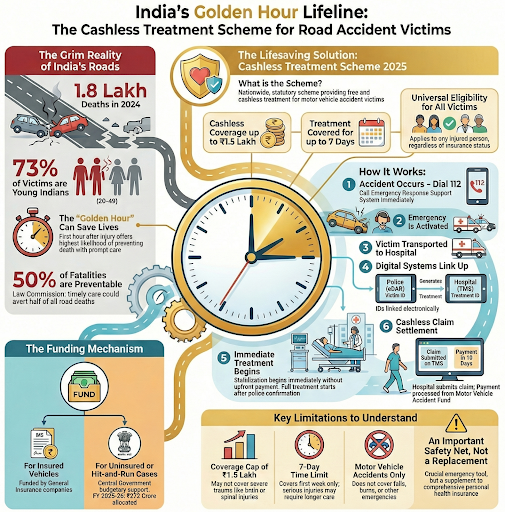
The Minister for Road Transport and Highways (MoRTH) is launching a nationwide cashless treatment scheme for road accident victims under the Motor Vehicles Act, 2019. Offering up to ₹1.5 lakh for seven days, it targets the golden hour, reduces deaths and financial distress, subject to effective implementation.
Copyright infringement not intended
Picture Courtesy: THEHINDU
Prime Minister to launch a nationwide cashless treatment scheme for road accident victims, offering coverage of up to ₹1.5 lakh and a cash award for Good Samaritans who rush victims to hospitals.
This initiative by the Ministry of Road Transport and Highways (MoRTH) aims to provide immediate, cashless medical treatment to road accident victims.
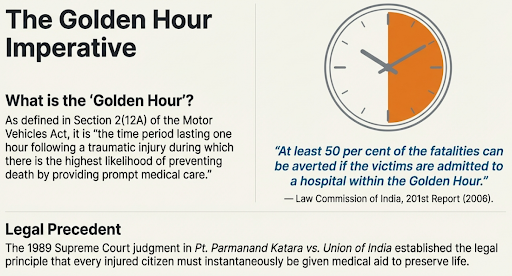
It is designed to save lives by ensuring professional medical care is not delayed due to financial constraints, especially during the critical "Golden Hour."
The number of road accident fatalities rose 2.3% to over 1.77 lakh in 2024, resulting in the death of 485 persons every day. The majority of victims (66.4%) are in the young age 18-45 years. (Source: Ministry of Road Transport and Highways).
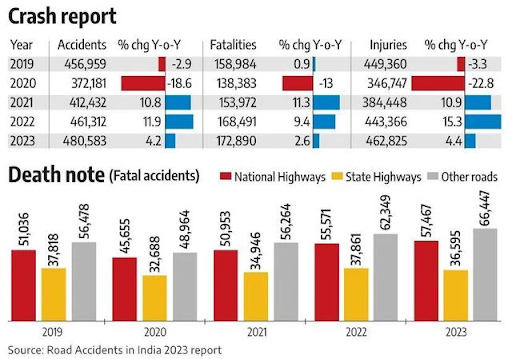
In 2023, State and UT Police Departments reported 480,583 road accidents, resulting in 172,890 fatalities and 462,825 injuries nationwide. (Source: Road Accident in India Report)
According to World Road Statistics 2024, India's fatality rate per lakh population is 11.89, higher than China's (4.3) but lower than the USA's (12.76).
India has the highest number of road accident fatalities globally. While global road fatalities fell by 5% between 2010 and 2021, India saw a 15% increase in the same period (Source: WHO Global Status Report on Road Safety).
Road crashes are estimated to cost the Indian economy 3% to 5% of its GDP annually (Source: World Bank).
The scheme is legally backed by the Motor Vehicles (Amendment) Act, 2019, which mandated the creation of a framework for the cashless treatment of accident victims.
Core Features of the Scheme
Reduces Preventable Deaths: By ensuring timely medical care, the scheme directly addresses delays that turn injuries into fatalities.
Alleviates Financial Burden: It protects victims and their families from catastrophic out-of-pocket expenditure on emergency health services.
Promotes Social Equity: The scheme provides a crucial safety net for the poor and uninsured, ensuring equitable access to emergency care.
Strengthens Emergency Ecosystem: It incentivizes private hospitals to admit accident victims without hesitation and improves coordination between police, health departments, and hospitals.
Funding Sustainability
The long-term financial health of the Motor Vehicle Accident Fund is crucial. Consistent and adequate replenishment is necessary to support a nationwide rollout.
Coverage Limit
The ₹1.5 lakh cap may be insufficient for severe trauma cases requiring multiple surgeries, ICU care, and prolonged hospitalization, potentially leaving families with substantial bills after the initial 7 days.
Infrastructure Gaps
A severe shortage of well-equipped trauma centers, particularly in rural and highway areas, limits the scheme's effectiveness due to a lack of quality healthcare infrastructure.
Administrative Hurdles
Hospitals may face delays in reimbursement, creating reluctance to participate. A streamlined, fast, and transparent claim processing system is essential.
Public Awareness
Widespread awareness among the public, police, and ambulance services is needed to ensure victims are taken to empanelled hospitals where they can avail the benefits.
Preventing Fraud
Robust monitoring and audit mechanisms are required to prevent potential misuse, such as over-billing by healthcare providers.
The cashless treatment scheme is a crucial component of post-accident care, but it must be part of a broader, integrated strategy for road safety.
Learn from globally recognized approach, which focuses on the '4 Es' of Road Safety.
The Cashless Treatment Scheme for Road Accident Victims compassionate post-crash intervention, but its success in achieving a truly safer India requires complementary efforts in robust prevention through enforcement, better engineering, and public education.
Source: THEHINDU
|
PRACTICE QUESTION Q. Assess the economic impact of road accidents on India’s GDP. How does the Cashless Treatment Scheme act as a social safety net for the vulnerable? 150 words |
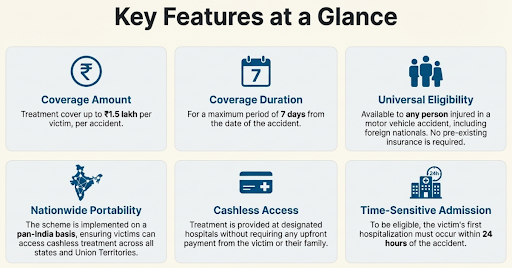
It is a nationwide scheme launched by the Ministry of Road Transport and Highways (MoRTH) to provide free and cashless medical treatment up to ₹1.5 lakh for victims of road accidents during the critical initial period.
The scheme is universally applicable to all victims of road accidents caused by motor vehicles in India, regardless of their domicile, social status, or whether they have insurance.
The 'Golden Hour' refers to the first critical hour after a traumatic injury. According to the Law Commission of India, providing timely and appropriate medical care within this hour can prevent up to 50% of road accident fatalities. This scheme aims to ensure victims receive immediate care without any delay due to payment issues.





© 2026 iasgyan. All right reserved