India’s female workforce and education enrollment are rising, yet the unpaid care economy and literacy gaps hinder progress. Achieving 'Nari Shakti' requires adopting global models like Iceland’s equal pay audits to ensure substantive socio-economic empowerment.
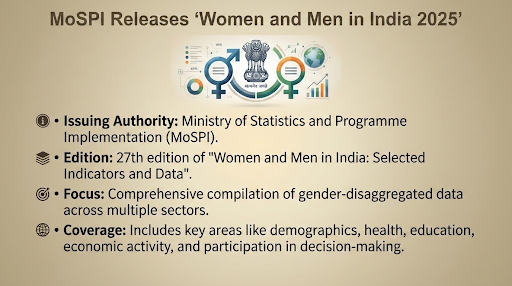
The Ministry of Statistics and Programme Implementation (MoSPI) released the 27th edition of its publication titled “Women and Men in India 2025: Selected Indicators and Data”.
The report summarizes gender-based socio-economic data, facilitating evidence-based policy and national development tracking.
Education and Health
Higher Education: India has achieved gender parity in school education. The Gross Enrolment Ratio (GER) in Higher Education for females (30.2) has surpassed that of males (28.9) in 2022-23.
Child Survival: The Sex Ratio at Birth (SRB) has shown improvement, rising from 904 (2017-19) to 917 (2021-23), indicating better survival rates for the girl child.
Maternal Health: The Maternal Mortality Ratio (MMR) has reduced from 254 deaths per 100,000 live births (2004-06) to 88 (2021-23), reflecting improved healthcare access and institutional deliveries.
Case Study - Beti Bachao Beti Padhao (BBBP) successfully used community mobilization and digital tracking to promote behavioral change, leading to a tangible increase in the local Sex Ratio at Birth in districts like Jalgaon, Maharashtra.
Rise in Women's Economic Participation
Rural Workforce Growth: Female Labour Force Participation Rate (LFPR) in rural areas (for ages 15+) surged from 37.5% in 2022 to 45.9% in 2025, signaling greater financial autonomy.
Corporate Leadership: Women in managerial positions grew by 102.54% between 2017 and 2025, outpacing the 73.80% growth for men in similar roles.
Case Study - JEEViKA Project (Bihar): The JEEViKA project in Bihar mobilized 1.2 crore women into SHGs, providing credit and market access. This initiative transitions rural women from unpaid domestic labor to active economic participation, effectively reducing poverty.
Unpaid Care Economy: Women spend an average of 289 minutes/day on unpaid domestic services, compared to just 88 minutes for men. This "time poverty" limits their economic potential.
Economic Opportunity: India ranks 131th out of 148 countries in the Global Gender Gap Index 2025, with a particularly low rank of 144th in 'Economic Participation and Opportunity'.
Preventive Healthcare Gaps: Only 1.7% of Indian women have ever undergone screening for cervical cancer, indicating a critical gap in preventive healthcare. (Source: NFHS 5)
Literacy & Digital Divide: 14.4 percentage point literacy gap persists between men and women (age 7+). This translates into a digital divide, making women more vulnerable to cybercrimes.
Strengthen Health Screenings: Prioritise awareness and access for cervical and breast cancer screenings at the Ayushman Arogya Mandir level to bridge the urban-rural health gap and improve preventive care.
Targeted LFPR & Literacy Support: Sustain the 45.9% rural female LFPR through skill-development programs and bridge the 14.4% literacy gap by focusing on adult literacy initiatives like ULLAS for older female cohorts.
Evidence-Based & Safe Governance: Use the report’s 50 key indicators to design gender-responsive local policies while enhancing digital reporting portals to ensure women can safely report cyber and physical crimes.
Learn from Global Best Practice
Iceland (Equal Pay): Ranks 1st on the Global Gender Gap Index. Its Equal Pay Standard legally mandates companies to prove they offer equal pay for equal work. India can adopt a similar legislative auditing framework.
Sweden (Care Work): The "Daddy Quota" policy reserves 90 days of non-transferable paid parental leave for fathers, promoting a more equitable distribution of unpaid caregiving responsibilities at the household level.
While India has achieved historic progress in female education and leadership—evidenced by women’s growth in managerial roles doubling that of men—achieving true gender parity requires bridging the 14.4% literacy gap and improving preventive health screenings through precision-targeted interventions.
Source: PIB
|
PRACTICE QUESTION Q. Consider the following statements regarding the "Women and Men in India 2025" report: 1. It is an annual publication released by NITI Aayog. 2. The Gross Enrolment Ratio (GER) in Higher Education for females currently exceeds that of males. Which of the statements given above is/are correct? a) 1 only b) 2 only c) Both 1 and 2 d) Neither 1 nor 2 Answer: b) 2 only Explanation: Statement 1 is Incorrect: The report is an annual publication released by the Ministry of Statistics and Programme Implementation (MoSPI), not NITI Aayog. It has been published annually since 1995 to provide crucial gender-disaggregated data. Statement 2 is Correct: The report highlights a shift where the Gross Enrolment Ratio (GER) in Higher Education for females (30.2) has surpassed that of males (28.9) for the year 2022-23. |
It is a comprehensive annual statistical publication that provides a critical overview of the socio-economic status of both genders in India. It compiles 50 key indicators across domains such as population, health, education, economic participation, and violence against women.
The report is published by the Ministry of Statistics and Programme Implementation (MoSPI), Government of India.
The 2025 report highlights an unprecedented surge in rural female LFPR, jumping from 37.5% in 2022 to a historic 45.9% in 2025, indicating active integration of rural women into the formal and semi-formal economy.


© 2026 iasgyan. All right reserved