The Anti-Defection Law is undermined by the "Merger" loophole, which incentivizes mass defection. Experts recommend abolishing the 2/3rd exemption and transferring adjudication from the Speaker to an independent tribunal to protect the voter’s mandate and democratic stability.
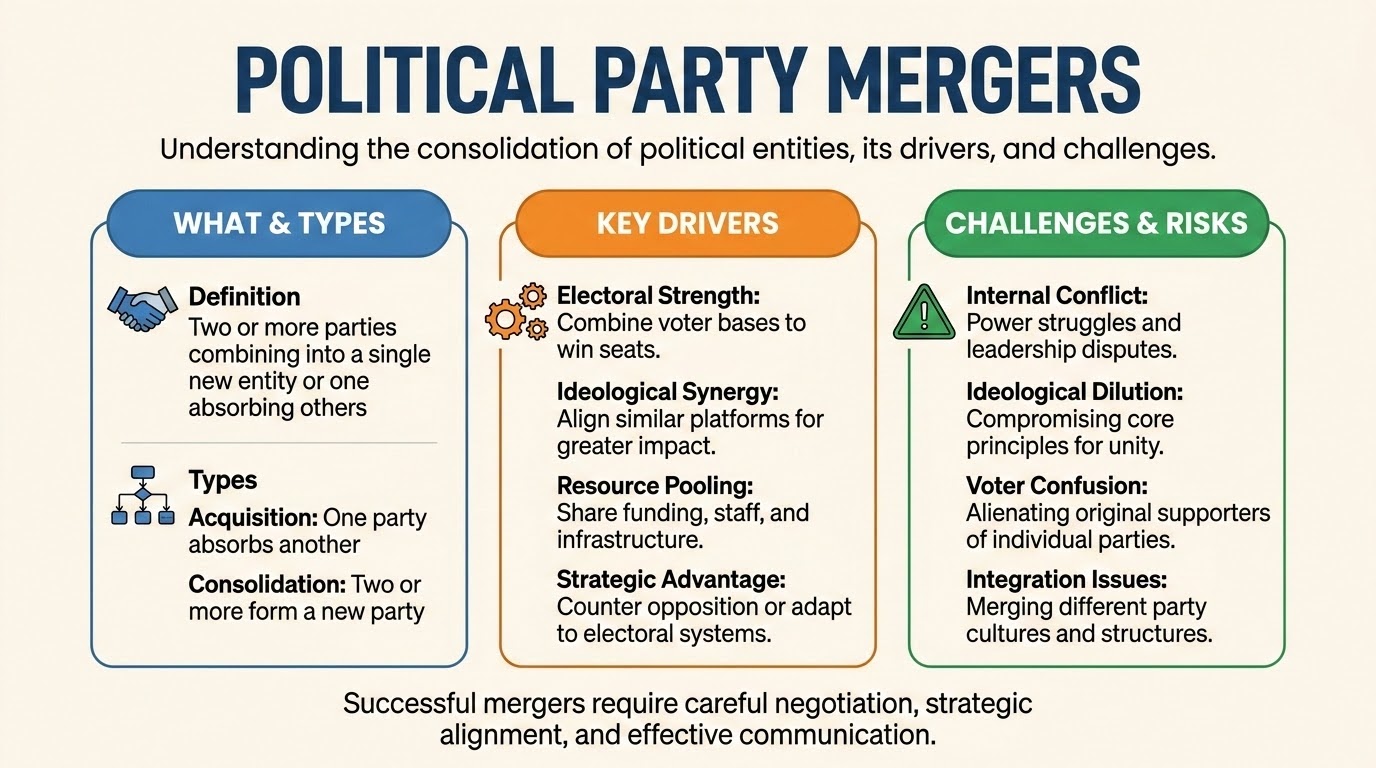
Seven AAP Rajya Sabha MPs have joined the BJP by invoking the "Merger" clause of the Anti-Defection Law to retain their seats, bypassing the need for the entire organizational party to merge.
|
Read all about: DISQUALIFICATION OF MPS: CONSTITUTIONAL FRAMEWORK, CHALLENGES, AND REFORMS |
Beyond ideological alignment, the primary driver for modern political mergers in India is statutory immunity from the Anti-Defection Law.
The legal framework is governed entirely by Paragraph 4 of the Tenth Schedule (Anti-Defection Law), introduced by the 52nd Amendment (1985) and modified by the 91st Amendment (2003).
The "Two-Thirds" Exemption (Paragraph 4(2))
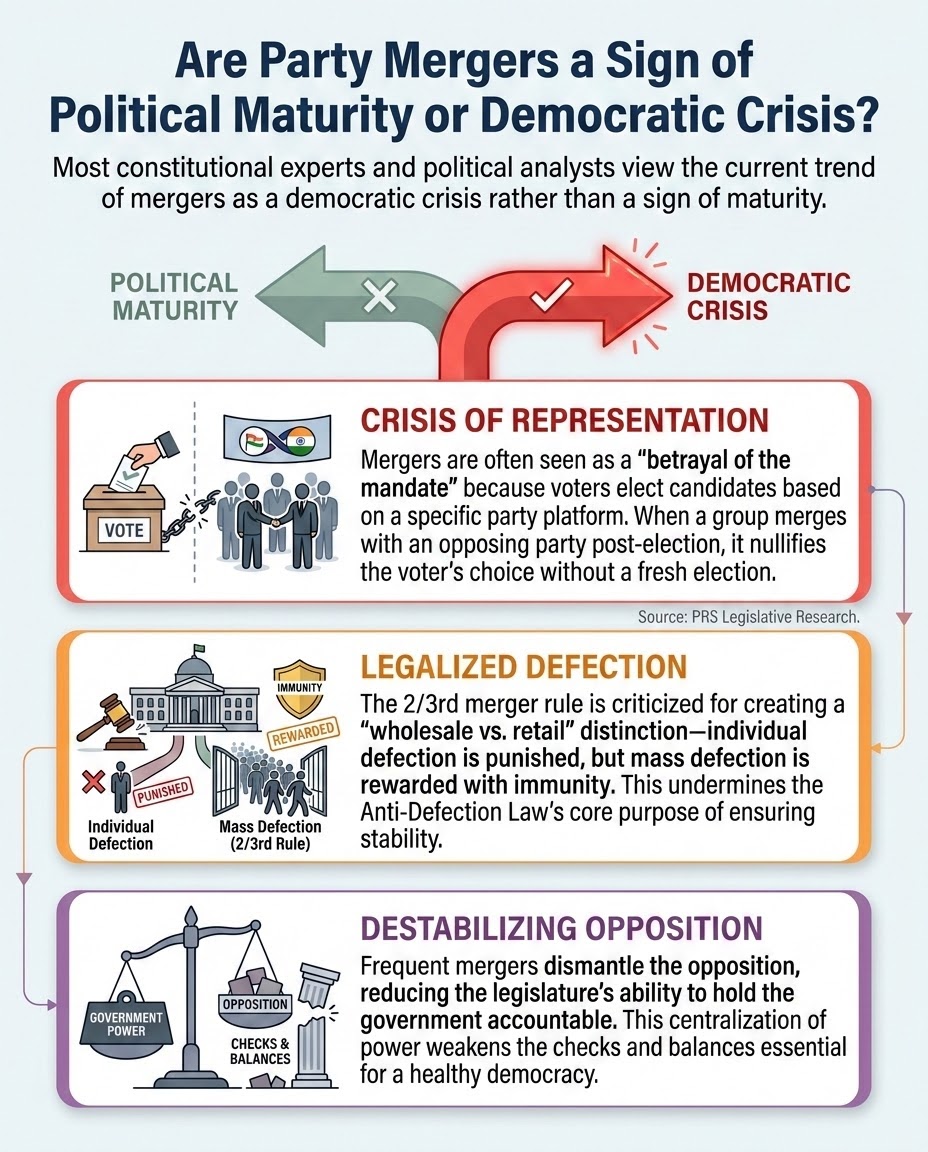
The Rule: Under the Tenth Schedule, legislators avoid disqualification if their original party merges and at least two-thirds of the legislature party consent.
The 91st Amendment (2003): This tightened the law by eliminating protections for "splits" (one-third requirement), mandating a two-thirds super-majority for any recognized merger.
The "Deemed Merger" Loophole (Legislature vs Original Party)
Legal Ambiguity: Although law mandates both organizational and legislative wings to merge, Speakers frequently allow "Deemed Mergers" involving only legislators, even against the parent party's opposition.
Judicial View: In Jagjit Singh vs State of Haryana (2006), the Supreme Court ruled that a legislature party cannot act without the original party; however, Speaker discretion often permits these one-sided mergers to persist.
Role of the Speaker & Election Commission
Decision-Making: The Speaker or Chairman holds the exclusive authority to validate mergers under the Tenth Schedule, though their ruling is subject to judicial review.
Name and Symbol Conflict: The Election Commission of India (ECI) resolves disputes regarding party identity according to the Election Symbols Order, 1968.
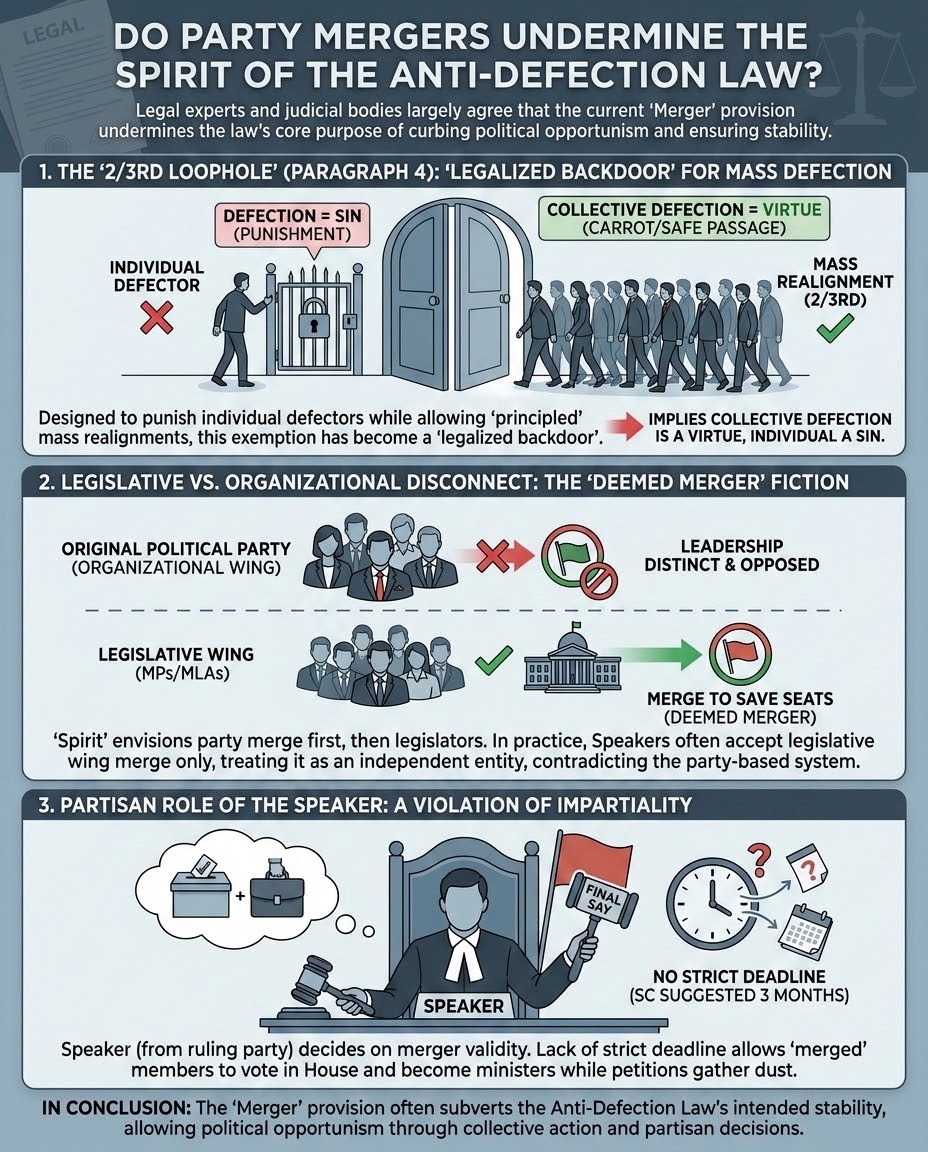 How Do Party Mergers Impact Democratic Representation?
Social Contract Betrayal: Voters support party ideologies, so mid-term mergers with opponents nullify their choice by flipping anti-incumbency votes into incumbency support.
Manufactured Majorities: Parties can bypass electoral verdicts by engineering post-election majorities. Examples include Goa (2019) and Arunachal Pradesh (2016), where opposition mergers virtually eliminated parliamentary dissent.
Weakening Parliamentary Opposition: Mergers dismantle legislative opposition, reducing diverse perspectives and turning the House into an "echo chamber" for the ruling party.
Erosion of Trust: Frequent party-switching fuels public cynicism, suggesting power is valued over ideology, which may ultimately decrease voter engagement.
 Judiciary on Political Mergers
Party Structure & Mergers: In Subhash Desai vs Maharashtra (2023), the Supreme Court held that a legislature party cannot act independently of the original political party. A valid merger requires the parent organization to merge first, followed by two-thirds legislative consent, closing the "deemed merger" loophole.
Scope of Judicial Review: The seminal Kihoto Hollohan (1992) ruling established that the Speaker’s disqualification decisions are subject to judicial review, though courts usually wait for a final order, often resulting in procedural delays.
Adjudication Timelines: In Keisham Meghachandra Singh (2020), the Court mandated that Speakers decide petitions within a three-month window to prevent defectors from holding office during protracted litigation.
What Reforms Are Needed to Regulate Party Mergers?
Transfer Adjudication Power: Shift disqualification authority from the Speaker to an independent body. The Law Commission (170th Report) and Election Commission suggest the President or Governor decide based on the EC's binding advice.
Independent Tribunal: In Keisham Meghachandra Singh (2020), the Supreme Court proposed a permanent tribunal led by retired judges for impartial, swift rulings.
Abolish "Merger" Exception: The National Commission to Review the Working of the Constitution (NCRWC) recommends deleting Paragraph 4. All defectors, individual or group, would then have to resign and seek a fresh mandate.
Limit the "Whip": The Dinesh Goswami Committee suggested applying the law only to votes affecting government stability, protecting freedom of conscience on other issues.
Strict Timeframes: To end indefinite delays, a 3-month limit should be constitutionally mandated for disqualification decisions.
Conclusion
To restore the original spirit of the Anti-Defection Law, it is essential to abolish the "Merger" exemption and transfer adjudication power from the Speaker to an independent body like the Election Commission, ensuring that any legislator switching parties must seek a fresh mandate from the voters
Source: INDIAN EXPRESS
|
PRACTICE QUESTION Q. Evaluate the role of the Speaker in adjudicating disqualifications under the Tenth Schedule. 150 words |
Political parties often merge to ensure political survival, evade anti-defection penalties, and consolidate electoral mathematics by absorbing regional factions to eliminate fragmented opposition.
Passed in 2003, the 91st Amendment abolished the "split" provision (Paragraph 3) which allowed one-third of a party's members to defect legally. However, it retained the two-thirds "merger" exception, which is now heavily misused.
The Law Commission of India recommends completely repealing the merger exception (Paragraph 4) to end bulk defections. Furthermore, committees suggest transferring the power of disqualification from the Speaker (who may be biased) to the President or Governor, acting on the binding advice of the Election Commission of India.




© 2026 iasgyan. All right reserved