The Supreme Court reinforced Article 21A, declaring RTE a "national mission." Despite mandates for 25% EWS seats, challenges like reimbursement delays and discrimination persist. To achieve equity, India must digitize administration and adopt models like the UK’s Pupil Premium.
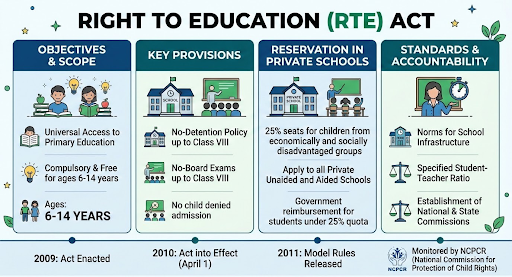
The Supreme Court affirmed the 25% economically weaker sections (EWS) quota as a fundamental right, ruling that private schools cannot delay or reject government-allotted admissions.
|
Read all about: Section 12(1)(C) of The Right To Education Act, 2009 l RTE Quotas have Failed to Make School Education Inclusive l Right to Education |
The Right of Children to Free and Compulsory Education Act, 2009 (commonly known as the RTE Act) was enacted to implement Article 21-A of the Constitution, which was inserted by the 86th Amendment Act, 2002.
Key Features of the RTE Act 2009
Free & Compulsory Education: Every child aged 6-14 has the right to free elementary education (Classes 1–8) in a neighborhood school.
25% Reservation for Disadvantaged Groups: Private unaided schools must reserve 25% of their seats at the entry level (Class 1) for children from economically weaker sections and disadvantaged groups in the neighborhood.
No Detention Policy: Originally, the Act prohibited holding back (failing) or expelling any child until they completed elementary education. This was amended in 2019 to allow regular exams in Classes 5 and 8, where a child can be detained if they fail a re-examination.
Prohibition of Screening & Capitation Fees: Schools cannot subject children or parents to any screening procedure (interviews/tests) for admission, nor can they charge any capitation fee (donation). Violations attract heavy fines.
Norms for Infrastructure & Teachers: The Act lays down specific standards for Pupil-Teacher Ratios (PTR) (e.g., 1:30 for primary), building infrastructure, working days, and teacher qualifications.
Teacher Duties & Ban on Private Tuition: Teachers are legally required to be punctual, complete the curriculum on time, and hold parent meetings. They are prohibited from offering private tuition.
School Management Committees (SMCs): Government and aided schools must form SMCs consisting of 75% parents/guardians to monitor school functioning and utilize grants.
Zero Discretion for Private Schools: Once a state government allots a student to a private unaided school under the RTE quota, the school has no authority to question the student's eligibility or delay admission.
Violation of Fundamental Rights: Obstructing RTE admissions is a direct violation of Article 21A of the Constitution, which guarantees education as a fundamental right.
A "National Mission": The court redefined the 25% quota for EWS and Disadvantaged Groups as a "national mission" to drive social integration and equality.
|
Significance of the 25% RTE Quota Section 12(1)(c) of the RTE Act mandates a 25% reservation for EWS/DG children in private unaided schools. This provision is essential for achieving socio-economic equality for several reasons:
|
|
Type of Hurdle |
Details |
Example / Impact |
|
Financial Bottlenecks |
State governments are mandated to reimburse private schools for EWS students (Section 12(2), RTE Act). However, chronic and severe delays in these payments create immense financial strain on schools. |
In Tamil Nadu, the state government had to release ₹875 crore in December 2025 to clear two years of pending dues for over 7,600 private schools, highlighting the scale of the delay. (Source: The Hindu) |
|
Social Discrimination |
Physical inclusion does not guarantee social acceptance. EWS students face discrimination, exclusion from paid extracurriculars, and a "classroom within a classroom" divide. |
This psychological and learning gap widens inequality, contrary to the Act's objective of integration. |
|
Administrative Red Tape |
Application process demands huge documentation like income certificates, Aadhaar cards, and domicile proofs, which are difficult for the most vulnerable families to obtain. |
Migrant laborers and undocumented urban poor families are often excluded from the system, defeating the policy's purpose. |
Poor Learning Outcomes: While enrollment is high, learning levels remain low. Reports like ASER consistently show that many students in Class 5 cannot read Class 2 level text.
Shift Focus from Inputs to Learning Outcomes: Monitoring should move from tracking physical infrastructure (like boundary walls) to tracking learning gains.
Expansion of Age Coverage: To align with the National Education Policy (NEP) 2020, the RTE should be extended to cover 3 to 18 years, including Early Childhood Care and Education (ECCE) and Secondary Education.
Streamlining the 25% Reservation Quota: To improve the 25% EWS seat fill rate, states need to adopt centralized online admission portals and ensure timely reimbursement to private schools to prevent discrimination against students.
Teacher Empowerment and Accountability: Reforms should focus on continuous professional development (CPD) and linking teacher performance to student learning progress rather than just administrative duties.
Strengthening School Management Committees (SMCs): SMCs, largely made up of parents, need better training and digital tools to monitor school funds and teacher attendance effectively, ensuring true community-led governance.
Focus on Inclusive Education: Ensure better infrastructure and specialized teaching staff for Children with Special Needs (CWSN), ensuring that "free and compulsory" education is truly accessible to all.
To strengthen the Right to Education (RTE) Act, India must shift from an input-centric approach to an outcome-oriented framework. This prioritizes quality learning, teacher accountability, and expanding the age bracket to 3–18 years per the National Education Policy 2020.
Source: INDIANMASTERMINDS
|
PRACTICE QUESTION Q. "The Right to Education Act, despite its constitutional backing under Article 21A, suffers from structural friction between state mandates and private implementation." Analyze. 150 words |
The Supreme Court recently ruled that private unaided schools are legally bound to immediately admit students allotted by state governments under the 25% RTE quota. The court emphasized that schools cannot exercise discretion or deny admission, as doing so violates the fundamental right to education enshrined in Article 21A of the Constitution.
Section 12(1)(c) of the RTE Act, 2009, is a crucial provision that mandates all private unaided schools to reserve at least 25% of their entry-level seats for children belonging to Economically Weaker Sections (EWS) and Disadvantaged Groups (DG) from their neighborhoods.
The Right to Education was recognized as a fundamental right through the 86th Constitutional Amendment Act of 2002. This amendment inserted Article 21A into the Constitution, mandating free and compulsory education for all children aged 6 to 14 years.



© 2026 iasgyan. All right reserved