The landmark 2026 Supreme Court Shishupal judgment recognized homemakers as "Nation Builders," establishing a "Loss of Domestic Care" compensation head with a ₹30,000 monthly baseline. It dismantles patriarchal norms, rectifies GDP blind spots, and legally monetizes women's unpaid caregiving labor.
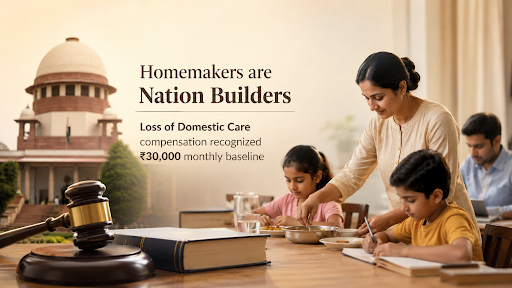
In the 2026 Shishupal vs Surjeet judgment, the Supreme Court formally designated homemakers as “Nation Builders”, addressing the historical undervaluation of women’s unpaid labor.
Household Management Activities: Unpaid domestic labor includes daily repetitive tasks—such as cooking, cleaning, fetching water, and managing household finances—which directly sustain the paid workforce.
Substitutable Economic Value: These activities hold direct economic value because families would otherwise pay out-of-pocket market rates to hire domestic help, as noted in the Arun Kumar Agrawal Case (2010).
Nurturing Human Capital: This labor involves the intense physical and emotional work of nursing sick family members, providing eldercare, and managing the comprehensive development of children.
Time-Intensive Caregiving: Women spend hours in providing maternal and spousal care, tasks that demand 24/7 attendance without formal shifts or financial remuneration.
Massive GDP Exclusion: Unpaid caregiving constitutes an estimated 15% to 17% of India's Gross Domestic Product (GDP), yet conventional macroeconomic indicators completely exclude it, according to the Time Use Survey 2019.
The Pigou Paradox: Economic accounting suffers from a structural blind spot where hiring a domestic worker increases GDP, but performing the same tasks for one's family renders the labor statistically invisible.
Economic Entities over Dependents: The Court rejects the patriarchal notion of the "dependent" housewife, designating homemakers as active "economic entities" and "Grihaswamini."
Nation Builders: Homemakers manage homes that act as the foundational building blocks of the economy, earning them the title of "Nation Builders."
New Standalone Head: The Court establishes a strict new compensatory head called "Loss of Domestic Care" to replace arbitrary judicial guesswork in motor accident claims.
Fixed Baseline Valuation: The Court institutes a strict base income of ₹30,000 per month for non-earning homemakers, supplemented by an automatic 10% triennial upward revision to account for inflation.
Separating Emotion from Economy: The judgment differentiates tangible economic household management from emotional loss, holding that standard "loss of consortium" (capped at ₹40,000) only covers emotional companionship.
Paid-Employment Top-Up Rule: The Court rules that if a homemaker holds an active paid job, the ₹30,000 baseline for domestic care must be added on top of her actual verified income.
|
Constitutional Dimensions Article 14 (Equality Before Law): Recognizing unpaid domestic work enforces substantive equality, ensuring laws treat unremunerated economic output with the same gravity as salaried labor. Article 15 (Non-Discrimination): Article 15(3) empowers the State to make special provisions for women, validating the judicial mandate to protect women from systemic macroeconomic discrimination. Article 21 (Right to Dignity): Elevating the homemaker to a "Nation Builder" fulfills the mandate of Article 21, ensuring the right to a life with dignity by honoring invisible life-sustaining labor. |
Measuring Household Services: Conventional GDP frameworks ignore non-market transactions, making it complex to assign exact monetary values.
Estimating Opportunity Costs: It remains difficult to calculate the specific financial wages a woman foregoes by choosing domestic labor over the formal job market.
Diverse Nature of Domestic Work: A homemaker acts as a manager, chef, nurse, and tutor, making it difficult to place a single unified price tag on these tasks.
Lack of Formal Documentation: The absence of payslips or contracts forces tribunals to rely on subjective guesswork rather than hard evidence.
Deep-Rooted Patriarchal Conditioning: Societal norms frame caregiving as a "biological function" rather than a demanding economic profession.
Better Time-Use Surveys: The state must mandate frequent, technology-enabled Time Use Surveys (TUS) to eliminate macroeconomic blind spots.
Recognition of Care Economy in Policy: India must establish a National Care Economy Satellite Account to estimate unpaid work's contribution to GDP.
Gender-Sensitive Economic Planning: Governments must redirect budgetary focus toward care infrastructure, such as crèches and elder-care facilities.
Universal Social Security for Homemakers: Policy must offer direct social protection, including co-contributory pensions and caregiver tax credits, linked via platforms like PM Jan Dhan.
The Supreme Court formalized India’s care economy and advanced gender justice by designating homemakers as "Nation Builders" and establishing a ₹30,000 monthly economic baseline for their unpaid labor.
Source: INDIANEXPRESS
|
PRACTICE QUESTION Q. The heavy burden of unrecognized domestic care drives India's low Female Labour Force Participation (FLFP). Discuss. 150 words |
Unpaid domestic labour refers to non-marketed, non-monetized work executed inside a household—such as cooking, cleaning, washing, routine maintenance, and the direct care of children, the elderly, or sick family members.
The Supreme Court formally calculated the monetary value of a homemaker's work to ensure fair compensation in motor accident third-party insurance claims. The judiciary ruled that assuming a homemaker does not contribute economically to a family is a patriarchal fallacy that directly violates the Right to Equality under Article 14.
Courts and economists calculate this value by using the Opportunity Cost Method (potential formal market earnings) or the Replacement Cost Method (market rates for hiring professional workers).





© 2026 iasgyan. All right reserved