The Supreme Court's UAPA bail jurisprudence highlights the conflict between national security and personal liberty. While Section 43D(5) imposes strict statutory bail restrictions, courts invoke Article 21 to grant relief in cases of prolonged incarceration, ensuring constitutional rights prevail.
Why In News?
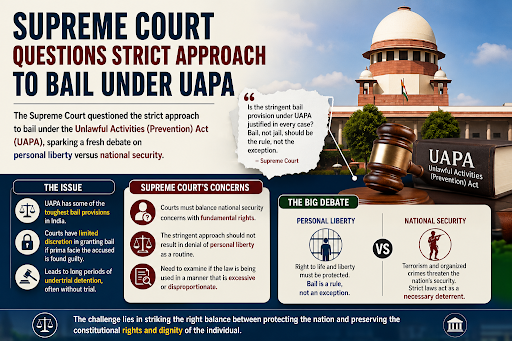
The Supreme Court questioned the strict approach to bail under the Unlawful Activities (Prevention) Act (UAPA), sparking a fresh debate on personal liberty versus national security.
|
Read all about: UNLAWFUL ACTIVITIES (PREVENTION) ACT, (UAPA) 1967 l BAIL LAW IN INDIA EXPLAINED |
What is the Unlawful Activities (Prevention) Act (UAPA)?
The UAPA operates as the principal legislation to prevent unlawful activities and terrorist acts that threaten the sovereignty, unity, and territorial integrity of India.
The Act functions under the Ministry of Home Affairs and was originally enacted in 1967, to tackle secessionist movements.
The law exercises jurisdiction over the whole of India and applies equally to both Indian and foreign nationals.
The Act imposes the death penalty and life imprisonment as the highest punishments for committing a terrorist act.
It allows investigating agencies, such as the National Investigation Agency (NIA), to keep an accused in pre-trial detention for up to 180 days without filing formal charges.
Following the 2019 Amendment, the Act empowers the Central Government to designate not just organizations, but also individuals as terrorists without a formal judicial trial.
Why is Bail Under UAPA More Restrictive Than Ordinary Criminal Law?
Section 43D(5) of the UAPA mandates courts to deny bail if they form an opinion, based purely on the police report or case diary, that there are reasonable grounds for believing the accusation is prima facie true.
The law limits the judge's role to a limited inquiry; the court must accept the prosecution's evidence at face value and cannot conduct a mini-trial, weigh evidence, or evaluate the accused's defence at the bail stage.
It places the burden of proof on the accused to demonstrate the absence of a case, making pre-trial release exceptionally difficult and ensuring that jail becomes the rule and bail is the exception.
Arguments Supporting Strict Bail
Protects National Security: Safeguards the sovereignty, integrity, and security of the State against organized and deep-rooted terror networks.
Prevents Evidence Tampering: Restrains the accused from intimidating witnesses, destroying electronic evidence, or reactivating dormant sleeper cells.
Fulfills International Commitments: Aligns with global counter-terrorism frameworks (e.g. Financial Action Task Force guidelines) to stop terrorism financing and money laundering.
Addresses Complex Conspiracies: Gives the investigating agencies adequate time to unearth large-scale, multi-layered criminal conspiracies without interference from the accused.
Arguments Opposing Strict Bail
Violates Fundamental Rights: Prolonged pre-trial detention violates the Right to Life, Personal Liberty, and Speedy Trial guaranteed under Article 21 of the Constitution.
Operates as Punishment: Subverts the standard principle of justice, turning prolonged pre-trial incarceration into an effective punishment without a guilty verdict.
Low Conviction Rates: National conviction rate between 1.5% and 6%, meaning up to 98% of cases end in acquittal. (Source: NCRB)
Stifles Civil Liberties: Broad and vague definitions of "terrorist act" allow the state to misuse the law to suppress political dissent, peaceful protests, and civil rights activism.
What Reforms Are Needed in UAPA Bail Provisions?
Enforce Mandatory Timelines
Judiciary must enforce strict mandatory timelines, requiring investigative agencies to file charge sheets within 90 days and concluding trials within a maximum of two years.
Establish Automatic Bail Mechanisms
Introduce provisions granting automatic bail if investigative agencies delay proceedings beyond a reasonable timeframe without justifiable cause, preventing the misuse of extended detention.
Adopt a Constitutional Presumption of Liberty
Judiciary needs to adopt a structured framework to ensure uniform criteria for delay and transparency in reasoning, ensuring that the "rule of Bench" does not replace the "rule of law".
Institute Clearer Judicial Standards
Legal system requires stronger procedural safeguards and clearer judicial guidelines to ensure that pre-trial detention does not function as a tool for punishment.
Publish Transparent Designations
Government must publish detailed reasons when banning organizations or individuals, allow the accused to legally challenge the order and ensure transparency in the designation process.
Conclusion
To protect democratic values, the Indian legal system must actively balance legitimate national security imperatives with the fundamental right to personal liberty, ensuring that stringent UAPA provisions do not normalize indefinite and punitive pre-trial detention
Source: THEHINDU
PRACTICE QUESTIONQ. With reference to the Unlawful Activities (Prevention) Act (UAPA), consider the following statements:
Which of the statements given above are correct? A) 1 and 2 only B) 2 and 3 only C) 1 and 3 only D) 1, 2, and 3 Answer: D Explanation: Statement 1 is correct: The Act applies to both Indian and foreign nationals. It has extraterritorial jurisdiction, meaning individuals can be charged even if the offense is committed outside India. Statement 2 is correct: The 2019 Amendment empowered the Central Government to designate individuals as "terrorists" by adding them to the Fourth Schedule of the Act. Prior to this, only organizations could be so designated. This designation can happen at the executive level before a formal trial. Statement 3 is correct: While previous judgments (like Arup Bhuyan, 2011) required "active" membership involving violence, the Supreme Court in a 2023 landmark ruling overturned this. The Court held that mere membership in an unlawful or banned organization is sufficient to constitute an offense under Section 10 of the UAPA. |
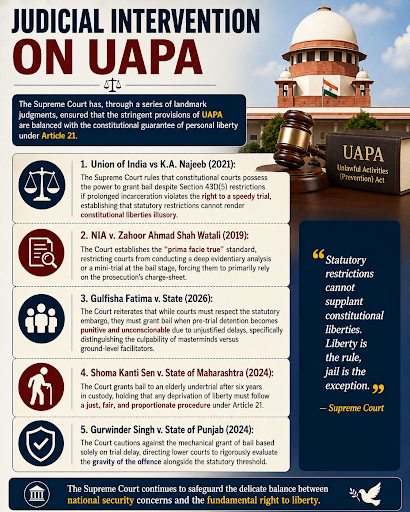
Section 43D(5) is a stringent provision that restricts courts from granting bail to an accused if, upon perusing the case diary or police report, the court believes there are reasonable grounds to find the accusations "prima facie true".
Established in the Watali judgment (2019), it mandates that courts must evaluate the prosecution's evidence at face value during the bail stage, without conducting a detailed evidentiary analysis or a mini-trial to assess the probability of conviction.
Following the 2019 UAPA Amendment, the Central Government is empowered to designate not just organizations, but also individuals as terrorists without a formal judicial trial.




© 2026 iasgyan. All right reserved