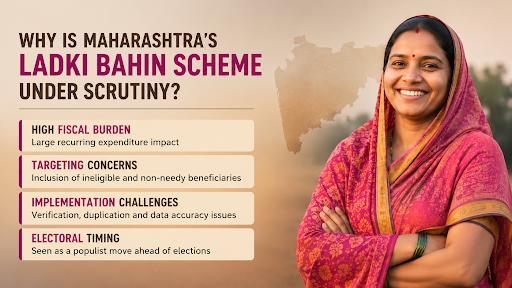
The SUMAN Roadmap 2030 is India's tech-driven health strategy aiming to eliminate preventable maternal and newborn deaths. Launched to achieve SDG targets, it integrates AI monitoring, community participation, and specialized healthcare infrastructure across high-burden districts to ensure respectful maternity care.
Why In News?
The Union Health Minister launched the SUMAN Roadmap 2030 to provide a comprehensive strategy to eliminate preventable maternal and newborn deaths across India.
What is SUMAN Roadmap 2030?
The SUMAN (Surakshit Matritva Aashwasan) Roadmap 2030 functions as a tech-enabled national strategy, providing a specialized operational matrix to guarantee respectful, quality, and zero-cost maternal and neonatal healthcare.
The roadmap builds upon India’s progress in reducing the Maternal Mortality Ratio (MMR) from 130 per 100,000 live births in 2014-16 to 88 per 100,000 live births. (Source: Sample Registration System 2021-23).
It scales with the original SUMAN initiative (launched in 2019) to meet Sustainable Development Goal (SDG) targets.
Objectives
Respectful Maternity Care: Guarantees dignified, zero-cost healthcare with zero tolerance for service denial.
MMR Reduction: Drives national MMR below 70 per 100,000 live births by 2030.
Newborn Survival: Lowers the Neonatal Mortality Rate (NMR) to ≤12 per 1,000 live births by 2030.
System Strengthening: Implements high-quality medical interventions in underserved geographies.
Universal Access: Saturates healthcare coverage from early pregnancy through 6 months post-delivery.
Key Features
Quality Antenatal Care: Implements Four-Stage High-Risk Pregnancy Tracking and mandates Bi-Weekly ASHA Screenings during the 8th and 9th months to enforce birth preparedness.
Skilled Birth Attendance: Deploys concentrated infrastructure across 130 high-burden districts in 13 states and utilizes the Midwifery Initiative to train specialized Nurse Practitioners.
Emergency Obstetric Care: Mandates the use of Non-Pneumatic Anti-Shock Garments (NASG) for hemorrhage control and upgrades facilities with Obstetric ICUs and Birth Waiting Homes.
Newborn Care Services: Integrates services with the Samagra Shishu Bal Swasthya Karyakram (SSBSK) and standardizes care across Special Newborn Care Units (SNCUs) and Newborn Care Corners (NBCCs).
Digital Monitoring: Integrates AI-Enabled Labour Rooms for real-time vitals tracking and deploys the JANANI Portal for centralized geographic tracking of high-risk cases.
Referral Networks: Operates a 24/7 SUMAN Call Centre for grievance redressal and emergency transport coordination.
Source: DDINDIA
|
PRACTICE QUESTION Q. With reference to the 'SUMAN Roadmap 2030' recently launched by the Ministry of Health and Family Welfare, consider the following statements: 1. It aims to reduce the Maternal Mortality Ratio (MMR) to below 70 per 100,000 live births by 2030. 2. It introduces "SUMAN Panchayats" to enforce local governance accountability for 100% institutional deliveries. 3. The roadmap completely phases out the usage of the JANANI Portal to introduce a decentralized localized tracking system. Which of the statements given above is/are correct? A) 1 and 2 only B) 2 and 3 only C) 1 and 3 only D) 1, 2, and 3 Answer: A Explanation: Statement 1 is correct: The SUMAN (Surakshit Matritva Aashwasan) Roadmap 2030 explicitly aims to reduce the Maternal Mortality Ratio (MMR) to below 70 per 100,000 live births by 2030. This core target directly aligns with the United Nations Sustainable Development Goals (SDGs) for maternal health. Statement 2 is correct: The strategic framework builds active community participation and local accountability through the newly introduced "SUMAN Panchayats". This mechanism leverages local governance to monitor health metrics, enforce accountability, and encourage 100% institutional deliveries and universal antenatal care. Statement 3 is incorrect: Rather than phasing out the platform, the roadmap mandates enhanced digital monitoring and reporting through the JANANI Portal. The JANANI portal serves as a centralized cloud platform optimized for the real-time tracking of clinical interventions, regional health data, and high-risk pregnancies. |
The SUMAN (Surakshit Matritva Aashwasan) Roadmap 2030 is a multi-dimensional, data-driven national health strategy launched on June 29, 2026, to eliminate preventable maternal and newborn deaths through localized, high-quality public health interventions.
The core objectives are to reduce the Maternal Mortality Ratio (MMR) to below 70 per 100,000 live births by 2030, achieve universal coverage of top-tier healthcare saturation for all pregnant women, and sharply lower Neonatal and Infant Mortality Rates.
It cuts maternal mortality by adopting a continuous life-cycle approach (pre-pregnancy to postnatal care), implementing a four-stage high-risk pregnancy tracking framework, deploying smart AI-enabled labor rooms, and mandating Birth Waiting Homes alongside Obstetric Intensive Care Units in 130 high-burden districts.
The roadmap is strictly aligned with the United Nations Sustainable Development Goal 3 (SDG 3), which targets global health and well-being, specifically focusing on ending preventable maternal, newborn, and infant mortality by 2030.





© 2026 iasgyan. All right reserved