Recent research finds a “carbon anomaly” in the Southern Ocean, where CO2 absorption has strengthened since the 2000s. Antarctic meltwater creates a freshwater lid that traps carbon below. This temporary climate buffer exposes model flaws and risks a sudden reversal into a carbon source.
Copyright infringement not intended
Picture Courtesy: THEHINDU
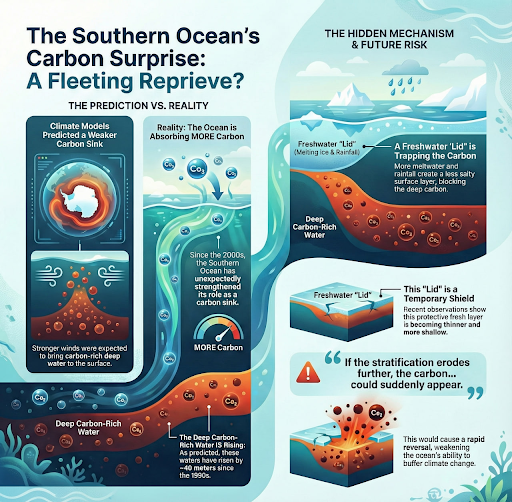
A study in Nature Climate Change reports that the Southern Ocean continues to absorb more carbon dioxide since the early 2000s, which contradicts earlier climate model predictions that its carbon-sink capacity would weaken.
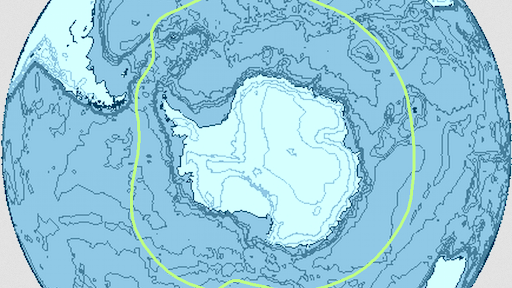
The Southern Ocean, which surrounds Antarctica, is vital to the Earth's climate system because it absorbs a large amount of atmospheric heat and carbon dioxide (CO₂).
A study on a recent "carbon anomaly" reveals the ocean's carbon sink capacity has unexpectedly strengthened since the 2000s, challenging climate models and highlighting the need for ongoing climate observation.
The Mechanism: Surface Stratification
The key to this anomaly is a process called surface stratification. This phenomenon creates a stable, layered structure in the upper ocean that acts like a lid, trapping carbon-rich waters below.
Causes: Stratification is driven by an increase in freshwater at the ocean surface. This freshwater comes from increased rainfall and the melting of Antarctic ice sheets and glaciers.
How it Works:
|
Description |
Significance for Climate & Ecosystem |
|
|
Geographical Extent |
Waters surrounding Antarctica, extending north to the 60° South latitude. It is the only ocean defined by a current rather than by continents. |
Its unique geography allows for the uninterrupted flow of the world's most powerful current. |
|
Size and Rank |
The fourth largest ocean, after the Pacific, Atlantic, and Indian, and larger than the Arctic Ocean. |
Its vast area provides a massive surface for heat and gas exchange with the atmosphere. |
|
Carbon Sink Role |
Absorbs approximately 40% of the total anthropogenic CO₂ taken up by all the world's oceans (Source: Columbia Climate School). |
Acts as a powerful buffer against the accumulation of greenhouse gases in the atmosphere. |
|
Key Current |
Dominated by the Antarctic Circumpolar Current (ACC), the world's strongest ocean current. It flows eastward, connecting the Atlantic, Pacific, and Indian Oceans. |
Drives global ocean circulation (the "conveyor belt"), distributing heat, nutrients, and carbon around the planet. Recent studies warn it may be slowing due to ice melt. |
|
Ecosystem |
The cold, nutrient-rich waters support high phytoplankton productivity. Antarctic krill (Euphausia superba) are the keystone species, forming the base of the food web. |
Krill support populations of whales, seals, penguins, and fish. They also play a role in the biological carbon pump by transporting carbon to the deep ocean. |
Source: THE HINDU
|
PRACTICE QUESTION Q. The term "upwelling" in the context of oceanography refers to: (a) The horizontal movement of surface water due to strong winds. (b) The formation of a stable, less dense layer of water at the ocean surface. (c) The process of deep, cold, and often nutrient-rich water rising towards the surface. (d) The absorption of atmospheric carbon dioxide by the ocean's surface layer. Answer: C Explanation: Upwelling is an oceanographic phenomenon involving the wind-driven motion of dense, cooler, and usually nutrient-rich water from deep layers of the ocean toward the ocean surface. This process replaces the warmer, nutrient-depleted surface water that has been pushed away by winds and the Coriolis force. |
The Southern Ocean carbon anomaly is the contradiction between climate model predictions, which suggested the ocean's carbon sink would weaken, and actual observations, which show its carbon uptake has surprisingly strengthened since the early 2000s.
The Southern Ocean is a critical climate regulator. It absorbs nearly 40% of human-emitted CO2 taken up by oceans and about 75% of the planet's excess heat. Its dominant feature, the Antarctic Circumpolar Current, drives the global transport of heat and nutrients.
The Southern Ocean Carbon and Climate Observations and Modeling (SOCCOM) project is an international research initiative that deploys hundreds of autonomous robotic floats. These floats gather crucial year-round data on the ocean's chemistry and physics to fill data gaps and improve the accuracy of climate models.


© 2026 iasgyan. All right reserved