NOAA has operationalized SOLAR-1 at Lagrange Point 1 (L1) to serve as the nation's premier space weather early warning system. Complementing India’s Aditya-L1, it tracks Coronal Mass Ejections (CMEs) and solar wind in real-time to protect global power grids, GPS, and satellites.
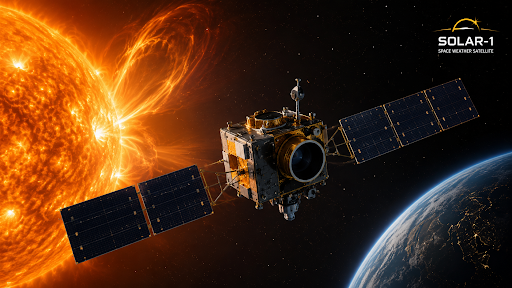
The United States National Oceanic and Atmospheric Administration (NOAA) operationalizes SOLAR-1 to provide early warnings for space weather events.
SOLAR-1 (Space Weather Observations at L1 to Advance Readiness – 1) operates as the first U.S. satellite designed exclusively for continuous, operational space weather observation.
The spacecraft travels nearly 1 million miles to the Sun-Earth Lagrange point 1 (L1).
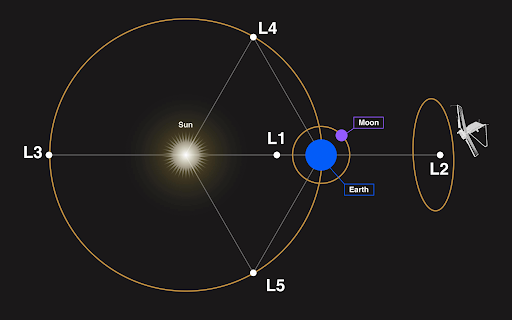
The satellite replaces older systems like SOHO to ensure absolute continuity of solar wind monitoring and track Coronal Mass Ejections (CMEs).
About Space Weather
Space weather includes dynamic environmental conditions in space dictated by solar emissions, including solar flares, solar energetic particles, and CMEs.
Solar flares release intense X-rays that cause Radio Blackout Storms, degrading high-frequency (HF) radio communications on Earth's sunlit side.
Solar energetic particles penetrate satellite shielding, causing electrical failures and posing severe radiation hazards to astronauts.
CMEs trigger geomagnetic storms upon interacting with Earth’s magnetosphere, inducing hazardous currents in power grids and degrading GPS/GNSS accuracy.
Source: MONEYCONTROL
|
PRACTICE QUESTION Q. Consider the following statements regarding the SOLAR-1 mission:
Which of the statements given above are correct? (a) 1 and 2 only (b) 2 and 3 only (c) 1 and 3 only (d) 1, 2, and 3 Answer: (b) Explanation: Statement 1 is incorrect: The SOLAR-1 mission (operated as an early warning beacon for space weather) is operated by the U.S. National Oceanic and Atmospheric Administration (NOAA), not jointly by ISRO and ESA. Statement 2 is correct: Like India's Aditya-L1 mission, SOLAR-1 is positioned in a deep space orbit around the Sun-Earth Lagrange Point 1 (L1) to continuously monitor the solar wind and track Coronal Mass Ejections (CMEs) before they reach Earth. Statement 3 is correct: SOLAR-1 is equipped with a compact coronagraph (CCOR) that delivers CME imagery to space weather forecasters in under 30 minutes, a massive improvement compared to older observatories (like SOHO) which can take up to 8 hours. |
SOLAR-1 (formerly SWFO-L1) is the first U.S. satellite designed exclusively for continuous, operational space weather observation. Operated by NOAA and parked at Lagrange Point 1, it provides early warnings for solar storms by streaming coronal mass ejection (CME) imagery and solar wind data to Earth.
Constant monitoring is critical to safeguard modern technology-dependent infrastructure by giving operators vital lead time to protect electrical power grids, orbital satellites, and aviation navigation systems from severe radiation damage.
Coronal mass ejections (CMEs) are enormous, high-speed bubbles of magnetized plasma and billions of tons of solar particles violently expelled from the Sun's outer atmosphere into interplanetary space.
When solar storms strike Earth's magnetosphere, they trigger intense geomagnetic disturbances that cause widespread radio blackouts, scramble GPS accuracy, corrupt satellite electronics, and overload transformers on electrical grids.






© 2026 iasgyan. All right reserved