The NITI Aayog 2026 report analyses India’s school education, noting universal primary access but severe learning deficits, secondary dropouts, and fragmented structures. It proposes 13 systemic and academic reforms to shift focus from mere access to meaningful learning quality.
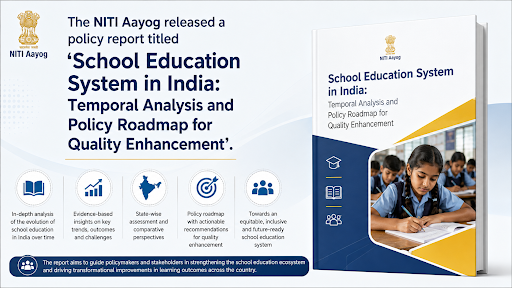
The NITI Aayog released a policy report titled ‘School Education System in India: Temporal Analysis and Policy Roadmap for Quality Enhancement’.
Scale of India's School Education System
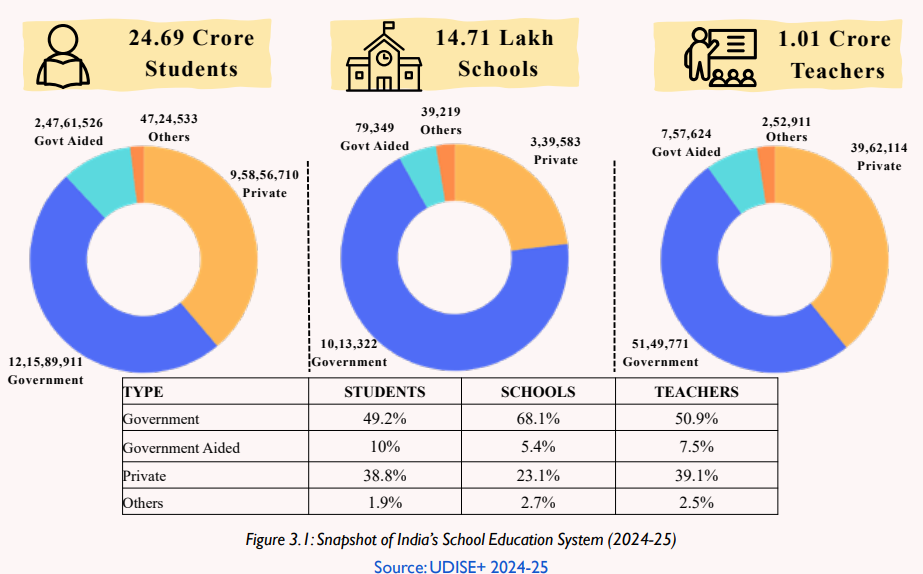
India operates the largest school education system in the world, comprising 14.71 lakh schools, 24.69 crore students, and 1.01 crore teachers.
Sectoral Shift: Government school enrollment has fallen below 50% (to 49.2%), while private schools now account for 38.8% of students, driven by parental aspirations for English-medium education and discipline.
 Key Progress and Achievements
Universal Access at Foundational Level: Near-universal access at the elementary level, with a Primary Gross Enrolment Ratio (GER) of 90.9% and an Upper Primary GER of 90.3%.
Infrastructure Expansion: Currently, 91.9% of schools have functional electricity, 92.4% have functional boys' toilets, and 94% have functional girls' toilets.
Equity Gains: Improvements in the participation of girls and the enrollment of SC and ST students across various educational stages.
Major Challenges and Bottlenecks
Deepening Learning Crisis: There is a severe deficit in foundational and conceptual learning due to an overemphasis on rote learning and syllabus completion.
High Attrition and Dropout Rates: Primary dropout is extremely low (0.3%), Secondary GER drops to 78.7%, and Higher Secondary GER plummets to 58.4%.
Fragmented Schooling Structure: India’s school structure is shaped like a pyramid with a wide base of primary schools and very few higher secondary schools.
Teacher Deployment Crisis: India faces a structural crisis with over 1 lakh single-teacher schools and uneven teacher deployment.
Infrastructure & Digital Divides: While internet access is at 63.5%, only 30.6% of schools have functional smart classrooms.
Systemic Reforms
Reform School Structures: Transition from a fragmented pyramidal structure to a "cylindrical" model by rationalising small schools into integrated composite "school complexes" offering continuous Grades 1-12 education.
Governance & Administrative Capacity: Establish independent State School Standards Authorities (SSSA) to hold both public and private schools accountable to learning and infrastructure benchmarks.
Whole-of-Society Approach: Form State and District Task Forces (headed by Chief Secretaries and District Magistrates) to enable cross-departmental resource pooling and governance convergence.
Teacher Deployment: Eliminate single-teacher schools, enforce strict 'Time-on-Task' governance to free teachers from non-academic duties, and improve professional development.
Bottom-Up Planning: Strengthen School Management Committees (SMCs) to monitor learning progress and create School Development Plans.
Upgrade Infrastructure: Universalize essential WASH (Water, Sanitation, and Hygiene) facilities and barrier-free access.
Digital & Broadcast Learning: Expand digital infrastructure, leveraging schemes like PM eVidya and BharatNet to integrate smart classrooms and broadband in all secondary schools.
Equity & Inclusion: Create Early Warning Systems (EWS) to predict and prevent dropouts, provide conditional safety nets (transport vouchers, scholarships), and establish flexible re-entry pathways for migrant populations.
Academic Reforms
Pedagogy & Assessment: Shift from rote memory to foundational mastery (Foundational Literacy and Numeracy) using Teaching-at-the-Right-Level (TaRL) models and competency-based assessments.
AI Integration: Leverage AI for personalized learning, dropout prediction, and teacher support to bridge the digital divide.
Student Wellbeing: Provide health screenings and MANODARPAN mental health counseling to ensure holistic development.
Vocational Education: Integrate skills from Grade 6 via "Vocational Hubs" and dual certifications under the National Credit Framework (NCrF).
Strengthen Early Childhood Care and Education (ECCE): Co-locate Anganwadis with primary schools under a unified framework for better school readiness.
The NITI Aayog report emphasizes that expanding school networks is insufficient; success must be measured by meaningful learning, retention, and employability.
States should adopt district-wise, evidence-based reforms that link spending to learning outcomes, building a skilled human-capital base for Viksit Bharat@2047.
Source: PIB
|
PRACTICE QUESTION Q. "While India has successfully achieved near-universal access to primary education, the system continues to suffer from a 'pyramidal' structure and severe retention challenges at higher levels." Analyze. 150 words |
Data from PARAKH 2024 and ASER 2024 reveal a severe learning crisis, with weak foundational inference and mathematical skills; for example, only 46% of preparatory stage students meet grade-level math proficiencies.
Government school enrolment has fallen to 49.24% as parental aspirations shift toward private schools in pursuit of English-medium instruction, better discipline, and perceived employability, despite poor actual learning outcomes in many low-fee private schools.
District Task Forces, chaired by Chief Secretaries and District Magistrates respectively, to pool cross-departmental resources (like health, rural development, and education) and CSR funds for cohesive school quality improvement.






© 2026 iasgyan. All right reserved