Description
WHY IN NEWS?
Driven by geopolitical tensions and high crude prices, the Indian Rupee fell to ₹94.20 per USD. This depreciation aids export-focused IT and pharma sectors but raises costs for import-dependent industries.
What is Rupee Depreciation?
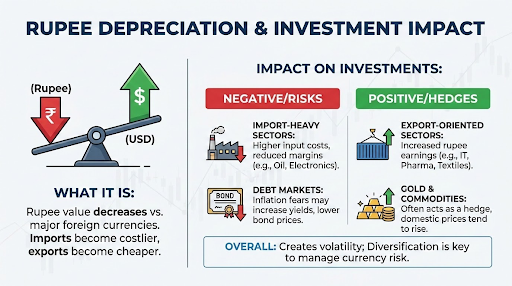
Rupee Depreciation refers to the fall in the value of the Indian Rupee (INR) against a floating foreign currency, specially the US Dollar (USD), due to market forces of demand and supply.
Depreciation vs Devaluation:
- Depreciation: Happens in a floating exchange rate system (market-driven).
- Devaluation: Is a deliberate downward adjustment by the central bank in a fixed exchange rate system.
Why is the Rupee Falling?
The depreciation is rarely due to a single factor. It is usually a mix of Global Headwinds and Domestic Challenges.
Global Factors (External Push)
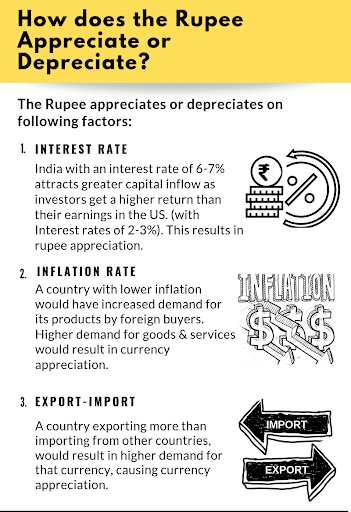
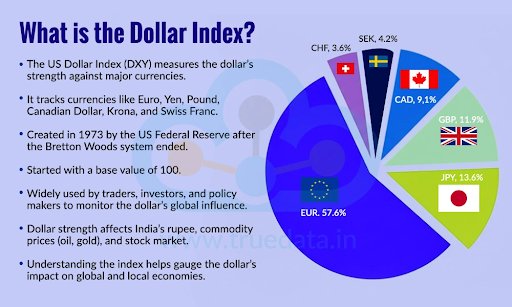
- Strengthening US Dollar: When the US Federal Reserve hikes interest rates to fight inflation, the Dollar Index (DXY) rises, sucking liquidity from emerging markets like India.
- Geopolitical Instability: Events like the Russia-Ukraine war or West Asia tensions disrupt supply chains, increasing the demand for dollars as a "safe-haven asset".
- Crude Oil Prices: Since India imports over 85% of its crude oil, any rise in global oil prices inflates the import bill, leading to higher demand for USD.
Domestic Factors (Internal Pull)
- Widening Current Account Deficit (CAD): When India imports more total value (goods + services) than it exports, there is a net outflow of dollars, weakening the Rupee.
- FPI Outflows: Foreign Portfolio Investors (FPIs) selling off Indian equities to chase higher yields in the US puts immense pressure on the Rupee.
Impact on Investments
Equity Markets (Stock Market)
The impact is sector-specific. The stock market does not react uniformly.
- The Losers (Import-Intensive Sectors):
- Sectors: Oil Marketing Companies (OMCs), Aviation, Paints, Consumer Electronics.
- Why: These companies pay in dollars for raw materials (crude oil, titanium dioxide, components). A weaker Rupee increases their input costs, squeezing profit margins.
- Investment Impact: Stock prices of these companies tend to be volatile or bearish during depreciation phases.
- The Winners (Export-Oriented Sectors):
- Sectors: IT Services, Pharmaceuticals, Textiles, Specialty Chemicals.
- Why: These companies earn revenue in USD. When they convert these earnings back to INR, they get more Rupees for every Dollar, boosting their revenue and operating margins.
- Investment Impact: These stocks often act as a "hedge" or defensive bet when the currency falls.
Debt & Bond Markets
- Rising Yields: To defend the Rupee and curb imported inflation, the RBI often keeps interest rates elevated or tightens liquidity.
- Price Fall: Bond prices and yields move inversely. When yields rise, the market price of existing bonds falls, leading to negative or low returns for investors in long-term debt funds.
- FPI Exit: A falling Rupee reduces the "real return" for foreign investors, prompting them to sell Indian bonds, further depressing prices.
Gold
- Safe Haven: Gold is priced in USD internationally. When the Rupee depreciates, the landed cost of gold in India rises even if international gold prices remain stable.
- Investment Impact: Gold acts as a perfect hedge against currency depreciation, delivering positive returns when the Rupee falls.
Institutional Response: How RBI Manages the Fall
India follows a "Managed Float" exchange rate system. The RBI does not target a specific rate but intervenes to smooth out volatility.
- Selling Forex Reserves: The RBI sells dollars from its reserves to increase the supply of USD in the market, arresting the Rupee's sharp fall.
- Monetary Tightening: Raising the Repo Rate increases the interest rate differential, theoretically making Indian bonds more attractive to attract foreign capital.
- Internationalization of Rupee: The RBI has introduced mechanisms like Vostro Accounts to settle trade in Rupees, reducing the dependence on the US Dollar for imports.
SOURCE: THEHINDU
|
PRACTICE QUESTION
Q. A depreciating Rupee is a double-edged sword for the Indian economy. Analyze. 150 words
|
Frequently Asked Questions (FAQs)
Depreciation refers to the fall in the Rupee's value driven by market forces of demand and supply in a floating exchange rate system. Devaluation, on the other hand, is a deliberate, official reduction in the currency's value by a central bank operating under a fixed exchange rate system.
The impact varies by sector. Import-intensive businesses (like aviation, consumer electronics, and oil marketing companies) suffer because a weaker Rupee makes their raw materials more expensive, squeezing margins. Conversely, export-oriented businesses (like IT services and pharmaceuticals) benefit because their dollar earnings translate to more rupees.
Internationalization of the Rupee is a strategic effort to increase the acceptance and use of the Indian Rupee for cross-border trade and financial transactions. Mechanisms like the Special Rupee Vostro Accounts (SRVAs) and Local Currency Settlement systems (e.g., the India-UAE LCS) facilitate this, structurally reducing India's reliance on the US Dollar.