Rash Behari Bose was a revolutionary nationalist who played a pivotal role in extending India’s freedom struggle beyond its borders. From early militant activities in India to organising overseas resistance through the Ghadar Movement, Indian Independence League, and Azad Hind Fauj, he laid the foundation for organised armed struggle abroad and left a lasting legacy in India’s independence movement.
Copyright infringement not intended
Picture Courtesy: PIB
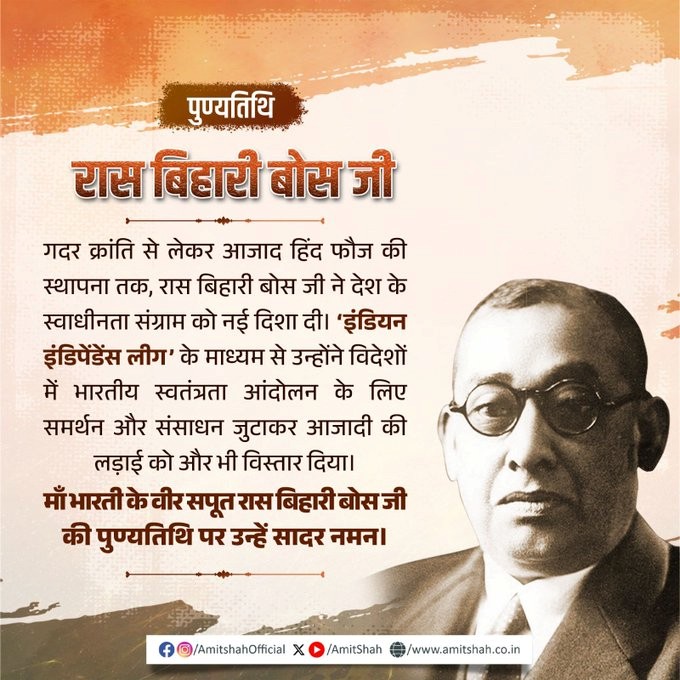
Union Home Minister and Minister of Cooperation Shri Amit Shah paid heartfelt tribute to the brave son of Mother India, Ras Behari Bose, on his death anniversary.
Rash Behari Bose was born on 25 May 1886 in Bardhaman, Bengal. He emerged as a revolutionary nationalist who expanded India’s freedom struggle beyond national boundaries, giving it a strong international orientation.
Role in revolutionary Nationalism:
Bose rose to prominence due to his involvement in early revolutionary activities against British rule. He was associated with the Alipore Bomb Case (1908) and later played a crucial role in the 1912 assassination attempt on Viceroy Lord Hardinge, which marked one of the most daring acts of revolutionary resistance during the colonial period.
Association with revolutionary leaders:
In 1913, Rash Behari Bose came into close contact with Jatin Mukherjee (Bagha Jatin), under whose guidance his commitment to armed resistance deepened. This association strengthened his resolve to pursue militant methods for India’s liberation.
Rash Behari Bose played a significant role in strengthening the Ghadar Movement, which was initiated by Indian revolutionaries and expatriates abroad with the objective of overthrowing British colonial rule in India. He acted as a vital connecting link between revolutionary networks within India and Indian communities overseas, facilitating coordination, communication, and strategic planning.
His involvement underscored the shift of the freedom struggle from being confined within India to becoming a transnational revolutionary movement, drawing support from Indians settled in North America, East Asia, and Southeast Asia. By aligning militant nationalism with global anti-imperialist sentiments during the First World War period, Rash Behari Bose contributed to expanding the ideological and geographical reach of the Indian independence movement, thereby adding an important international dimension to India’s fight against colonial rule.
Escape from British surveillance:
To evade British intelligence, Bose left India in 1915 and eventually found asylum in Japan, which became the base for his later political and organizational activities.
Interaction with Subhas Chandra Bose:
In 1924, while in Japan, Rash Behari Bose met Subhas Chandra Bose, an interaction facilitated by Veer Savarkar. This meeting later proved significant in shaping the leadership of the armed struggle abroad.
Indian Independence League (IIL):
In 1942, Rash Behari Bose established the Indian Independence League (IIL) in Japan. The organization aimed to unite Indians living in East and Southeast Asia and mobilize them against British colonial rule.
Formation of Azad Hind Fauj:
The same year, he took the initiative to organize the Azad Hind Fauj (Indian National Army). Recognizing Subhas Chandra Bose’s leadership qualities and mass appeal, Rash Behari Bose voluntarily transferred the leadership of the INA to him.
Rash Behari Bose stands out as a visionary revolutionary who carried India’s freedom struggle beyond national boundaries. Through his sacrifices, strategic leadership, and role in nurturing organized armed resistance abroad, he left an enduring imprint on the course of India’s independence movement.
Source: PIB
|
Practice Question Q. With reference to Rash Behari Bose, consider the following statements: 1.He played an important role in giving an international dimension to India’s freedom struggle. 2.He was closely associated with the Ghadar Movement and revolutionary activities during the First World War period. 3.He founded the Indian Independence League (IIL) and later handed over the leadership of the Azad Hind Fauj to Subhas Chandra Bose. 4.He spent the later part of his life in Germany, where he continued revolutionary activities. Which of the statements given above are correct? (a) 1, 2 and 3 only Answer: (a) Explanation: · Statement 1 is correct: Rash Behari Bose internationalised India’s freedom struggle by operating from abroad, especially Japan, and mobilising overseas Indians. · Statement 2 is correct: He was associated with the Ghadar Movement, which aimed to overthrow British rule through coordinated revolutionary action by Indian expatriates. · Statement 3 is correct: He founded the Indian Independence League (1942) and later transferred the leadership of the Azad Hind Fauj (INA) to Subhas Chandra Bose. · Statement 4 is incorrect: Rash Behari Bose spent his later life in Japan, not Germany, and died in Tokyo in 1945. |
Rash Behari Bose was a revolutionary nationalist and freedom fighter who played a key role in both early militant activities in India and later in organising armed resistance from abroad against British rule.
Rash Behari Bose acted as an important connecting link in the Ghadar Movement, helping coordinate revolutionary activities between Indian revolutionaries at home and Indian expatriates abroad during the First World War period.
He played a foundational role in organising the Azad Hind Fauj (INA) in 1942 and later handed over its leadership to Subhas Chandra Bose, recognising his leadership abilities.


© 2026 iasgyan. All right reserved