The Communist movement in India grew out of global socialist ideas and Indian anti-imperialist conditions, formally taking organisational shape in 1925 at Kanpur. It played an active role in organising workers and peasants during the freedom struggle, faced repression through conspiracy cases, and later led major agrarian movements like Tebhaga and Telangana. After Independence, the movement debated between armed revolution and parliamentary democracy, eventually becoming a major force in electoral politics in states such as Kerala, West Bengal and Tripura. The 1964 split between CPI and CPI(M) marked a major ideological division, and although the Left later faced electoral decline and new socio-economic challenges, it continues to remain relevant by highlighting issues of inequality, labour rights and social justice in contemporary India.
Copyright infringement not intended
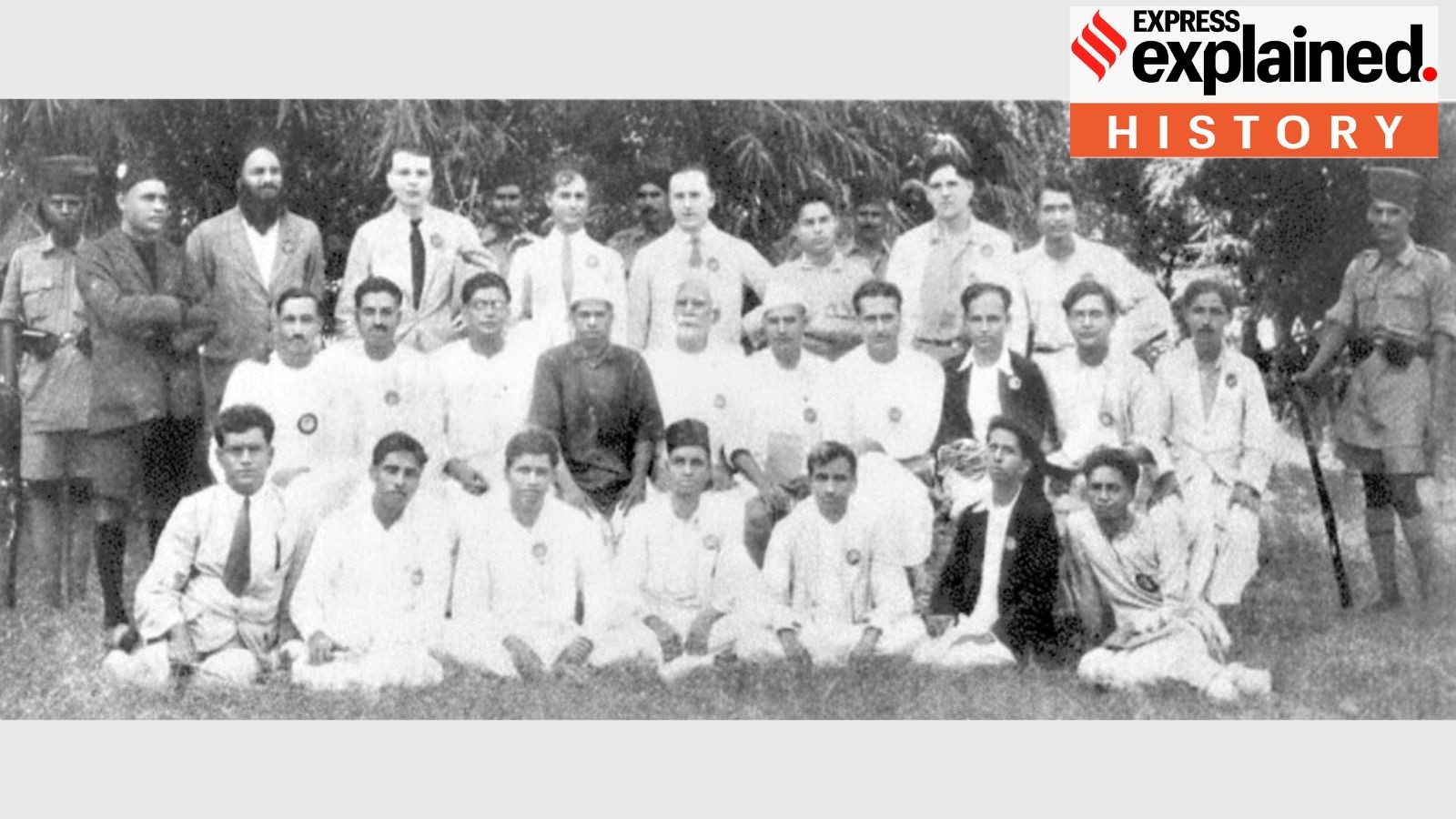
Picture Courtesy: Indian Express
The Communist Party of India (CPI) says that it was founded on December 26, 1925, when Communist groups from different parts of the country met in Kanpur (then Cawnpore).
|
Must Read: NATIONAL PARTY | Right vs left | |
The Communist Party of India treats 26 December 1925 as its foundation day because, on this date, various Communist groups met in Kanpur and decided to form an all-India organisation. The party emerged with the goal of ending British colonial rule, creating a political system based on workers and peasants, and bringing the means of production and distribution under social ownership. Over time, the movement was influenced both by international socialist ideas and by Indian anti-imperialist conditions, and it gradually adopted a mix of revolutionary activity and parliamentary democratic participation.
After the French Revolution of 1789, European politics became sharply divided between forces that supported monarchy and those that demanded political change. Industrialisation generated prosperity but also produced deep economic inequality. In this context, Karl Marx argued that capitalism would ultimately collapse because of its internal contradictions and would eventually be replaced by socialism. Although Marx expected such a transformation to occur first in industrial Western Europe, the first successful socialist revolution actually took place in Russia in 1917 under the leadership of Vladimir Lenin, and this revolution powerfully influenced anti-colonial societies, including India.
Indian Revolutionaries Abroad
One major stream came from Indian revolutionaries working outside India. M. N. Roy was a key figure who worked in the United States, Mexico, Europe and the Soviet Union, and he represented India at the Communist International in 1920. The Comintern advised Communists in colonies to give priority to the fight against imperialism, even if that required temporary alliances with other anti-imperialist forces.
Indigenous Left Groups Within India
At the same time, independent Left groups emerged inside India in cities such as Bombay, Calcutta, Lahore and Madras under leaders like S. A. Dange, Muzaffar Ahmad, Ghulam Hussain and Singaravelu Chettiar. These groups initially functioned independently but gradually felt the need to coordinate at the national level to make their political work more effective.
Workers’ and Peasants’ Organisations
Parallel to these developments, workers’ and peasants’ organisations gained strength and provided the mass base for Communism. The formation of the All India Trade Union Congress in 1920 marked the beginning of organised national-level labour mobilisation and helped connect Marxist ideas with everyday struggles of workers and peasants.
Foundational debate between Tashkent (1920) and Kanpur (1925)
Tashkent Meeting: In 1920, Indian revolutionaries created a Communist organisation in Tashkent with the approval of the Communist International. This party largely functioned from outside India and had weak links with Communist groups that were already active within the country.
Kanpur Meeting: In 1925, Indian Communist leaders met in Kanpur and formally declared the formation of the Communist Party of India. The resolutions of this conference emerged directly from Indian political realities and from the ongoing anti-colonial movement.
Divergent Opinions: In later years, two different interpretations emerged. The Communist Party of India (Marxist) considered the Tashkent initiative of 1920 as the true beginning because of its connection with the Comintern, whereas the Communist Party of India regarded the Kanpur conference of 1925 as the real foundation since it was rooted in Indian conditions and Indian initiatives.
Linking class struggle with national freedom: Communists in India tried to connect the broader anti-colonial movement with the everyday struggles of workers and peasants, and they spread ideas of class consciousness, equality and socialism while organising strikes, protests and trade unions. They opposed not only British political control but also the wider colonial economic system that produced exploitation and inequality.
Repression and conspiracy cases: The British government viewed Communist activities as highly dangerous, and therefore imposed close surveillance, bans and repeated arrests on Communist activists. The Meerut Conspiracy Case of 1929 became a major turning point because several leading Communists were prosecuted and imprisoned, which revealed both the rising influence of Communist politics and the determination of the colonial state to suppress it.
Building wider anti-imperialist alliances: During the 1930s, Communists worked with the Congress Socialist Party to construct a broader anti-imperialist front and argued that workers, peasants, students and the urban poor must be mobilised together to defeat colonialism and feudalism. By participating actively in local struggles across regions, they strengthened their organisational base and deepened contact with the masses.
Leadership in agrarian and peasant movements: After 1945, Communists assumed leadership in major peasant struggles such as the Tebhaga movement in Bengal, which demanded a greater share of produce for sharecroppers, and the Telangana peasant uprising in Hyderabad, which directly challenged landlordism and sought redistribution of land. These movements provided the Communist Party with a strong rural foundation and tied it closely to concrete issues of land, wages and agrarian exploitation.
Position during World War II and Quit India: Between 1942 and 1945, Communists prioritised the international struggle against Fascism during the Second World War, and because of this global orientation they did not extend full support to the Quit India Movement. This created friction with other sections of the national movement, but after the War they again became active participants in anti-colonial politics until Independence.
Debate on strategy after Independence: After Independence, the central question before the Communists was how to reshape Indian society within a new democratic and constitutional framework, and intense debate emerged between those who supported an armed revolutionary path and those who favoured parliamentary democracy and elections.
Shift from underground politics to electoral participation: Some groups briefly went underground and experimented with insurrectionary politics, while others entered legislatures and worked within democratic institutions, and gradually the parliamentary and constitutional route became the dominant line of action within the movement.
Formation of elected communist governments: Communist parties later formed governments in states such as Kerala, West Bengal and Tripura, where they implemented land reforms, strengthened local self-government and introduced various social welfare measures that significantly influenced development and governance patterns.
Ideological disagreements and the 1964 split: Internal ideological differences over relations with the Congress, interpretations of Marxism and the impact of the global China–Soviet split created deep divisions, and these finally led to the 1964 split, resulting in the formation of two distinct organisations, the Communist Party of India and the Communist Party of India (Marxist).
Role in mass movements after the split: Even after the split, Communist parties continued to influence labour unions, peasant struggles and student politics, and they remained important actors in several state-level political systems while taking part in coalition governments at various times.
In the post-Independence period, the Communist movement in India evolved from revolutionary debates to active participation in democratic politics, shaping land reforms, labour rights and state-level governance. Though weakened by ideological splits, social change and electoral decline, it continues to remain relevant by consistently highlighting inequality, workers’ welfare and social justice in India’s political discourse.
Source: Indian Express
|
Practice Question Q. Discuss the evolution of the Communist movement in India after Independence. (250 words) |
The Communist Party of India considers 26 December 1925 as its official foundation date, when Communist groups met in Kanpur and formed an all-India organisation.
Its primary objectives were to end British colonial rule, establish a workers’ and peasants’ state, and promote social ownership of resources.
They organised workers and peasants, led strikes and agrarian movements, provided ideological opposition to colonialism, and participated in united fronts, despite facing bans and conspiracy cases such as Meerut (1929).

© 2026 iasgyan. All right reserved