The Zehanpora archaeological site in North Kashmir is a major Kushan-period Buddhist complex that provides crucial evidence of Kashmir’s role as a centre of Buddhist architecture, learning, and Mahayana thought, as well as its position on ancient trade and cultural exchange routes connecting India with Central Asia.
Copyright infringement not intended
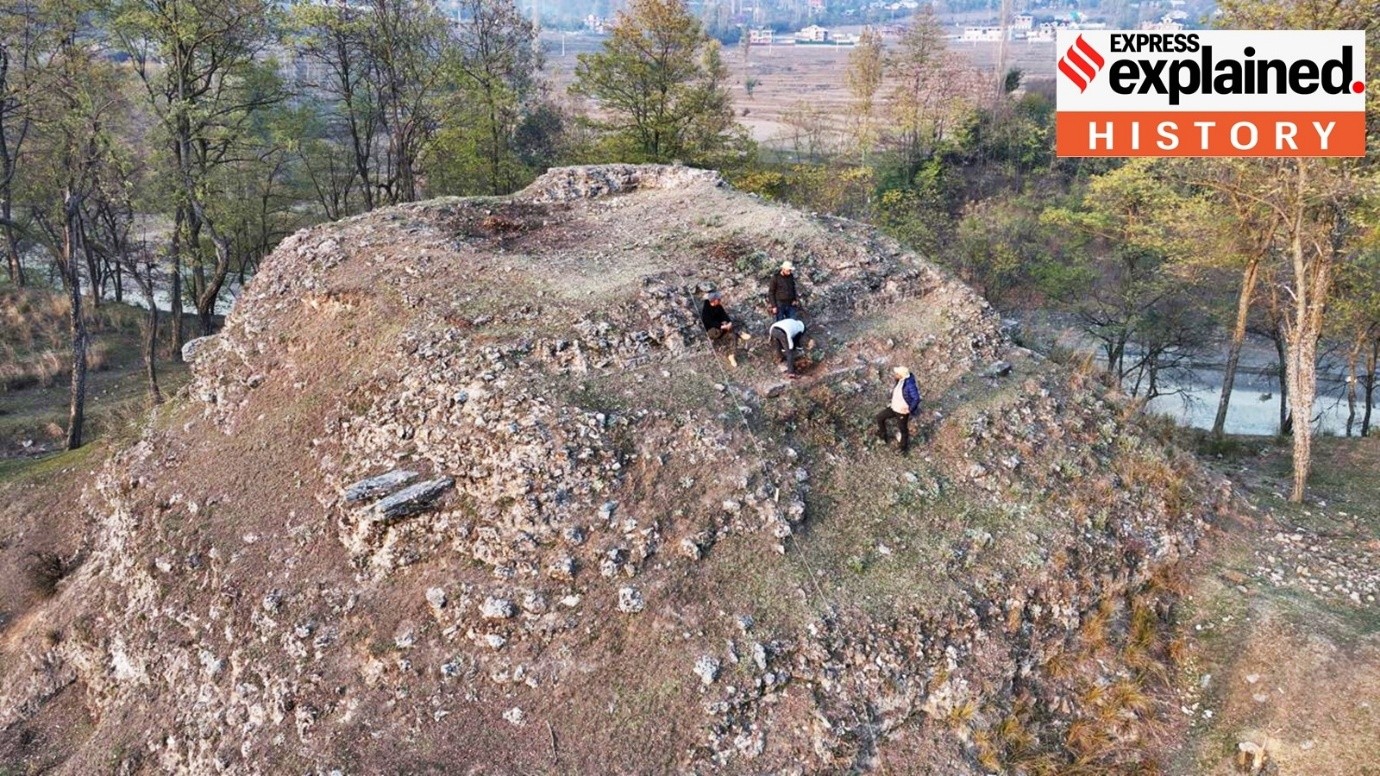
Picture Courtesy: Indian Express
Archaeological excavations in Zehanpora, Baramulla (North Kashmir), have uncovered a massive, over 2,000-year-old Buddhist stupa.
The Zehanpora archaeological site, located in Baramulla district of North Kashmir and spread over nearly ten acres, was long considered a natural landscape feature but has now been identified as a large man-made complex over 2,000 years old.
Archaeological significance: Zehanpora represents one of the largest and most prominent Buddhist archaeological sites in Kashmir, with extensive man-made mounds dating back over 2,000 years to the Kushan period.
Evidence of Buddhism in Kashmir: The site provides material evidence of a strong Buddhist presence in Kashmir, reinforcing textual references from sources like the Rajatarangini and confirming the region’s early adoption of Buddhism.
Architectural importance: The plateau-like mounds resembling Buddhist stupas, along with traces of a possible wooden superstructure, offer valuable insights into early Buddhist architectural practices in the Himalayan region.
Kushan patronage and Mahayana Buddhism: Zehanpora reflects the period of Kushan royal patronage, especially under Emperor Kanishka, when Mahayana Buddhism flourished and gained philosophical depth in Kashmir.
Centre of Buddhist Learning: The scale of the site suggests that Zehanpora may have functioned as a major religious and educational centre, contributing to Kashmir’s reputation as a hub of Buddhist scholarship.
Role in trade and cultural exchange: Its location highlights Kashmir’s role in ancient trade and pilgrimage routes linking the Indian subcontinent with Central Asia, facilitating cultural and religious exchanges.
The Zehanpora site is a landmark archaeological discovery that reaffirms Kashmir’s role as a major centre of Buddhism during the Kushan period, highlighting its importance in religious learning, architecture, and trans-Asian cultural exchange.
Source: Indian Express
|
Practice Question Consider the following statements regarding the Zehanpora archaeological site in Kashmir: 1.The Zehanpora site has been dated to the Kushan period. 2.The structures discovered at the site are associated with Buddhist stupas. 3.Zehanpora provides evidence for the spread of Mahayana Buddhism from Kashmir to Central Asia. 4.The site is located in South Kashmir near the Jhelum river basin. Which of the statements given above are correct? (a) 1 and 2 only Answer: (b) Explanation:
|
Zehanpora is located in Baramulla district of North Kashmir, Jammu and Kashmir.
The site has been dated to the Kushan period, approximately 2,000 years old.
Zehanpora contains large man-made mounds resembling Buddhist stupas, indicating a strong Buddhist presence and activity in ancient Kashmir.




© 2026 iasgyan. All right reserved