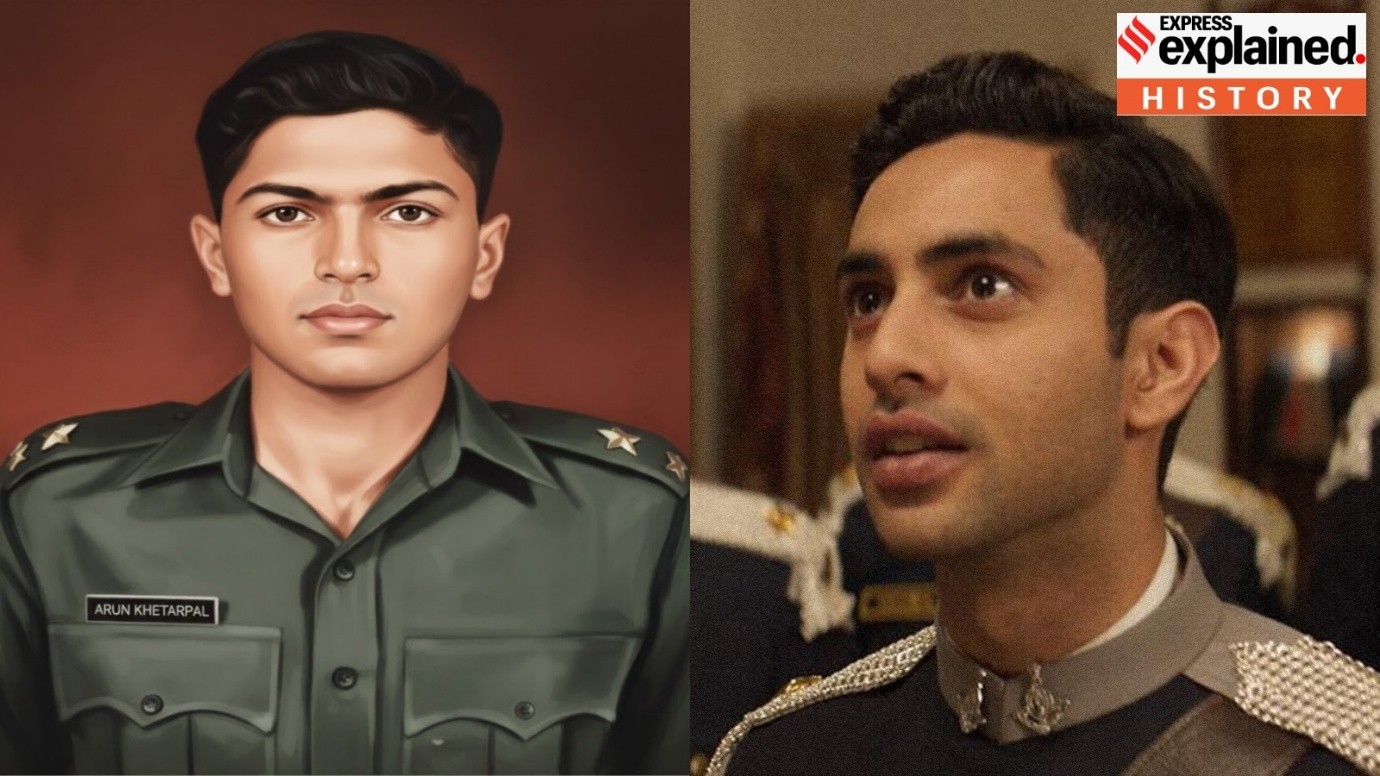
The Battle of Basantar was a decisive engagement fought during the 1971 Indo–Pakistan War in the Shakargarh Bulge region near the Basantar River. Indian forces crossed heavily mined areas, repelled repeated Pakistani armoured counterattacks and destroyed a large number of Patton tanks. The battle protected the vital Jammu–Pathankot axis and prevented Pakistan from threatening India’s land link to Jammu and Kashmir. It became one of the largest tank battles after World War II and highlighted exceptional bravery, especially that of 2nd Lt Arun Khetarpal of the Poona Horse, who was posthumously awarded the Param Vir Chakra.
Copyright infringement not intended
Picture Courtesy: Indian Express
2nd Lieutenant Arun Khetarpal was a young Indian Army officer who showed extraordinary bravery during the 1971 India–Pakistan War. He fought in the Battle of Basantar, one of the most important battles on the Western Front. He was only 21 years old and had served in the Army for just six months.
|
Must Read: SHAKARGARH BULGE | |
The 1971 war is mostly remembered for India’s decisive victory in East Pakistan and the creation of Bangladesh, but equally serious fighting took place on the Western Front. Pakistan believed that gains in the West could compensate for losses in the East and therefore launched major operations there. India had to stop these advances to protect its territory and important national routes.
Importance of the Shakargarh Bulge
The Battle of Basantar took place in the Shakargarh Bulge, an area between the Ravi and Chenab rivers. This region was strategically very important because capturing Pathankot could cut off Jammu and Kashmir from the rest of India. The land here is flat and open, which makes it easy for tanks to move and very difficult to defend.
|
What is the Shakargarh Bulge? The Shakargarh Bulge is a wedge-shaped stretch of land in the Sialkot region of Pakistan that juts toward Indian territory. It lies between the Ravi and Chenab rivers, which form its natural boundaries. Because of its position, the area projects like a “bulge” into India, and hence came to be known as the Shakargarh Bulge. Strategic features The terrain in the Shakargarh Bulge is largely flat and open, which makes it ideal for the movement of armoured vehicles and large military formations. The region is well connected through important road and railway networks, allowing quick mobility of troops and supplies. These features give the area high operational value during wartime. The Shakargarh Bulge became the site of one of the biggest tank battles fought after World War II, during the 1971 India–Pakistan War. The Battle of Basantar, fought here, involved intense armoured warfare and became one of the decisive engagements of the conflict. |

Picture Courtesy: Indian Express
Indian forces launched an offensive in this area to surprise Pakistan and prevent them from advancing. Indian soldiers crossed the heavily mined Basantar River under intense enemy fire. They then resisted repeated Pakistani tank counter-attacks. After days of intense fighting, Indian troops captured large areas of territory and destroyed many Pakistani Patton tanks, stopping Pakistan’s plans in this sector.
Arun Khetarpal and the Poona Horse Regiment
Arun Khetarpal was an officer of the Poona Horse regiment, a famous armoured regiment with a long history of bravery. When Pakistani tanks tried to break through Indian positions, he moved forward fearlessly to engage them. He destroyed several enemy tanks and continued to fight even when the situation became extremely dangerous.
His bravery played a decisive role in stopping the Pakistani armoured breakthrough. Because of his determined stand, the Indian Army held its position and continued its advance in the area. His courage inspired his fellow soldiers and contributed greatly to India’s success in the battle.
Legacy:
He was awarded the Param Vir Chakra, India’s highest wartime gallantry award, and remains the youngest officer ever to receive it. Military academies and institutions across India are named in his honour, and his preserved tank stands as a symbol of his sacrifice. He is remembered today as one of India’s greatest war heroes and as a symbol of courage, duty, and devotion to the nation.
The Battle of Basantar was a decisive engagement on the Western Front of the 1971 India–Pakistan War, where Indian forces successfully crossed heavily mined territory, repelled repeated Pakistani armoured counterattacks, and secured vital ground in the Shakargarh Bulge. The battle halted Pakistan’s plans to break through towards Pathankot and threaten India’s link to Jammu and Kashmir. It demonstrated superior planning, courage, and armour–infantry coordination by the Indian Army and produced legends like 2nd Lt Arun Khetarpal, whose bravery became symbolic of the victory.
Source: Indian Express
|
Practice Question Q. The Battle of Basantar (1971) was primarily fought in which strategic region? A. Chhamb sector Answer: B Explanation The Battle of Basantar was fought in the Shakargarh Bulge, a wedge-shaped area between the rivers Ravi and Chenab in the Sialkot region. This region is strategically important because movement of armoured forces is easy due to flat terrain, and it provides access to key road and rail networks. Control of this area could threaten the Jammu–Pathankot axis, which is India’s crucial land link to Jammu and Kashmir. Therefore, the battle here carried enormous strategic value during the 1971 India–Pakistan War. |
The Battle of Basantar took place during the Indo–Pakistan War of 1971, which was fought between India and Pakistan in December 1971. This war had two major fronts — the Eastern Front, which led to the creation of Bangladesh, and the Western Front, where battles like Basantar were fought. The Basantar battle became one of the most decisive engagements on the Western Front and played an important role in shaping the overall outcome of the war.
The battle was fought near the Basantar River in the Shakargarh Bulge region, located in the Sialkot area of present-day Pakistan. This region lies between the Ravi and Chenab rivers and projects like a bulge toward Indian territory. The fighting mainly took place around minefields, riverbanks, and open plains, making it ideal for large-scale tank warfare.
The Shakargarh Bulge was strategically important because it provided access to the Jammu–Pathankot axis, which is the key road link connecting Jammu and Kashmir with the rest of India. If Pakistan had been able to break through this sector and capture Pathankot, India’s land connectivity with Jammu and Kashmir could have been threatened. The area is also flat and open, allowing easy movement of tanks and mechanised forces, which made it militarily valuable.

© 2026 iasgyan. All right reserved