The MEA recently clarified that an Indian passport is exclusively a travel document, not conclusive proof of citizenship. This article explores the critical legal distinctions between functional identity tools, statutory citizenship proofs, and passport issuance mechanisms.
Why In News?
The Ministry of External Affairs (MEA) clarified that an Indian passport functions strictly as a travel document rather than conclusive proof of citizenship.
What is a Passport?
A passport serves as an official travel document issued by a sovereign government to certify the holder's nationality and identity for international transit.
Primary Purpose: It guarantees safe passage and facilitates entry into foreign ports. Currently, it provides visa-free entry to 27 countries, visa-on-arrival in 47 countries, and e-visa access in 66 countries.
Passports Act 1967: Authorizes three classes of passports: ordinary, official, and diplomatic.
Legal Position: Passport vs Citizenship
Judicial Ruling: The Bombay High Court rules that citizenship questions fall exclusively under the Citizenship Act, 1955. Passports do not serve as root documents for domestic citizenship disputes.
Identity vs Citizenship: Identity documents like Aadhaar, PAN, and Driving Licences verify residency and identity, whereas citizenship defines the legal and political relationship between an individual and the State.
Supreme Court Stance: The Court confirms that Aadhaar functions only as an identity and residence document, rejecting its use as proof of citizenship.
Constitutional and Statutory Framework
Constitutional Provisions: Articles 5–11 govern citizenship. Article 11 grants Parliament the sovereign power to regulate, acquire, and terminate citizenship.
Citizenship Act, 1955: This Act serves as the supreme legal code for citizenship.
Modes of Acquisition: Citizenship is acquired by Birth (Jus Soli), Descent (Jus Sanguinis), Registration, Naturalisation, and Incorporation of Territory.
Renunciation: Article 9 of the Constitution and Section 9 of the Citizenship Act mandate that voluntary acquisition of foreign citizenship results in the automatic loss of Indian citizenship.
Burden of Proof: Under Section 9 of the Foreigners Act, 1946, the legal burden of proving citizenship rests entirely on the individual.
Passport Issuance and Security
Passport Seva Programme: The MEA manages 545 Passport Seva Kendras (PSKs). In 2025, the Ministry delivered over 1.5 crore passports.
Technological Upgrades: The government is rolling out chip-embedded e-passports to enhance biometric security; currently, 10% of users hold these documents.
Verification: State machinery conducts mandatory police verification against criminal databases to ensure national security before issuance.
Challenges
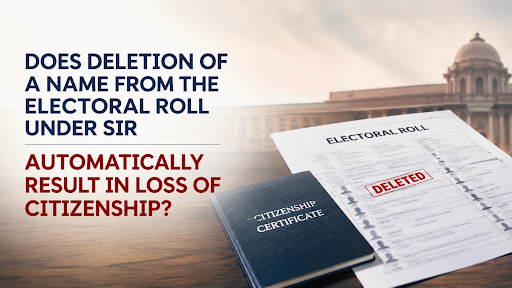
Administrative Confusion: Public conflation of identity markers with citizenship creates friction during exercises like the National Register of Citizens (NRC) and SIR.
Documentation Deficits: Many rural and tribal populations lack root-level documents, such as parental birth certificates, required for post-1987 birth verification.
Statelessness: Marginalized communities face risks of statelessness when identity documents fail to meet the stringent criteria of Foreigners Tribunals.
Fraud: High documentation demands fuel illegal industries that counterfeit birth certificates and manipulate electoral rolls.
Way Forward
Public Awareness: The government must launch nationwide legal literacy campaigns to clarify that passports and Aadhaar do not confer citizenship.
Digitisation: The State must scale the National Register of Indian Citizens (NRIC) under the Citizenship Rules 2003 to create a centralized, immutable digital repository.
Administrative Efficiency: The Ministry of Home Affairs (MHA) should implement streamlined Standard Operating Procedures (SOPs) for issuing formal citizenship certificates.
Full e-Passport Transition: The MEA must accelerate the transition to 100% chip-based e-passports to align with global biometric standards and eliminate forgery.
Conclusion
While the Indian passport remains a vital instrument for global mobility, legal citizenship is anchored strictly in the criteria of birth, descent, and statutory MHA certification.
Source: INDIANEXPRESS
|
PRACTICE QUESTION Q. Consider the following statements regarding the Indian passport and citizenship laws: 1. The Ministry of External Affairs officially recognizes a valid Indian passport as conclusive proof of Indian citizenship. 2. The Supreme Court clarified that Aadhaar is merely a document of identity and residence, not proof of citizenship. 3. Naturalisation under the Citizenship Act, 1955, requires an applicant to possess adequate knowledge of a language specified in the Eighth Schedule. Which of the statements given above are correct? (a) 1 and 2 only (b) 2 and 3 only (c) 1 and 3 only (d) 1, 2, and 3 Answer: (b) Explanation: Statement 1 is incorrect: The Ministry of External Affairs (MEA) explicitly clarified during the 14th Passport Seva Divas that an Indian passport is primarily a travel document and is not conclusive proof of Indian citizenship. Section 20 of the Passports Act, 1967, allows the Central Government to issue a passport to non-citizens under specific circumstances, meaning a passport on its own does not legally guarantee absolute citizenship status. Statement 2 is correct: The Supreme Court of India, as well as several high courts and the Unique Identification Authority of India (UIDAI), have consistently established that Aadhaar is strictly a proof of identity and residence, not a proof of legal citizenship or domicile status. Statement 3 is correct: Under the Third Schedule of the Citizenship Act, 1955, one of the primary qualifications for naturalisation in India requires that the applicant must possess adequate knowledge of a language specified in the Eighth Schedule of the Constitution of India. |
The Ministry of External Affairs clarified that an Indian passport is not conclusive proof of citizenship, because Section 20 of the Passports Act, 1967, permits the government to issue passports to non-citizens under specific public interests, and documents obtained via fraud or misrepresentation can always be revoked.
The primary legal purpose of a passport is to function strictly as an official travel document that enables international mobility and establishes a holder's identity and nationality while travelling abroad.
Under the Citizenship Act, 1955, an individual can acquire Indian citizenship through four primary statutory channels: by birth (subject to strict parental status cut-offs based on the year of birth), by descent (being born abroad to Indian parents), by registration, or by naturalisation.
Because common identifiers like Aadhaar (identity/residence), PAN (taxation), and Passports (travel) are not conclusive, legal citizenship must be verified through root-level records including a Birth Certificate (registered under the Registration of Births and Deaths Act, 1969), a state-issued Domicile Certificate, or an official Naturalisation/Citizenship Certificate issued by the Ministry of Home Affairs.





© 2026 iasgyan. All right reserved